

What Is a PEO?
Quick Answer
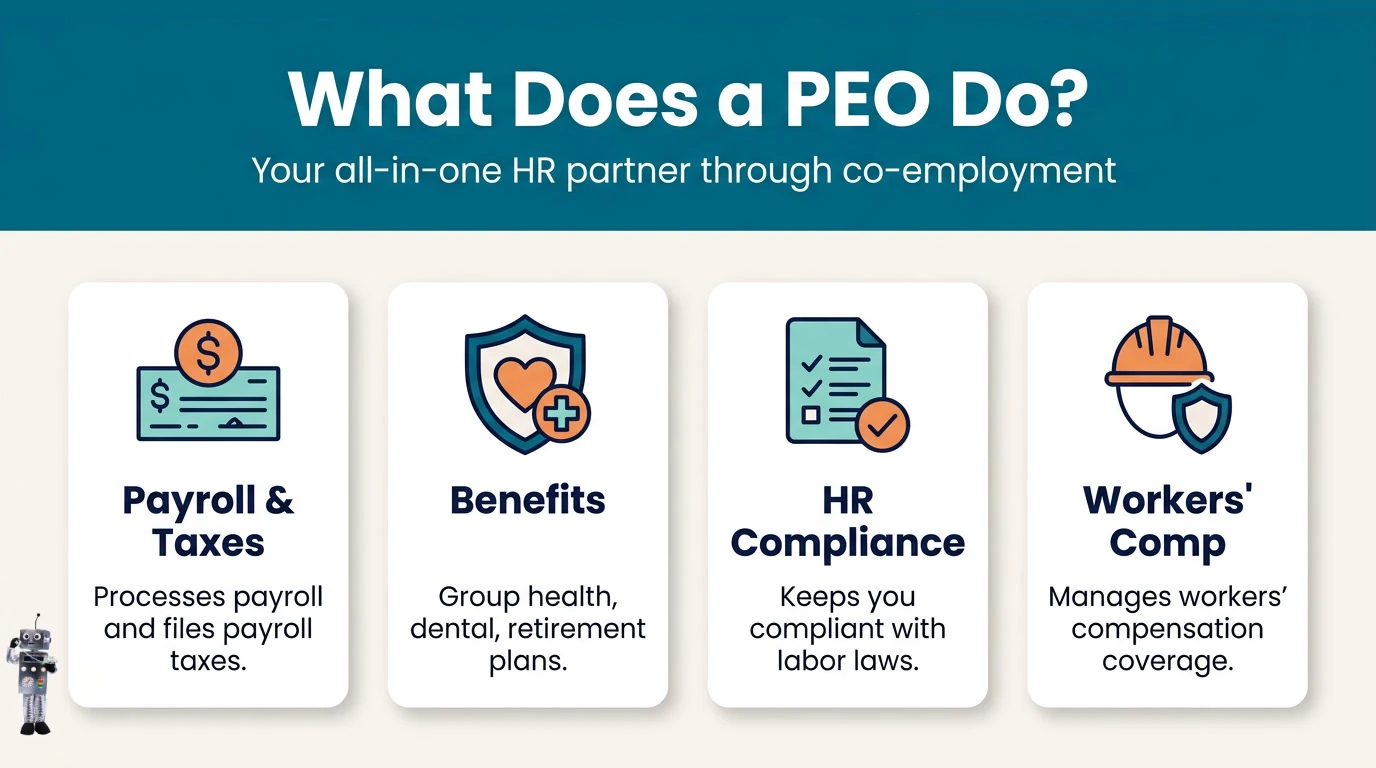
A PEO (professional employer organization) is a firm that partners with your business through a co-employment arrangement to handle the heavy, high-risk parts of being an employer (payroll and employment taxes, benefits, HR compliance, and workers' compensation) while you keep full day-to-day control of your people and your business. By pooling your employees with those of hundreds of other clients, a PEO can offer large-employer benefits and buying power that a small business usually can't reach on its own. In short, a PEO lets a growing company carry big-company HR complexity without a big-company HR department, which is why businesses that use one tend to grow faster, keep employees longer, and are markedly less likely to fail.

What Is a PEO (Professional Employer Organization)?
A Professional Employer Organization (PEO) is a firm that enters a co-employment arrangement with a business, taking on shared employer responsibilities for payroll processing, benefits administration, HR compliance, and risk management. For the client company, a PEO reduces administrative burden, opens access to enterprise-level benefits, and helps keep the business compliant across the states where it operates, without building a large internal HR department.
Key Concepts at a Glance
- Payroll administration: The PEO processes payroll, withholds taxes, and remits payments to federal, state, and local authorities on behalf of the client company.
- Benefits sponsorship: PEOs offer access to large-group health, dental, vision, and retirement plans, often at rates unavailable to small or mid-sized employers on their own.
- HR compliance management: The PEO tracks and applies employment-law changes, maintains employee handbooks, and manages required workplace postings and documentation.
- Workers' compensation coverage: PEOs arrange workers' comp coverage and manage claims administration, reducing employer exposure and administrative overhead.
Overview of Related Topics
- Co-employment structure: Employer responsibilities are divided between the PEO and the client under a written contract, with each party holding distinct authority over different parts of the employment relationship.
- Who uses a PEO: Small and mid-sized businesses, multi-state employers, and high-growth companies are the primary adopters, each driven by different operational and compliance needs.
- Regulatory and compliance considerations: PEOs operate under a patchwork of state licensure rules and federal benefits law, which makes jurisdictional compliance a defining part of the work.

How a PEO Works: Co-Employment Explained
The single concept that separates a PEO from any other HR vendor is co-employment. When you sign with a PEO, your employees become jointly employed by two parties, your company and the PEO, under a written agreement called a Client Service Agreement (CSA). This is not a staffing arrangement and it does not change who runs your business. It simply splits the legal roles of "employer" so the PEO can take on the administrative and tax-related pieces.
Employer of Record vs. Worksite Employees
Under co-employment, the PEO becomes the employer of record for tax and benefits purposes. Your staff are reported as "worksite employees" of the PEO for administrative reasons, often filed under the PEO's employer identification number, which is exactly what lets the PEO pool everyone together to negotiate benefits. Nothing about their actual jobs changes: they work where they always did, report to the managers they always reported to, and do the same work.
Who Controls What
You keep control of everything that makes the business yours: who you hire and fire, what people are paid, how work gets done, and your culture. The PEO handles the paperwork of employment: running payroll, remitting employment taxes, sponsoring benefit plans, and supporting compliance. Think of it as splitting one job into two lanes: you run the business, the PEO runs the back office of being an employer.
How Liability Is Shared
Because it is a real legal and financial relationship, the CSA spells out how responsibilities and liabilities are allocated: payroll tax filings, benefits obligations, and certain employment matters are shared or assigned between the two parties. That shared responsibility is a genuine benefit, but it also means the contract matters.

What a PEO Does: Core PEO Services
When business owners ask what a PEO actually does, the answer is the cluster of employer responsibilities that are essential, ongoing, and expensive to get wrong. A full-service PEO typically covers all of the following under one relationship.
Payroll and Employment Taxes
The PEO processes payroll on your schedule, withholds and remits federal, state, and local employment taxes, issues W-2s, and handles garnishments and new-hire reporting. Getting these right on time, every time, removes one of the most common sources of penalties for small employers.
Benefits Administration
By pooling worksite employees across many client companies, a PEO can sponsor health, dental, vision, and retirement plans priced closer to what a large employer pays. It also administers enrollment, changes, and questions, so benefits stop consuming your team's time.
HR Compliance and Employment Law
Wage-and-hour rules, ACA reporting, required postings, handbooks, documentation, and termination procedures form a dense, shifting landscape. A PEO monitors changes and applies them, lowering the odds of the honest mistakes that surface in audits and claims.
Workers' Compensation and Risk Management
PEOs arrange workers' comp coverage, manage claims, and often provide safety and loss-control support. Handled well, this protects employees and helps control one of the more volatile line items in a small business's budget.
HR Support and Technology
Most PEOs pair the above with a technology platform and access to HR professionals: an employer portal, employee self-service, and a team to answer the questions that used to land on the owner's desk.

PEO vs. ASO vs. HRO vs. EOR
"PEO" is often confused with other HR outsourcing models. The defining difference is co-employment: a PEO shares legal employer status with you, while most alternatives simply perform tasks on your behalf. Here is how the common models compare.
| Model | Co-Employment? | What It Handles | Best For |
|---|---|---|---|
| PEO (Professional Employer Organization) | Yes, shared employer status | Payroll, taxes, benefits sponsorship, compliance, workers' comp, HR support | Small businesses that want pooled big-company benefits and shared compliance responsibility |
| ASO (Administrative Services Organization) | No | HR administration and payroll processing without sponsoring benefits or sharing liability | Businesses that want help with tasks but already have benefits and want to keep sole employer status |
| HRO (HR Outsourcing) | No | Some or all HR functions performed by a vendor; scope varies widely | Companies wanting to outsource specific HR functions à la carte |
| EOR (Employer of Record) | Becomes the full legal employer | Fully employs workers on your behalf, often to hire in states or countries where you have no entity | Hiring remote or international workers without setting up a local entity |
| Payroll service | No | Payroll processing and tax filing only | Businesses that only need payroll handled, not broader HR or benefits |
The short version: a payroll service runs payroll, an ASO or HRO runs HR tasks while you stay the sole employer, an EOR becomes the full employer (useful for reach), and a PEO shares employer status so it can pool benefits and split compliance responsibility with you.

Who Uses a PEO, and Is One Right for You?
PEOs serve a broad range of employers, but a few profiles come up again and again. Almost two-thirds of PEO clients have between 10 and 49 employees, the size where employer obligations are fully in force but there is rarely a dedicated HR person to carry them.
Who Adopts a PEO Most Often
- Small and mid-sized businesses: Companies roughly in the 10–500 employee range gain enterprise-grade HR infrastructure without building an internal department.
- Multi-state employers: Businesses operating across state lines use a PEO to manage varying registrations, leave laws, and workers' comp rules without dedicated compliance staff.
- High-growth companies: Startups and scaling businesses lean on a PEO to provide benefits and onboarding infrastructure ahead of building a full HR team.
Quick Self-Assessment
The more of these that sound like you, the more likely a PEO is worth evaluating:
- You have around 10 or more employees and no dedicated HR department.
- You employ people in more than one state, or plan to soon.
- Benefits are a deciding factor when you try to hire, and yours aren't competitive.
- Payroll, taxes, and compliance are eating hours that should go to the business.
- You're worried about a compliance mistake you wouldn't know you'd made.
A PEO isn't for everyone. Very small teams or businesses that only need payroll may be better served by simpler tools. But for the profiles above, it tends to pay for itself in benefits access, reclaimed time, and reduced risk.

How Much Does a PEO Cost?
PEOs generally price their administrative fee one of two ways: a flat amount per employee per month (PEPM), or a percentage of total payroll. Published market ranges commonly land around $40–$160 per employee per month, or roughly 2%–12% of payroll, with many small businesses paying an administrative fee in the neighborhood of $100–$120 per employee per month. NAPEO data puts the average administrative fee at about $1,395 per employee per year. What you actually pay depends on your headcount, industry and risk profile, the states you operate in, and which services are bundled.
The Two Main Pricing Models
| Model | Typical Range | Trade-off |
|---|---|---|
| Per employee per month (PEPM) | ~$40–$160 / employee / month | Predictable and easy to budget; the fee doesn't fall as payroll rises, which favors higher-wage teams |
| Percentage of payroll | ~2%–12% of gross payroll | Scales with the business; every raise, bonus, and commission increases the fee, which can penalize high-wage teams |
What Drives the Price
The biggest cost movers are the services included, your workforce's risk profile (industries like construction and healthcare carry higher workers' comp costs), the number of states you operate in, and the benefit plans you select. Health insurance and workers' comp are usually billed as pass-through costs on top of the admin fee, so compare total cost, not just the headline rate.
Fees Worth Asking About
Before signing, request a complete fee schedule and a sample invoice. Watch for one-time setup or implementation fees (commonly a few hundred to a few thousand dollars), early-termination penalties on annual contracts, annual admin fee escalators, per-state expansion fees, and any markup on benefits. The right comparison is total cost of ownership against what you pay, in dollars and hours, to handle the same work in-house.

Benefits & Drawbacks of a PEO
A PEO is a strong fit for many growing businesses, but it is a real relationship with trade-offs. An honest look at both sides makes for a better decision.
The Benefits
- Enterprise-grade benefits: Pooling gives your team access to health, dental, vision, and retirement plans priced like a much larger employer's, often the deciding factor in recruiting and retention.
- Compliance and risk support: Specialists track employment law across jurisdictions and help you stay current, reducing the risk of costly penalties.
- Reclaimed time: Offloading the HR back office returns hours to owners and managers for revenue-generating work.
- Better outcomes on average: Research links PEO use to faster growth, lower turnover, and higher survival rates (see the statistics below).
The Drawbacks to Weigh
- Less direct control of benefits and vendors: You generally choose from the PEO's plan menu rather than building your own program from scratch.
- Cost at scale: As headcount and benefits spend grow, some businesses find assembling their own HR stack more economical.
- Contract commitment: Most contracts run annually with renewal and termination terms that deserve close reading.
- Shared, not surrendered, responsibility: Co-employment is a legal relationship; you remain accountable for running your business and for choosing a reputable, licensed partner.
For most businesses in the profiles above, the benefits outweigh the trade-offs, but the drawbacks are real and worth pressure-testing against your own numbers.

PEO Statistics & Industry Outlook
The numbers help explain why PEO adoption keeps climbing. These figures come from NAPEO (the PEO industry association), the U.S. Bureau of Labor Statistics, and the U.S. Small Business Administration.
The Market a PEO Serves
Small businesses dominate the U.S. economy. According to the Bureau of Labor Statistics, firms with fewer than 249 employees accounted for about 99% of the 5.6 million firms covered under Unemployment Insurance in early 2023, and employed roughly 46% of the covered private workforce over the prior decade. These are exactly the organizations that face the heaviest HR compliance burden relative to their internal resources.
The PEO Difference
NAPEO-commissioned research on businesses that use a PEO finds they:
- Grow about twice as fast as comparable businesses that don't use one.
- Have employee turnover roughly 12% lower.
- Are approximately 50% less likely to go out of business in a given year.
- See a positive average return on investment, around 27% in cost savings alone.
An Industry That Keeps Growing
The PEO industry has expanded dramatically, more than quadrupling in size since 2012. Roughly 500 PEOs now serve more than 200,000 primarily small and mid-sized businesses, covering several million worksite employees. The broad trend is toward more HR outsourcing, not less: as employment regulation grows more complex and small employers compete for talent against larger ones, the case for pooled benefits, professional compliance, and reclaimed owner time keeps strengthening.

How to Choose the Right PEO
The right PEO is the one that fits your workforce, your states, and the way your team works. Use this sequence to compare providers on what actually matters, not just the headline fee.
- Confirm licensing and credentials: Verify the PEO is licensed or registered in every state where you have employees.
- Compare total benefits cost and quality: Ask for plan details and the employer premium contributions, not just carrier names, and compare the all-in benefits cost under the PEO against your current or projected small-group market cost.
- Test the technology: Request a demo of the HRIS and employee self-service portal and judge whether your team will actually use it day to day.
- Understand the service model: Find out whether you'll have a dedicated HR account manager or a general support queue, and how quickly issues get resolved.
- Read the contract carefully: Pay close attention to termination provisions, renewal terms, fee escalators, and transition and benefits-continuation clauses.
- Get an itemized, apples-to-apples quote: Ask for a complete fee schedule and a sample invoice so you can compare providers on the same basis before deciding.

Technology in Modern PEOs
PEOs sit at the intersection of HR, payroll, and compliance, and their technology reflects that. The foundation is usually a unified human resource information system (HRIS) or human capital management (HCM) platform that centralizes employee records, benefits enrollment, payroll, and compliance tracking across all clients, with a client-facing portal that gives owners real-time visibility into their workforce.
Workflow Automation
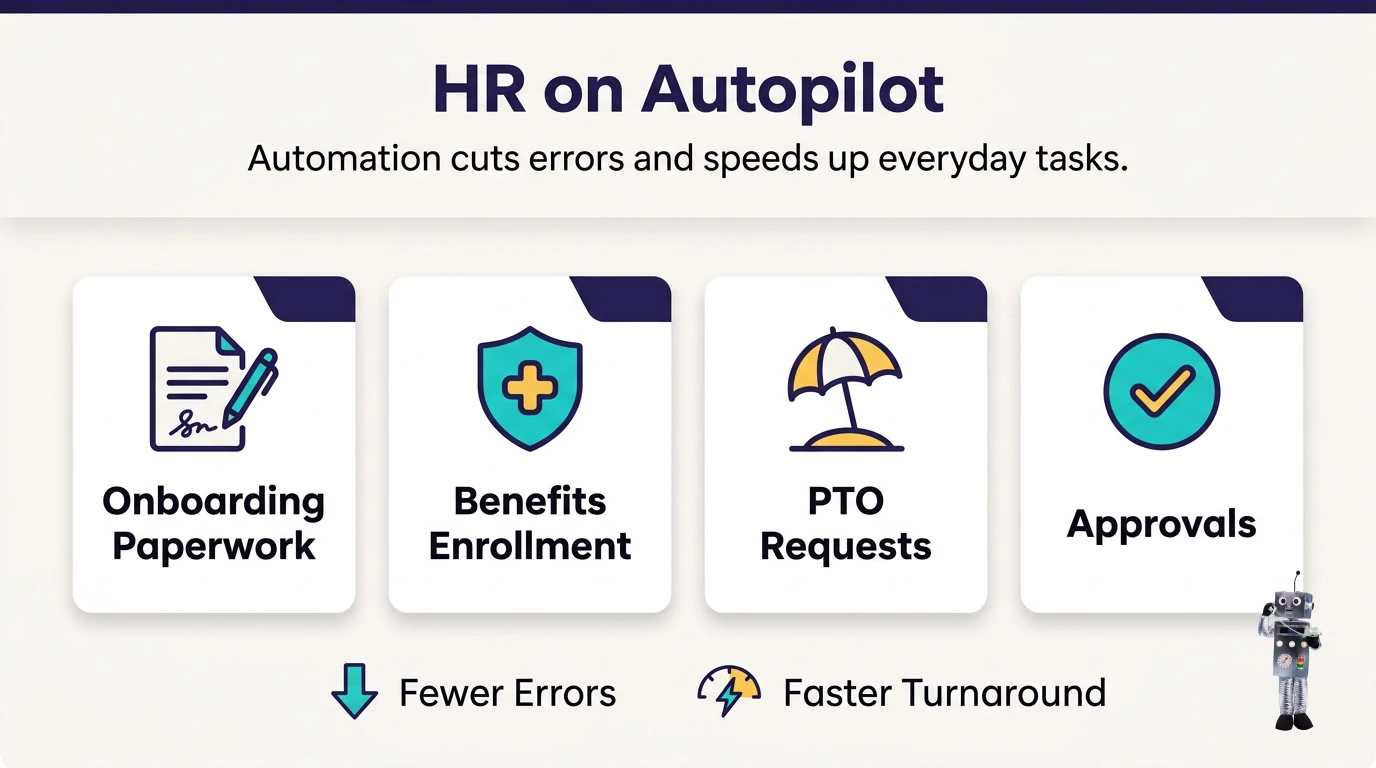
Routine processes such as onboarding paperwork, benefits enrollment, PTO requests, and approvals are increasingly automated, which cuts errors and speeds up the tasks that used to require manual handling.
Integration and Interoperability
Because clients use a range of time-tracking, accounting, and applicant-tracking systems, open APIs let those tools exchange data with the PEO's core platform, eliminating duplicate entry and lowering error rates.

Common Questions About PEOs
Is a PEO the Same as a Staffing Agency?
No. A staffing agency recruits and supplies workers to you; a PEO co-employs the people you already hired to handle their payroll, benefits, and compliance. With a PEO, you still choose, direct, and manage your own team.
Does a PEO Replace My HR Team?
Not necessarily. Smaller companies may use a PEO in place of an internal HR function, while larger ones use it to support and extend an existing HR team, offloading administration and compliance so in-house staff can focus on strategy and people.
Can I Keep My Own Benefits or Vendors?
It depends on the model. Many PEOs provide benefits through their own pooled plans, which is where much of the value comes from, though some offer flexibility. If keeping a specific plan or broker matters to you, raise it early, as an ASO arrangement may fit better if you want to retain your own benefits.

Frequently Asked Questions
What is a PEO in simple terms?
A PEO (professional employer organization) is a firm that co-employs your staff to handle payroll, benefits, HR compliance, and workers' comp, while you keep full control of hiring, pay, and daily operations.
Through a co-employment arrangement, the PEO becomes the employer of record for tax and benefits purposes and pools your employees with those of other clients, which is what lets a small business access large-employer benefits and buying power.
How is a PEO different from HR outsourcing?
The defining difference is co-employment. Traditional HR outsourcing and ASOs perform tasks on your behalf while you remain the sole legal employer; a PEO formally shares employer status, which is what allows it to sponsor pooled benefits and share compliance responsibility.
That shared status is also why a PEO can negotiate large-group benefit rates an individual small business couldn't reach on its own. The trade-off is a real contractual relationship worth reviewing carefully.
How much does a PEO cost?
Administrative fees commonly run about $40–$160 per employee per month, or roughly 2%–12% of payroll, with the NAPEO average around $1,395 per employee per year. Benefits and workers' comp are usually billed separately on top.
Your actual price depends on headcount, industry risk, the states you operate in, and the services and plans you select, so compare total cost of ownership and ask for an itemized quote rather than judging by the headline rate.
Is a PEO worth it for a small business?
For most small businesses with roughly 10 or more employees, a PEO tends to deliver value that exceeds its cost through better benefits, reduced compliance risk, and reclaimed time.
Research on businesses that use a PEO finds they grow faster, have lower turnover, and are about 50% less likely to go out of business. A single payroll-tax penalty or employment claim can exceed a year of PEO fees, which strengthens the case in high-compliance industries and multi-state operations.
Do I lose control of my employees with a PEO?
No. You keep full day-to-day control: you hire, fire, set pay, direct the work, and own the culture. The PEO handles the administrative side of being an employer, not the running of your business.
Co-employment splits the legal roles of employer through a written Client Service Agreement; it does not transfer ownership or operational authority. Choosing a reputable, licensed PEO and reviewing that agreement is how you protect that balance.
Key Takeaways
A PEO (professional employer organization) gives growing businesses enterprise-grade HR (payroll, benefits, compliance, and workers' comp) through a co-employment model that shares employer responsibilities between the PEO and the client. By pooling worksite employees across hundreds of companies, a PEO unlocks benefits quality and compliance depth that most small and mid-sized businesses can't build on their own, while the owner keeps full control of the business.
The value is well documented: businesses that use a PEO tend to grow faster, keep employees longer, and are markedly less likely to fail, with a positive average return in cost savings alone. The trade-offs (plan menus, contract terms, and cost at larger scale) are real, which is why choosing a licensed, reputable partner and comparing total cost matters.
For businesses operating across multiple states or in compliance-intensive industries, the case for a PEO is strongest. Evaluate benefits quality, technology, service model, and contract terms, and you'll be well positioned to decide whether a PEO is the right way to carry big-company complexity without a big-company headcount.