

What Is an EIN (Employer Identification Number)?
Quick Answer
An Employer Identification Number (EIN) is the nine-digit federal tax ID the IRS assigns to a business, written as XX-XXXXXXX, and best thought of as a Social Security number for your company. You need one if you have employees, operate as a corporation or partnership, file employment or excise tax returns, or run certain trusts, estates, retirement plans, or nonprofits. Sole proprietors and single-member LLCs with no employees can often use their own Social Security number instead, but most get an EIN anyway; banks usually require it to open a business account, and it keeps your SSN off W-9s and other vendor forms. Getting one is free directly from the IRS: you apply with Form SS-4, and the online EIN Assistant issues the number immediately. After that, the rules are simple. Save the CP 575 confirmation notice the IRS sends, keep your responsible-party and address details current with Form 8822-B, get a new EIN only when your business structure genuinely changes (incorporating, forming a partnership, certain mergers, but not a name or address change), and never pay a third-party website for a number the IRS hands out for free. An HR or PEO partner can't pull the EIN for you, but the moment you have it, the work begins (payroll, employment-tax deposits, and new-hire reporting), and that's where a partner takes the load off a small business.

EIN Defined
An Employer Identification Number (EIN), also called a Federal Employer Identification Number (FEIN) or simply a federal tax ID, is a unique nine-digit number the Internal Revenue Service assigns to identify a business entity for tax filing and reporting. It's formatted as two digits, a hyphen, and seven more (for example, 12-3456789), and it functions for a business much the way a Social Security number functions for an individual: it's how the IRS, banks, payroll systems, and other agencies know which business they're dealing with. Despite the word "employer" in the name, you don't have to have employees to get one; corporations, partnerships, many LLCs, estates, trusts, and nonprofits all use EINs. One rule worth remembering up front: an EIN is for business use, and the IRS asks you not to use it in place of your personal SSN or ITIN. This is general information, not legal or tax advice, and some rules vary by state, so confirm the specifics for yours.
Key Terms
- EIN / FEIN: The nine-digit federal tax ID for a business. "EIN," "FEIN," and "federal tax ID number" all refer to the same thing.
- Form SS-4: The IRS application for an EIN. You can complete it online, or submit the paper form by fax or mail. It establishes your business tax account.
- Responsible Party: The person the IRS holds as the contact for the entity: someone who owns or controls the business and manages its funds. It must be an actual individual (with an SSN or ITIN), not another company, except for government entities.
- CP 575: The confirmation notice the IRS issues when your EIN is assigned. It's the official record of your number. Save it, because the IRS generally won't reissue it.
- TIN: Taxpayer Identification Number: the umbrella term for all tax IDs, including the SSN, ITIN, and EIN. An EIN is one type of TIN.
- Disregarded Entity: A single-member LLC the IRS treats as part of its owner for tax purposes. It often uses the owner's SSN, though an EIN may still be needed for payroll or banking.
Overview of Related Topics
- Do You Need an EIN: The handful of triggers (employees, entity type, certain tax filings) that decide whether an EIN is required or simply a good idea.
- EIN vs. SSN, ITIN & TIN: How the business tax ID differs from the individual numbers it's often confused with.
- How to Apply: The free IRS process, step by step, and which application method fits how fast you need the number.
- Finding a Lost EIN: Where your number is already on file and how to recover it from the IRS if you can't locate it.
- When You Need a New EIN: The specific structure changes that require a fresh number, and the many changes that don't.

Do You Need an EIN?
The fastest way to answer this is to separate "required" from "recommended." The IRS requires an EIN in a specific set of situations, and outside of those, plenty of small businesses get one anyway because it makes ordinary business life easier. Knowing which side of that line you're on saves you from both unnecessary paperwork and a scramble later.
You Are Required to Get an EIN If You
- Have employees, or are about to hire your first one.
- Operate as a corporation (including an S-corporation) or a partnership, including a multi-member LLC, which the IRS taxes as a partnership by default.
- File employment, excise, or alcohol/tobacco/firearms tax returns.
- Withhold taxes on income, other than wages, paid to a nonresident alien.
- Have a qualified retirement plan (such as a Keogh or solo 401(k)).
- Are involved with certain trusts, estates, nonprofits, farmers' cooperatives, or plan administrators.
You Probably Don't Need One, But Likely Want One
This applies if you're a sole proprietor or a single-member LLC with no employees and no excise-tax obligations. In that case the IRS lets you use your own Social Security number to file. Most owners in this position still get an EIN, and for good reasons: banks generally require one to open a business checking account, clients and vendors ask for it on Form W-9, and using an EIN instead of your SSN on all that paperwork keeps your personal number out of circulation and lowers your identity-theft exposure. It also makes your business look established, and it's free. The practical answer for most growing one-person businesses is "yes."
A Note on State and Local IDs
An EIN is your federal number. Depending on where and how you operate, you may also need a separate state tax ID for state income-tax withholding, unemployment insurance, or sales tax; those are issued by your state, not the IRS, and the EIN doesn't replace them. If payroll and multi-state registration are on your horizon, this is one of the areas an HR or PEO partner routinely handles so nothing gets missed.

EIN vs. SSN, ITIN, and TIN
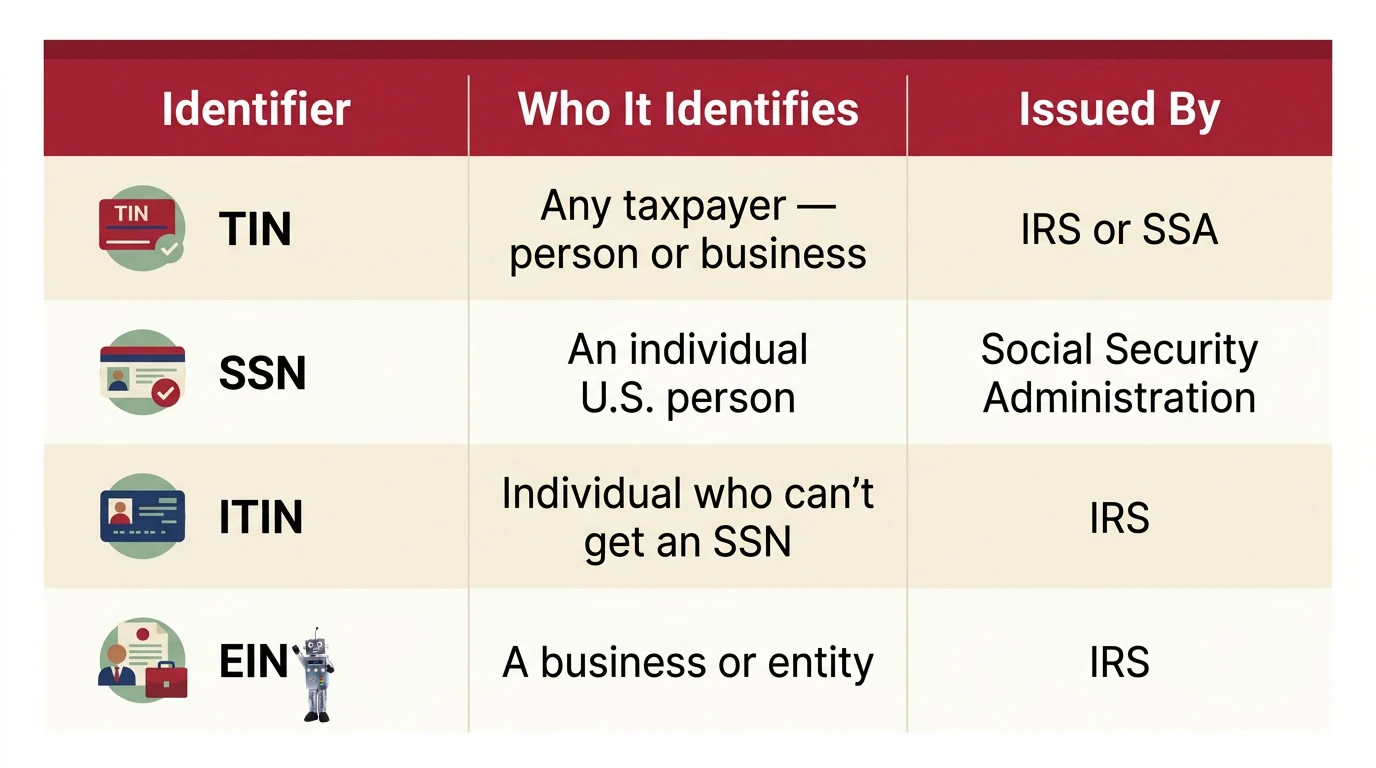
These acronyms get tangled constantly, and the confusion is understandable; they're all nine-digit numbers tied to taxes. The simplest way to keep them straight: TIN is the umbrella term for every tax ID, and the SSN, ITIN, and EIN are specific types of TIN underneath it. The key difference is who or what each one identifies (a person or a business) and which agency issues it.
| Identifier | Who or What It Identifies | Issued By | Format & Notes |
|---|---|---|---|
| TIN | Umbrella term: any taxpayer (person or business) | IRS or SSA, depending on type | Not a single number; a category that includes the SSN, ITIN, and EIN |
| SSN | An individual U.S. person | Social Security Administration | XXX-XX-XXXX (nine digits); used for personal taxes and, by sole proprietors, for the business |
| ITIN | An individual who needs to file but isn't eligible for an SSN | IRS | Nine digits, always beginning with "9"; for individuals, never for a business |
| EIN | A business or other entity | IRS | XX-XXXXXXX (nine digits); the focus of this article |
The Practical Takeaways
- An EIN identifies a business; an SSN and ITIN identify people. When a form asks for your "business tax ID" or "FEIN," it wants your EIN.
- A sole proprietor can use either. With no EIN, you file business taxes under your SSN; once you get an EIN, you can keep the SSN off vendor and bank paperwork.
- Don't substitute one for the other. The IRS specifically asks you not to use an EIN in place of an SSN or ITIN, or vice versa; each has its lane.
- You may also run into PTINs and ATINs. A PTIN identifies a paid tax preparer and an ATIN is a temporary number for a child in the process of adoption. Neither has anything to do with running your business.

The EIN in a Small Business
For a small business, the EIN is rarely the dramatic milestone. It's the quiet key that unlocks everything else. You don't feel its importance when you apply; you feel it the first time a bank, a payroll provider, or a vendor asks for it and you either have it ready or you don't. It's one of the few pieces of paperwork that touches money, hiring, and credit all at once, which is why getting it early and keeping its details current matters more than its low profile suggests.
What It Actually Unlocks
An EIN is what lets you open a business bank account, set up payroll and deposit employment taxes, apply for business licenses and permits, file your business tax returns, and, over time, build business credit that's separate from your personal credit. Vendors and clients will ask for it on Form W-9 before they pay you. In practical terms, the EIN is the first thing most of the rest of your business infrastructure is built on top of.
Get It Before You Need It
The common small-business mistake isn't getting the EIN wrong; it's needing it on a deadline you didn't see coming: a bank appointment, a first hire, a vendor who won't release payment without a W-9. Because the online application is free and issues the number immediately, there's no reason to wait until you're under pressure. If you're forming an LLC, corporation, or partnership, register the entity with your state first, then apply for the EIN against that legal name.
Free From the IRS: Watch for the Middlemen
Search "apply for an EIN" and you'll find official-looking sites that charge $50, $150, or more to "obtain" your number. They're not the IRS. The number is free directly from the IRS, and these services simply fill out the same free form on your behalf. For a small business watching every dollar, this is the easiest fee to avoid entirely.
The Number Is Step One: The Work Comes After
Here's the honest part: getting the EIN is simple. What follows (running payroll correctly, depositing and reporting employment taxes on schedule, handling new-hire reporting, and registering for the right state accounts) is where small businesses get tripped up. An HR or PEO partner can't and shouldn't apply for your EIN for you, but it can carry all of that downstream work, which is the part that takes real time and where mistakes get expensive.

Step-by-Step Guide to Applying for an EIN
- Form Your Legal Entity First (If Applicable): If you're creating an LLC, corporation, or partnership, register it with your state before you apply, so the EIN attaches to the correct legal name. Sole proprietors have no entity to form and can apply whenever they're ready. Tax-exempt organizations should wait until they're legally formed.
- Identify Your Responsible Party: The IRS requires you to name a responsible party (an actual person who owns or controls the business) and provide their SSN or ITIN. It can't be another company (except for government entities) or a nominee like a hired agent. For a single-owner business that's usually you.
- Gather Your Information: Have ready your legal business name exactly as registered, any trade name (DBA), a physical street address and a mailing address, your entity type, the reason you're applying, your principal business activity, the date the business started, and your expected number of employees. The IRS only accepts letters, numbers, hyphens, and ampersands in business names.
- Choose Your Application Method: Online is the fastest and is available to businesses whose principal location is in the U.S. or its territories. Fax and mail use the paper Form SS-4. Phone applications are reserved for international applicants without a U.S. presence. Use only one method per entity so you don't accidentally end up with two numbers.
- Apply Online Through the IRS EIN Assistant: Go straight to IRS.gov and use the free EIN Assistant. You must finish in a single session (it times out after about 15 minutes of inactivity and can't be saved partway), and it's available during posted hours (roughly Monday through Friday, 6 a.m. to 1 a.m. Eastern, with limited weekend hours). When you complete it, your EIN is issued immediately.
- Or Apply by Fax or Mail: Complete Form SS-4 and fax it (if you include a return fax number, you'll typically get the EIN back in about four business days) or mail it (allow about four weeks). Either way, keep a copy of what you submitted.
- Save Your Confirmation Notice: The IRS issues a CP 575 confirmation letter. Online applicants can download and print it on the spot. Store it where you can find it; it's the official record of your number, and the IRS generally won't issue a duplicate.
- Put It to Work and Keep It Current: Use the EIN to open your bank account, set up payroll and tax deposits, and complete W-9s. If your responsible party or address ever changes, report it to the IRS within 60 days using Form 8822-B. Remember the IRS limit of one EIN per responsible party per day.

How to Find or Recover a Lost EIN
Misplacing your EIN is common and rarely a crisis; your number is almost certainly already recorded in several places. An EIN is permanent and never reused, so you're recovering an existing number, not getting a new one. Work through the easy sources first, and call the IRS only if you come up empty.
Where to Look First
- Your CP 575 confirmation notice: The original letter the IRS sent when your EIN was assigned.
- Prior business tax returns: Your EIN appears at the top of any return you've filed.
- Bank and loan paperwork: The bank where you opened your business account, or any lender, has it on file.
- Licenses and prior filings: State or local business license applications, and old payroll forms or 1099s you've issued, all carry the number.
If You Still Can't Find It
Call the IRS Business & Specialty Tax Line at 800-829-4933, open Monday through Friday, 7 a.m. to 7 p.m. local time (Alaska and Hawaii follow Pacific time). After verifying that you're authorized to receive it (an owner, partner, corporate officer, or similar), the IRS will give you the number over the phone. If you've somehow ended up with more than one EIN and aren't sure which to use, the same line can tell you which is correct.

When You Need a New EIN
An EIN is meant to be permanent, so you keep the same one through most of a business's life. As a rule of thumb, a structure change usually means a new EIN, while a name, address, or ownership-stake change usually doesn't. The IRS publishes specific scenarios by entity type; here are the ones small businesses hit most often.
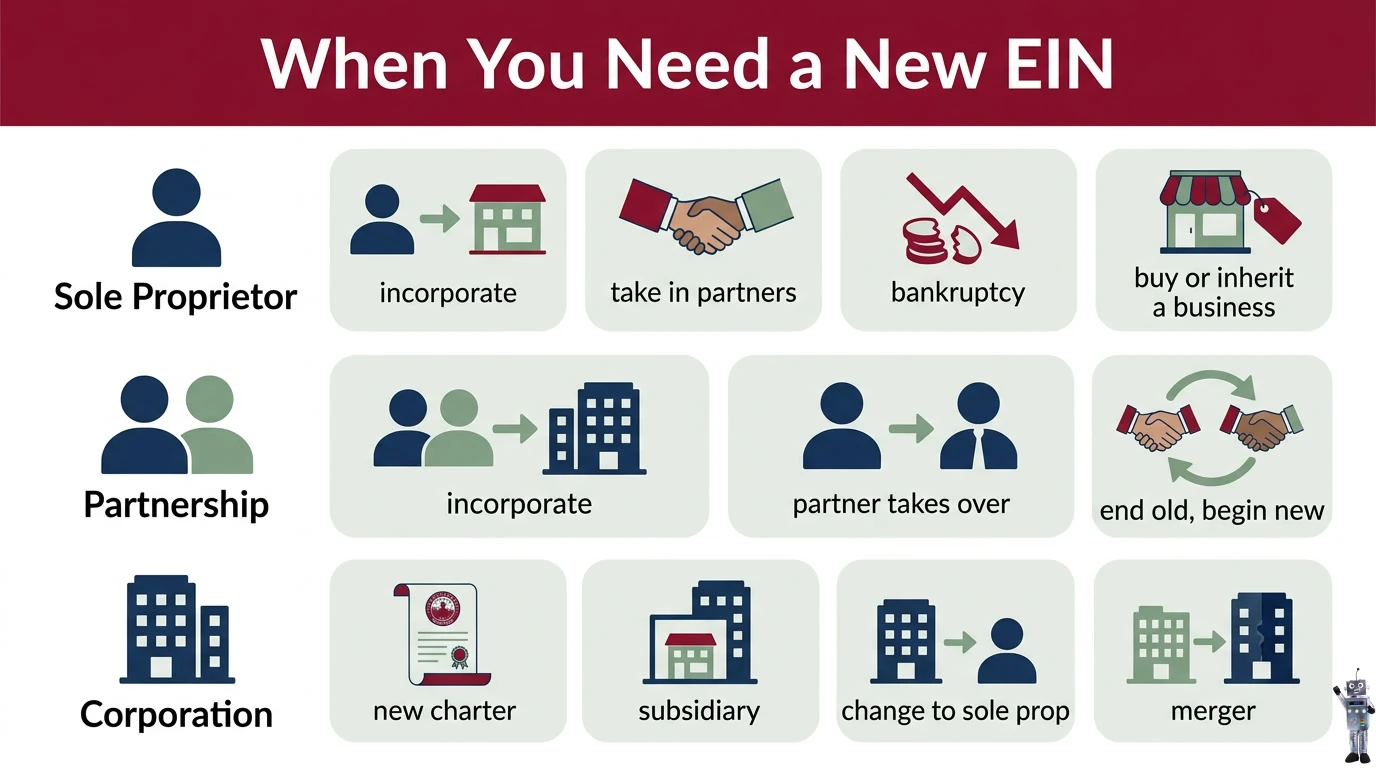
When a New EIN Is Generally Required (by Entity Type)
- Sole proprietor: Incorporate, take in partners and become a partnership, are subject to a bankruptcy proceeding, or buy or inherit an existing business you'll run as a sole proprietorship.
- Partnership: Incorporate, have one partner take over and operate it as a sole proprietorship, or end the old partnership and begin a new one.
- Corporation: Receive a new charter from the secretary of state, become a subsidiary of another corporation, change to a partnership or sole proprietorship, or form a new corporation after a statutory merger.
You Generally Do NOT Need a New EIN When You
- Change your business name.
- Change your location or add other locations.
- Operate multiple businesses under the same sole proprietorship.
- Elect S-corporation treatment for an existing corporation, or have an LLC that already has an EIN elect corporate tax treatment.
- Reorganize in a way that changes only the corporation's identity or place, or convert at the state level without changing the underlying structure.
Conversions can get genuinely technical, particularly LLC elections and corporate mergers, where keeping an existing EIN may be possible or even preferable to protect licenses and tax attributes. When a real structure change is on the table, confirm the requirement against the IRS's "When to get a new EIN" guidance, and loop in a CPA or your HR/PEO partner before you file, because the EIN question usually rides along with final returns, payroll transitions, and benefits.

EIN Compliance Checklist
An EIN doesn't carry ongoing filings of its own, but a few habits keep it from becoming a problem at exactly the wrong moment. Use this as a quick backbone: for getting the number, storing it, and keeping its information accurate as your business changes. None of it is complicated, and an HR or PEO partner can carry the recordkeeping and the payroll-side pieces if you'd rather not track them yourself.
Getting & Storing It
- Entity registered with the state first, if you're an LLC, corporation, or partnership.
- EIN obtained free directly from the IRS; no third-party fee paid.
- A correct, qualified responsible party named, with their SSN or ITIN.
- CP 575 confirmation notice saved somewhere you can find it, with a backup copy.
- Only one EIN obtained per entity, using a single application method.
Keeping It Current
- Responsible-party or address changes reported to the IRS within 60 days on Form 8822-B.
- Business name as used with the IRS kept consistent with your registration.
- The EIN, not your SSN, used on W-9s, bank accounts, and vendor paperwork.
- Any state tax IDs (withholding, unemployment, sales tax) obtained separately as needed.
When Things Change
- A structure change (incorporating, forming a partnership, certain mergers) checked against the IRS's "new EIN" rules before filing.
- An unneeded EIN handled correctly: the IRS can't cancel an EIN, but it can close the business account on request.
- A CPA or HR/PEO partner consulted for conversions, mergers, or anything tangled up with payroll or final tax returns.

Topics
What You Use an EIN For
- Hiring & Payroll: Required to report and deposit employment taxes, file payroll returns, and run payroll once you have employees.
- Banking & Credit: Used to open a business bank account, apply for business loans or credit cards, and build a business credit profile separate from your personal credit.
- Licenses & Permits: Frequently required on applications for state and local business licenses and permits.
- Vendor & Client Paperwork: The number you put on Form W-9 so clients can issue you a 1099, and that you use to issue 1099s to your own contractors.
- Tax Filing: The identifier on your business tax returns and on filings for trusts, estates, and retirement plans.
Who Does What
- Owner / Responsible Party: Applies for the EIN, is named as the IRS contact for the entity, and is responsible for keeping that information current. In a small business this is usually one person.
- CPA / Accountant: Advises on whether and when you need an EIN or a new one, especially around entity formation, S-corporation elections, conversions, and mergers.
- HR / PEO Partner: Handles the work that depends on the EIN (payroll setup and employment-tax deposits, new-hire reporting, and state account registrations) and keeps the recordkeeping clean, which is the specialist load a small company can't justify hiring for full-time.
- IRS: Issues the EIN free of charge, maintains the business tax account, and is the place to recover a lost number or report changes.
Key Compliance Considerations
- One Per Responsible Party Per Day: The IRS limits EIN issuance to one per responsible party per day, across all application methods.
- Free From the IRS: There's never a government fee. Paid "EIN filing" services are optional middlemen, not the IRS.
- Keep Information Current: Report responsible-party and address changes within 60 days using Form 8822-B.
- Beneficial Ownership Reporting: Separate from the EIN, some corporations and LLCs may have to report their beneficial owners to FinCEN; confirm whether your entity is covered, as these rules have shifted.
- State IDs Are Separate: An EIN is federal; state withholding, unemployment, and sales-tax IDs are issued by your state and aren't replaced by the EIN.

Frequently Asked Questions
Is an EIN the same as a tax ID number?
An EIN is a type of tax ID number, specifically the federal tax ID for a business. "Tax ID number" (or TIN) is the broad term that also covers individual numbers like the SSN and ITIN, so an EIN is one kind of TIN, not a separate thing.
You'll also see the EIN called a "FEIN" (Federal Employer Identification Number) or a "federal tax ID number." Those are all the same nine-digit number. When a bank or vendor form asks for your "business tax ID" or "FEIN," your EIN is what they want, and if you're a sole proprietor without an EIN, your SSN fills that role instead.
Is getting an EIN free?
Yes. The IRS issues EINs at no charge, and the fastest way to get one is the free online EIN Assistant on IRS.gov, which gives you the number immediately. There is never a government fee.
Many third-party websites charge to "obtain" an EIN for you. They aren't the IRS; they just complete the same free application on your behalf. For a small business, this is one fee that's entirely avoidable. Apply directly with the IRS and keep the money.
Do sole proprietors or single-member LLCs need an EIN?
Not always. A sole proprietor or single-member LLC with no employees and no excise-tax obligations can use the owner's Social Security number to file. But most get an EIN anyway, because banks usually require it for a business account and it keeps your SSN off vendor paperwork.
You cross into "required" the moment you hire an employee, take on a partner, incorporate, or pick up an excise-tax filing requirement. Since the number is free and removing your SSN from W-9s and bank forms reduces identity-theft risk, getting an EIN early is usually the easy call even when it isn't strictly required.
How long does it take to get an EIN?
Online, it's immediate. You finish the application and receive your EIN at the end of the same session. By fax it's about four business days if you include a return fax number, and by mail it's roughly four weeks.
The online tool has to be completed in one sitting because it times out after about 15 minutes of inactivity, so have your information ready before you start. Online applications are limited to businesses based in the U.S. or its territories; international applicants apply by phone, fax, or mail.
How do I find a lost EIN?
Check your IRS CP 575 confirmation notice, a prior business tax return, or your business bank, loan, or license paperwork; the number is on all of them. If you still can't find it, call the IRS Business & Specialty Tax Line at 800-829-4933 and they'll provide it after verifying you're authorized.
An EIN is permanent and never reused, so you're always recovering the same number rather than getting a new one. The tax line is open Monday through Friday, 7 a.m. to 7 p.m. local time, and can also tell you which number to use if you've accidentally ended up with more than one.
Do I need a new EIN if my business changes?
Usually only if your business structure changes. Incorporating, forming a partnership, certain bankruptcies, and some mergers require a new EIN; routine changes like a new business name, a new address, or added locations do not.
The rules are specific by entity type, and conversions, especially with LLCs and corporate mergers, can get technical, with some situations letting you keep your existing number. When a genuine structure change is happening, check the IRS's "When to get a new EIN" guidance and talk to a CPA or your HR/PEO partner before you file, since the EIN question usually travels with final returns and payroll transitions.
Key Takeaways
An EIN is the nine-digit federal tax ID that identifies your business (the business version of a Social Security number), and it's free directly from the IRS. You're required to have one if you have employees, operate as a corporation or partnership, or file employment or excise taxes; sole proprietors and single-member LLCs without employees can use their SSN but usually get an EIN anyway to open a bank account and keep their SSN off vendor forms.
Keep it simple: register your entity with the state first if you're an LLC, corporation, or partnership, then apply through the free IRS online EIN Assistant for an immediate number, save your CP 575 confirmation notice, and use the EIN, not your SSN, on bank and vendor paperwork. Report responsible-party or address changes within 60 days on Form 8822-B, and don't pay a third-party site for a number the IRS gives away free. Get a new EIN only when your structure genuinely changes, not for a name or address change.
The EIN itself is the easy part. The work that depends on it (payroll, employment-tax deposits, new-hire reporting, and state registrations) is where small businesses lose time and make costly mistakes. An HR or PEO partner can't apply for your EIN, but it can carry all of that downstream work, giving a small business the infrastructure of a much larger one without the overhead of staffing for it.