

How to Train Employees in a Small Business
Quick Answer
To train employees in a small business, start with a quick assessment that pinpoints the gap between what someone can do today and what the role requires. Turn each gap into a few clear, measurable objectives, usually 3-4 per role, tied directly to the job. Teach to the skill: short hands-on practice alongside an experienced coworker for procedural work, a brief sit-down session for judgment-based topics, and ready-made online modules for compliance training like safety and harassment prevention. Deliver it in phases over the first weeks rather than everything on day one and have the owner or manager check in at 30, 60, and 90 days to make sure they are mastering the skills. Confirm it worked with a knowledge check, by watching the person do the task, and by keeping completion records on file for compliance. You don't need a learning department or an enterprise platform to do this well; you need a clear plan and a reliable way to track and document it, which an HR partner can supply if you don't have one in-house.
Step-by-Step Guide to Training Employees
- Run a Quick Needs Assessment: Compare what each role requires against what the person can do today, using what you already see: work quality, customer feedback, recurring mistakes, and the manager's own observations. Write the gaps down. These define what training has to teach, starting with what a new hire needs from structured onboarding. In a small company this is a conversation and a short list, not a formal audit.
- Define a Few Clear Objectives: Turn each gap into 3-4 objectives per role, written as things you can watch someone do (e.g., "processes a standard order in under 10 minutes with no data-entry errors") rather than vague topics like "understands the system."
- Match the Method to the Skill: Use hands-on practice with an experienced coworker for procedural and technical work, a short live walkthrough for judgment-based or interpersonal topics, and ready-made online modules for standardized compliance content. Most small-business training works best as a blend: a little instruction, and a lot of doing.
- Get the Content Without Building It from Scratch: Have your most experienced employee document how the job is done: a checklist, a short recorded screen-share, an annotated example. For compliance topics like safety and harassment prevention, use vetted off-the-shelf courses (your HR or PEO partner can supply these) instead of writing your own.
- Assign It and Track Completion: Tie required training to each person's start date and set a deadline. Track it wherever you can see it at a glance (a shared tracker, or the training platform an HR partner provides) and aim for 100% completion on anything legally required.
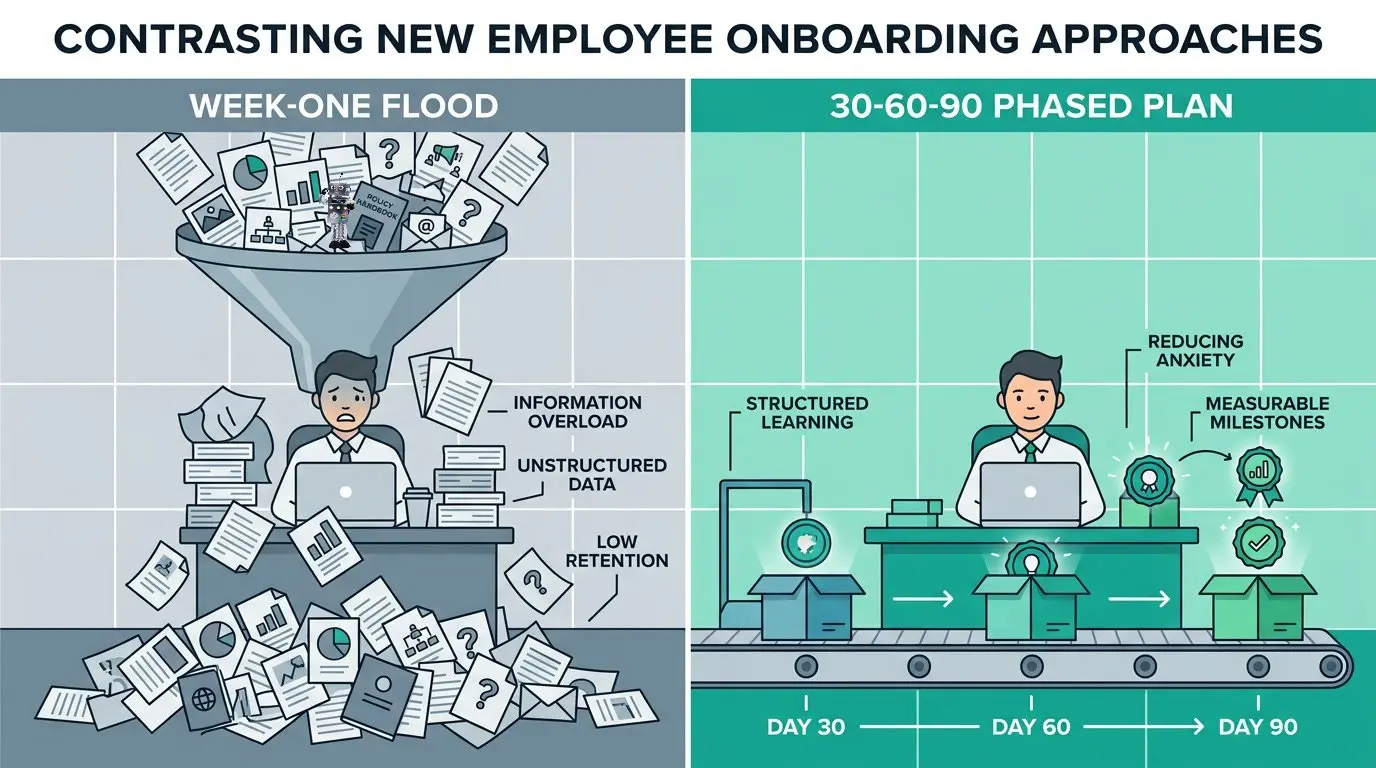
- Deliver It in Phases: Don't front-load everything on day one. Cover orientation and required policies in week one, then layer in role-specific training over the following weeks, each step building on the last. Keep any single session to 30-60 minutes so it sticks.
- Pair the New Hire with an Experienced Coworker: Have your trainee do real work alongside your best person on that task within the first couple of weeks. Practicing in real conditions builds competence far faster than watching or reading alone.
- Check That It Stuck: Confirm learning the simple way: a short quiz on key points, plus watching the person perform the task. For compliance and certification topics, use an 80% pass score as your benchmark.
- Have the Owner or Manager Check In at 30, 60, and 90 Days: Sit down at each mark to review how the new skills are showing up in the work, fix what's slipping, and note progress. In a small company the owner or manager is the reinforcement, and that follow-through is the biggest factor in whether training changes performance.
- Look at the Results and Adjust: Compare the simple before-and-after (fewer errors, faster work, less rework) and watch the handful of metrics that matter. Drop or rework any training that isn't moving the thing it was meant to fix.

How to Train Employees
In small to medium-sized companies, training employees is less about choosing courses and more about being deliberate. You won't have a learning department to lean on, so the quality of your training comes down to a few decisions the owner or manager makes up front: what the role really requires, what's worth teaching, who teaches it, and how you'll know it worked. Get those right and a small team can train as well as anyone; skip them and training becomes a stack of half-watched videos.
Start by Naming the Gap
The most common mistake is grabbing content before defining the problem. Before you assign anything, ask what each role needs to do well and where the person is falling short; you already have the evidence in their work, your customers' feedback, and the mistakes you keep correcting. Write the gaps down. Only training that closes a real gap earns a spot, which also keeps your limited time and money pointed at things that matter.
Set Goals You Can Actually Watch
Turn each gap into a couple of goals written as things you can observe, not topics to "cover." "Knows our safety rules" is a topic; "completes the equipment lockout correctly while you watch" is a goal. Goals like this tell you what to teach and how you'll know it worked, and for required topics like safety and harassment prevention, they become the standard your records are measured against if you're ever audited.
Match the Method to the Skill, and Keep It Cheap
No format is best at everything. A quick live walkthrough earns its time on judgment-heavy or people-facing topics; hands-on practice with your best employee wins for procedural work; and ready-made online modules handle standardized compliance content consistently and inexpensively. Small companies rarely need to buy courseware; they need someone experienced to show the way and a reliable source for the legal requirements.
The Owner or Manager Is the Program
Training that ends when the session ends rarely changes how people work. In a small business there's no separate learning & development function to hand this off to; the owner or direct manager is the bridge between "learned it" and "doing it," through short check-ins at 30, 60, and 90 days, in-the-moment corrections, and real assignments that put the new skill to use. That follow-through is what turns training into performance and retains top performers.
Measure Whether It Stuck, Not Just Whether It Got Done
"Completed the course" tells you someone clicked through; it says nothing about whether they can do the job. Watch the next level up: did the quiz score improve, is the person doing the task correctly a month later, and did the thing you were trying to fix (errors, slow turnaround, a safety issue) actually get better? You don't need a dashboard. A short list of the few things you're trying to change, checked honestly, tells you which training to keep and which to rebuild.

Employee Training Definition
Employee training is the structured way a business builds the knowledge and skills its people need to do their jobs well. For a small company it usually covers onboarding new hires, teaching the day-to-day work of each role, and meeting required compliance topics like workplace safety and harassment prevention. Small businesses invest in training for the same reasons big ones do (fewer errors, faster ramp-up, and a team that can handle what the business throws at it), but they do it with far fewer people and tools, which makes a simple, repeatable approach essential.
Core Training Methods
- On-the-Job Training (OJT): New hires learn by doing real work alongside an experienced coworker or the owner. This is the workhorse of small-business training: fast, free, and ideal for procedural and technical roles.
- Short Live Sessions: A brief in-person or video walkthrough led by the owner, a manager, or an experienced employee; best for judgment-based or people-facing topics that benefit from questions and discussion.
- Online & Self-Paced Modules: Ready-made digital courses people complete on their own; the practical way for a small team to deliver consistent compliance training and keep completion records without building anything.
- Blended Learning: A simple mix of the above: a short module to cover the basics, then hands-on practice to make it real. This outperforms any single method and is well within reach of a small business.
Overview of Related Topics
- Step-by-Step Guide to Training Employees: A simple process that runs from a quick needs assessment through teaching, reinforcing, and checking that training worked, sized for a team without a learning department.
- How Small Businesses Deliver Training: Most small companies train in three ways: the owner or manager teaches, an experienced coworker teaches, or an outside HR/PEO partner provides the platform and ready-made content. Each carries different tradeoffs in time, cost, and consistency.
- Who Does What: Three people carry training in a small business: the owner or manager who plans and reinforces, the experienced employee who shows others how the work is done, and an HR or PEO partner who supplies compliance content, a tracking platform, and the expertise you don't have on staff.
- Compliance Considerations: Federal law requires documented training in workplace safety (OSHA) and prohibits harassment and discrimination (EEOC), and many states mandate harassment-prevention training for even small employers, so a small business needs training and records to prove it.
- Measuring Effectiveness: You don't need an analytics team. A few honest signals (did the required training get completed, can the person do the job, and did the problem you set out to fix improve) tell a small business what's working.

Topics
How Small Businesses Deliver Training
- Owner- or Manager-Led: The owner or a manager plans and delivers training directly. It's the most common model in a small company and keeps training tightly tied to how the business runs, but it competes with everything else on that person's plate.
- Peer- or Mentor-Led: An experienced employee teaches the role to newer hires. It's effective and low-cost for technical or procedural work, and it frees up the owner; make sure that person can teach, not only do.
- Outsourced / PEO-Supported: An outside HR or PEO partner supplies ready-made compliance courses, a platform to assign and track them, and audit-ready recordkeeping. This is how a small business gets the training infrastructure of a big company without hiring for it.
Who Does What
- Owner / Manager: Decides what needs to be taught, makes the time for it, and reinforces it through follow-up. In a small business this one person wears the hats a large company splits across a whole department.
- Experienced Employee (Your In-House Expert): Knows how the work is really done and shows others, the small-business version of a subject matter expert. Capturing what's in their head before they leave is one of the highest-value things you can do.
- HR / PEO Partner: Provides compliance content, the platform to deliver and track training, audit-ready records, and answers to the "are we required to do this?" questions, the expertise a small company can't justify hiring full-time.
Regulatory & Compliance Considerations
- OSHA Safety Training: OSHA requires safety training for roles involving hazardous materials, machinery, or high-risk work, and the records must be kept. This applies to small employers; there is no headcount exemption.
- Anti-Harassment & Discrimination Training: EEOC guidance and a growing number of state laws require harassment-prevention training, and several states set the threshold low, so a small business is typically required to do this training and document accordingly.
- Documentation & Recordkeeping: If training isn't documented, in practice it didn't happen. Small businesses are audited and sued too, and clean completion records are your defense, which is one of the clearest reasons to lean on an HR partner's tracking.
Measuring Effectiveness
- Did It Get Done: Track completion of anything required, and aim for 100% on legally mandated training, which is realistic when you only have a couple dozen people.
- Did It Land: A short quiz and watching the person do the task confirm the skill stuck; 80% is a common pass mark for compliance and certification topics.
- Did It Help: Compare the before and after on the thing you were trying to fix: fewer errors, faster work, a safer floor. That's the proof that matters.
- Did They Stay: People who feel invested in tend to stay, and in a small business avoiding departure pays for a lot of training.
Key Infographic Statistics at a Glance
- 47 Hours: Employers provided an average of 47 hours of training per employee in 2024, reflecting the scale of investment organizations commit to workforce development (Training Magazine, 2024 Training Industry Report)
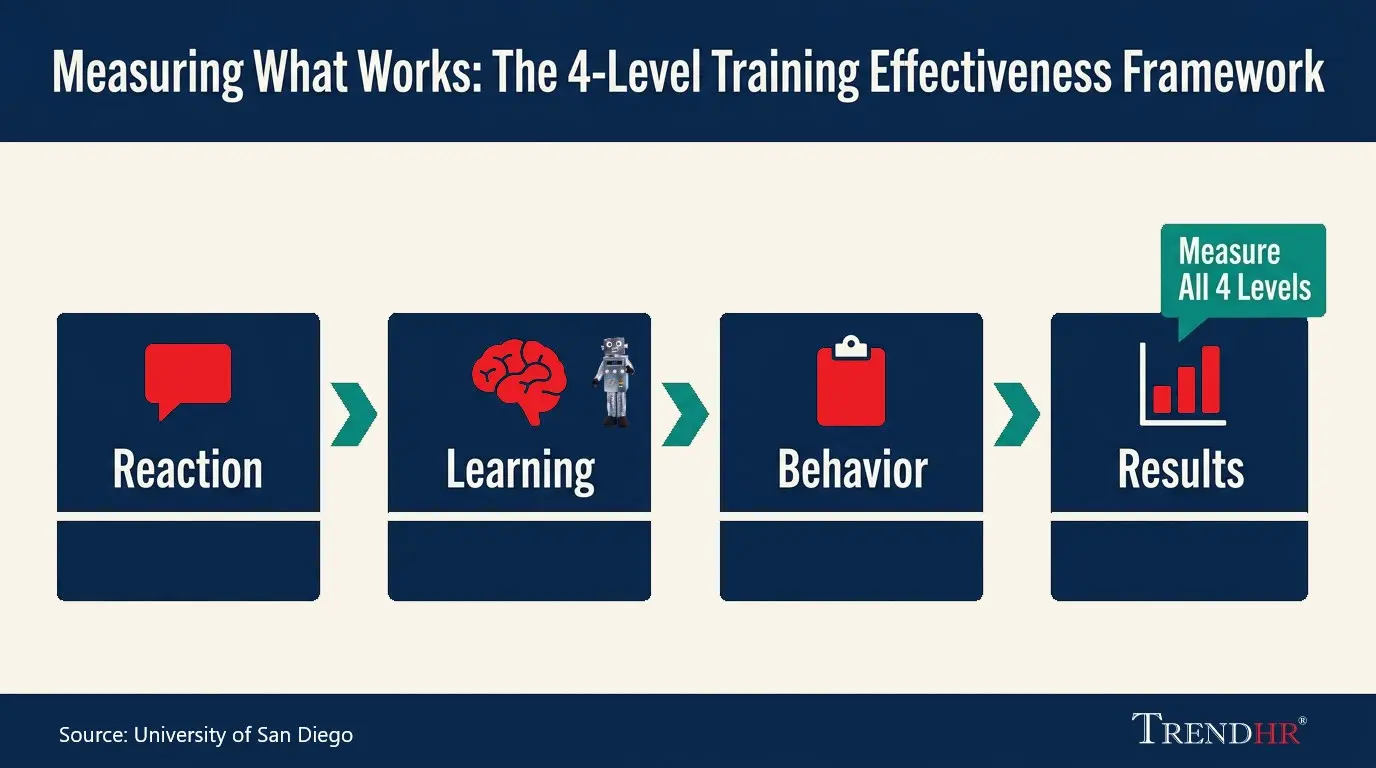
- The Four Levels of the Kirkpatrick Model: Level 1: Reaction, Level 2: Learning, Level 3: Behavior, Level 4: Results. It is the standard framework for verifying whether training actually changes on-the-job performance (University of San Diego)
- OSHA Language Requirement: Safety training must be conducted in a language and vocabulary workers can understand, making accessible content design a federal compliance obligation rather than a best practice (OSHA)

New Hire Training Plan: 30-60-90 Day Template
A 30-60-90-day plan breaks a new hire's first three months into three phases, each with a few activities and a simple checkpoint before moving on. It works especially well in a small business: phased training means you teach skills as the person is ready to use them instead of doing everything in a chaotic first week, and the checkpoints give the owner or manager early warning if someone is struggling, while there's still time to fix it. You can run this whole plan on a single shared page.
Days 1-30: Foundation
- Orientation & Access: Cover company basics and policy acknowledgments, and set up accounts, equipment, and software; checkpoint: access confirmed and required acknowledgments signed by day 5.
- Compliance & Safety Training: Complete all legally required training, including safety and harassment-prevention modules; checkpoint: 100% complete with passing scores by day 30.
- Core Role Knowledge: Learn the main tools, steps, and quality standards for the job; checkpoint: passes a basic knowledge check at 80% or above.
- Shadow an Experienced Coworker: Watch an experienced person work through the full job and meet the handful of people they'll work with; checkpoint: can describe the job start to finish in their own words.
Days 31-60: Guided Application
- Supervised Real Work: Do the core tasks with an experienced coworker reviewing the output before it goes out; checkpoint: first solo piece of work accepted with only minor fixes.
- Add the Harder Stuff: Learn the advanced tools, exceptions, and edge cases the role runs into; checkpoint: can handle a common exception correctly.
- Regular Feedback: Hold a short weekly one-on-one with the owner or manager to review how the work measures up to the role's goals; checkpoint: a 60-day review captures progress on each goal.
- Quality & Pace Targets: Hit a sensible intermediate target, for example around 75% of normal output at full quality; checkpoint: that's logged and reviewed at the 60-day check-in.
Days 61-90: Independent Performance
- Full Workload: Carry the normal workload without routine review; checkpoint: output meets your quality and timeliness standards for two weeks running.
- Handles Problems Solo: Works through exceptions and asks for help at the right moments; checkpoint: owner or manager sees at least one problem handled well without stepping in.
- Competency Sign-Off: Demonstrates all the skills required at hire; checkpoint: owner or manager signs off, and the record goes in the personnel file.
- Set Next Goals: Agree on 2-3 development goals for the next few months; checkpoint: goals written down at the 90-day review.
Keep the plan on one shared page and review it at each 30-day mark, checking off items as they're verified. The completed, signed 90-day record doubles as the employee's onboarding baseline and as your proof that required training was delivered and competency confirmed, so keep it on file.
Employee Training Checklist
Use this checklist as the backbone of any training: onboarding, compliance, or teaching a new skill. Adapt it to your business and your industry's rules but keep every item something you can mark done or not done. None of it requires a big system; a shared document works fine, and an HR partner can handle the tracking pieces if you'd rather not.
Before Training Begins
- Skill gaps for the role written down.
- A few clear, watchable goals set for the training.
- Content checked for accuracy by whoever knows the job best.
- All required compliance training identified (OSHA safety, harassment prevention, any industry licensing) with what's required confirmed.
- Who's being trained, on what, and by when, all written down.
- A trainer or an experienced coworker lined up, and coverage arranged for the trainee's normal duties.
During Training Delivery
- Attendance and completion tracked by person.
- Quick knowledge checks given at key points, with scores noted.
- Any needed accommodation provided, and content delivered in language the person clearly understands.
- Questions and points of confusion noted so you can fix the material.
- Hands-on practice provided for every skill, with someone watching.
After Training
- Final checks scored against your pass mark, with a plan for anyone who didn't pass.
- Completion records filed in each person's file.
- Signed acknowledgments collected for all policy and compliance training.
- Owner or manager plans how the new skill gets used on the job within a week.
- Quick feedback gathered from the trainee to improve next time.
Ongoing Reinforcement & Compliance
- Owner or manager check-ins done and noted at 30, 60, and 90 days.
- The before-and-after on the targeted problem is reviewed at the 90-day mark.
- Certification and license expiration dates tracked, with renewals scheduled before they lapse.
- Annual refreshers scheduled for recurring compliance topics.
- Training records kept audit-ready and organized by person, the piece an HR or PEO partner can take off your plate.
- A quick look, a few times a year, at whether training is moving the things that matter.

Statistics & Outlook
Training employees isn't just a big-company concern; it's a legal requirement that applies regardless of headcount and a proven driver of performance. The U.S. Department of Labor notes that systematic training improves both individual productivity and overall output, and federal law requires documented training in areas including workplace safety, anti-discrimination practices, and industry-specific operations, with no exemption for small employers (U.S. Department of Labor, dol.gov). For context on the scale of investment, the U.S. Bureau of Labor Statistics reports employers spent an average of 70.6 hours per employee on training annually in recent survey periods (Bureau of Labor Statistics, bls.gov/news.release/ebs2). OSHA also requires that safety training be delivered in a language and vocabulary workers can understand, a standard that applies to a five-person crew just as much as a five-thousand-person plant (OSHA, osha.gov/workers/file-a-complaint).
For a small business, the math on training is if anything more compelling than for a large one. Cornell University's ILR School has documented that organizations with formal training report higher engagement and lower voluntary turnover than those without (Cornell ILR, ilr.cornell.edu), and when you only have a couple dozen people, replacing one of them, at an estimated 50% to 200% of their annual salary, lands far harder than it would on a big payroll. A single untrained employee, a single missed compliance requirement, or a single avoidable departure is a much larger share of a 25-person operation. Small businesses that treat training as a simple, repeatable habit, and lean on an HR or PEO partner for the compliance and recordkeeping pieces, get the risk protection and workforce capability of a much larger company without the overhead.
Verified Sources
- Training Magazine: Employers provided an average of 47 hours of training per employee in 2024. (trainingmag.com)
- U.S. Bureau of Labor Statistics: Employers spent an average of 70.6 hours per employee on training annually in recent survey periods. (bls.gov)
- Occupational Safety and Health Administration (OSHA): Safety training must be conducted in a language and vocabulary workers can understand. (osha.gov)
- Cornell University ILR School: Organizations with formal training programs report higher employee engagement and lower voluntary turnover than those without structured learning initiatives. (ilr.cornell.edu)

Technology & Tools for Training
You Don't Need an Enterprise Platform
Large companies run training on a Learning Management System (LMS) wired into HR and payroll software. A small business doesn't need to buy or run this. What you need is a way to deliver courses, see who's done them, and keep the records, and you can get all three without owning enterprise software. The most common path for a small business is a training platform provided through an HR or PEO partner, which comes pre-loaded with compliance courses and handles tracking and recordkeeping for you.
Simple Tools That Do the Job
For everything outside formal compliance courses, the tools you already have are enough. A shared document or folder holds your role checklists and how-to guides. A short screen recording or phone video captures how an experienced employee does a task, so it can be reused with every new hire instead of repeated live each time. A simple spreadsheet or shared tracker shows training status at a glance. The goal isn't sophistication; it's that the knowledge lives somewhere other than one person's head, and that you can see what's been completed.
Keep Records Audit-Ready Without the Busywork
Training generates paperwork that matters: completion records, signed policy acknowledgments, certification dates. For a small business the risk isn't having the wrong system; it's letting these slip through the cracks until an audit or a claim makes them urgent. Electronic acknowledgments with a date stamp, stored in one place, solve most of this. Automated reminders before a certification or license expires prevent the lapse that quietly creates liability. An HR or PEO partner's platform typically handles both automatically, which is much of the value for a company without an HR staffer to chase it.
Where AI Can Help a Small Team
AI tools have made it cheap for a small business to produce decent training material. You can use them to turn a messy set of notes into a clean step-by-step guide, draft quiz questions from a procedure document, or write a first-draft job aid that your experienced employee then corrects. That lets one busy owner or manager create the kind of written training that used to require a dedicated person. Just keep a human who knows the job reviewing anything AI produces before it's used.
What to Prioritize
If you only fix a few things, fix these: make sure required compliance training gets assigned and completed, make sure the records are stored where you can find them, and make sure renewals don't lapse. Skip the temptation to buy complex software you won't fully use. A small business is better served by a couple of simple, consistent tools, plus an HR partner for the compliance heavy lifting, than by an enterprise platform no one has time to administer.

Key Performance Indicators (KPIs)
If you spend time and money training people but never check whether it works, you're guessing. The good news for a small business is that you don't need a dashboard or an analyst; you need a short list of honest signals you can glance at a few times a year. The handful below connects the training you do to the things you care about: staying compliant, getting people up to speed, and keeping good employees. Track these and you'll know what's working without drowning in metrics.
A Few Metrics Worth Tracking
| What to Track | How to Read It | Target |
|---|---|---|
| Required Training Completion | Has everyone finished the legally required courses (safety, harassment prevention)? | 100%; with a small team, it's achievable |
| Time to Competency | How long until a new hire is doing the full job at standard | Shorter over time means your onboarding is working |
| Knowledge Check Pass Rate | Share of people passing the post-training check | 80%+; consistently lower means the material needs fixing |
| Errors / Rework After Training | Mistakes or do-overs in the trained task, before vs. after | A measurable drop is your proof the training paid off |
| New-Hire Retention | Do new people make it past 90 days and stay? | Higher retention; turnover is costly on a small payroll |
| Compliance Records Complete | Are completion records and signed acknowledgments on file for everyone? | 100%; this is your defense if you're ever audited |
Look at these a few times a year, more often for the compliance items, less often for the rest. You don't need to slice the data by department or build reports; for a small team a quick honest review is enough to tell you which training to keep and which to rework. If pulling even these together feels like one more thing you don't have time for, it's exactly the kind of tracking an HR or PEO partner's platform handles in the background.

Frequently Asked Questions
What is the best way to train new employees in a small business?
The best way is a short structured onboarding, role training delivered mostly hands-on alongside an experienced coworker, and regular check-ins from the owner or manager in the first 90 days.
In a small company you don't have a training department, so keep it simple and deliberate. Spend the first week on the essentials: company basics, required policies, and any legally mandated safety and harassment-prevention training. Then teach the actual job the way small businesses do it best: have the new hire work alongside your most experienced person on real tasks, starting with supervision and easing into independence as they prove they've got it.
The part most small businesses skip is follow-up, and it's the part that matters most. When the owner or manager checks in at 30, 60, and 90 days, asking how it's going, watching the work, and correcting course, new hires get up to speed faster and are far more likely to stay. If finding and tracking the required compliance courses is the bottleneck, that's exactly where an HR or PEO partner earns its keep.
What are the most effective training methods for a small team?
For a small team, the most effective methods are hands-on practice with an experienced coworker, short live sessions for judgment-based topics, and ready-made online modules for compliance, usually blended together.
On-the-job training is the highest-impact method available to a small business, and conveniently the cheapest: a new hire doing real work next to your best employee learns faster than they would from any course. Use short live walkthroughs, in person or over video, for the topics that need discussion or judgment, like handling a difficult customer or a tricky policy.
For standardized compliance content (safety, harassment prevention, licensing), ready-made online modules are the practical choice, because they deliver the same vetted material every time and create the completion record you need. Blending these beats relying on any one of them: a short module to cover the basics, then real practice to make it stick. Avoid the common trap of picking a method because it's easy; start with what the person needs to be able to do and work backward to how to teach it.
How long should training a new employee take?
It depends on the role and the person's experience, but most onboarding runs 30 to 90 days, with full proficiency in a more complex role often taking three to six months.
Resist the urge to rush it; small businesses that push people onto the floor too fast usually pay for it in mistakes and early turnover, which hurt far more when you only have a few employees. A straightforward role with clear steps can reach competency in a focused couple of weeks. A more complex or customer-facing role typically needs structured learning over a few months, with simple checkpoints along the way.
Compliance training has its own clock that you don't control: OSHA safety requirements, harassment-prevention mandates, and any industry licensing each carry their own deadlines and renewal cycles, and missing them creates real exposure regardless of company size. Keeping those dates tracked is one of the easiest things to hand to an HR partner. The underlying principle is simple: training should last as long as it takes for someone to do the job safely and well, not just as long as is convenient.
How do you know if your training is working?
You'll know it's working when required training is completed, the person can do the job correctly a month later, and the problem you set out to fix (errors, slow ramp-up, turnover) improves.
You don't need a formal evaluation framework for a small team. Start with the basics: did people finish the training, and did a quick knowledge check show they got it? Those are easy to capture and worth tracking, but on their own they only tell you someone showed up and absorbed the material.
The signals that matter most come a bit later. A month or so after training, is the person doing the task right, not in a quiz, but in the real work? And did the thing you were trying to improve move in the right direction: fewer mistakes, faster turnaround, a safer floor, people sticking around? Those are easy to see in a business this size precisely because you're close to the work. Decide upfront what you're trying to change, then check honestly whether it did; that tells you which training to keep and which to rebuild.
Why does training matter so much for a small business?
Because in a small business every employee is a big share of the team, so training reduces costly errors, keeps you out of compliance trouble, and helps you hold onto the people you've already invested in.
Untrained employees make more mistakes, take longer to get productive, and handle tricky situations worse, and the cost of those mistakes, in rework, lost customers, or a safety incident, usually dwarfs the cost of the training that would have prevented them. Training also keeps people: employees who feel their employer is investing in them are much more likely to stay, and on a small payroll one avoided departure saves you the considerable cost of finding and training a replacement.
Federal and state rules require documented training in safety, anti-harassment, and industry-specific practices, and those rules don't waive themselves because you're small. If you can't show training was completed, you carry the risk. A small business that builds training into a simple routine and leans on an HR or PEO partner for the compliance and recordkeeping gets the protection and capability of a much larger company without needing to staff for it.
Key Takeaways
Training employees well is within reach of any small business; it takes a clear plan, not a learning department. The same compliance obligations and the same payoff in performance and retention apply as much to 10 employees as to 1,000 and arguably matter more when every person is a big share of the team.
Keep it simple and deliberate: name the gap, set a few watchable goals, teach mostly hands-on alongside your best people, lean on ready-made modules for compliance, and have the owner or manager follow up at 30, 60, and 90 days. That follow-through is what turns training into performance.
You don't have to build the infrastructure yourself. An HR or PEO partner can supply compliance content, a platform to deliver and track it, and audit-ready records, giving a small business the training capability of a much larger one without the overhead of staffing for it.