

How to Handle Employee Termination
Quick Answer
To handle an employee termination well, separate the decision from the event. Long before the meeting, make sure the reason is legitimate, applied consistently, and supported by a paper trail, and confirm it has nothing to do with a protected characteristic, a recent complaint, a workplace-safety report, or a leave the person just took. Check that the process was fair: were expectations clear, were there warnings or a performance plan where your own policy or past practice called for them? Then plan the logistics before you walk in: final pay timed to your state's deadline, benefits and COBRA, return of company property, and when system access gets cut off. Hold a short, respectful, witnessed meeting, deliver the decision plainly, and don't argue or improvise reasons. In 49 states employment is at-will, so you generally don't have to give a reason, but you can never fire for an illegal one, which is why clean, dated documentation is your real protection if a claim ever comes. You don't need an in-house employment lawyer to do this right; you need a consistent process and reliable records, which an HR or PEO partner can supply if you don't have one in-house.
Step-by-Step Guide to Terminating an Employee
- Confirm the Reason Is Legitimate and Documented: Before anything else, be able to state in one sentence why this person is being let go (poor performance, misconduct, or a position being eliminated) and point to the record that backs it up. A reason you can't show on paper is a reason you may have to defend from memory later. If the file is thin, that's a signal to slow down, not speed up.
- Check for Legal Red Flags: Pause and ask whether anything about the timing or the person could turn a routine firing into a claim: a protected characteristic (age, race, sex, disability, religion, national origin, pregnancy, genetic information), a recent complaint or harassment report, a safety or wage complaint, a workers' comp claim, a request for accommodation, or a medical or family leave. Firing close on the heels of any of these invites a retaliation or discrimination claim, even when your reason is sound, so this is the moment to involve HR or counsel.
- Make Sure the Process Was Fair: Were expectations clear and communicated? Did the person get the warnings, coaching, or performance-improvement plan that your handbook or your own past practice would lead them to expect? At-will or not, treating like situations alike is the single best defense against a claim that this person was singled out. If you fired someone for something you've tolerated from others, expect that to surface.
- Plan the Logistics Before the Meeting: Work out the mechanics in advance: the exact final-pay amount and when it's legally due in your state, accrued PTO if your state or policy requires payout, the benefits and COBRA notice, what company property comes back, and when IT will disable email and system access. Decide who delivers the news, who witnesses it, and what the person walks out with in writing.
- Prepare What You'll Say and Keep It Short: Write down two or three sentences and stick to them. State that the employment is ending, give the effective date, and cover the practical next steps. Resist the urge to soften it with a long explanation or to re-litigate every past issue; that's where managers improvise new "reasons" that contradict the file and create legal exposure.
- Hold the Meeting With a Witness: Keep it brief, private, and respectful, with a second member of management or HR present. Deliver the decision early, not after ten minutes of preamble. Let the person react, listen without arguing, and don't get pulled into a debate or a negotiation you didn't plan for. Have the written materials ready to hand over.
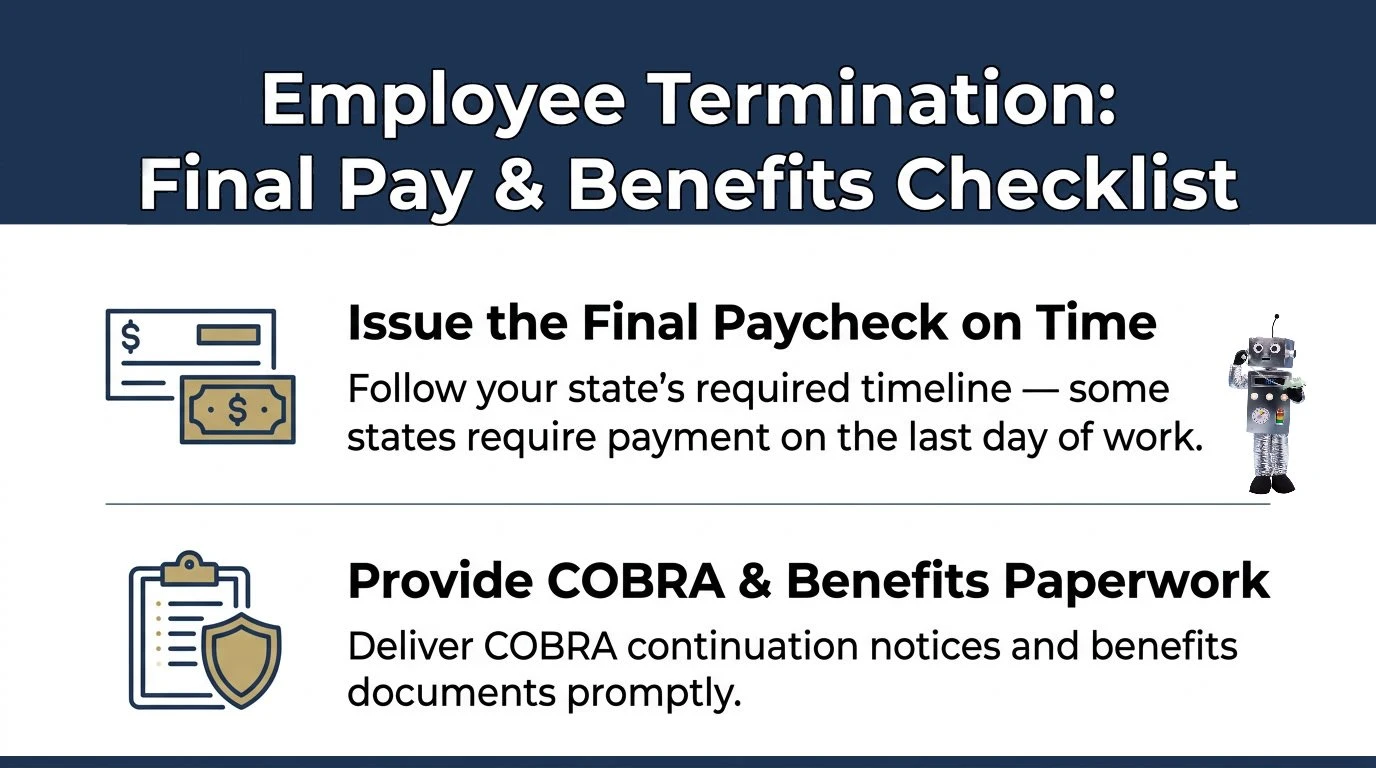
- Handle Final Pay, Benefits, and Property: Provide the final paycheck on your state's required timeline (some states require it on the last day) along with the COBRA and benefits paperwork. Collect keys, badges, devices, and credit cards, and confirm what happens to anything you can't recover that day. Document what was returned and what's outstanding.
- Cut Off Access and Notify the Team Appropriately: Coordinate with IT so access ends at the right moment: not so early the person learns of the decision from a locked laptop, and not so late that data walks out the door. Tell the rest of the team only what they need to know: that the person has left and who to go to now. Resist sharing the reasons, which protects both the business and the departing employee.
- Document Everything and Keep the File: Write a dated summary of the decision, the meeting, who was present, and what was provided. Keep it with the performance record, the final-pay calculation, and the signed acknowledgments. If you're ever challenged, a clean, contemporaneous file is what turns "their word against ours" into a documented, defensible decision.

Handling a Termination in a Small Business
In a small business, terminating an employee is one of the highest-stakes, lowest-frequency things you'll do, which is exactly why it goes wrong. You don't have an HR department rehearsing the process or an employment lawyer down the hall, so the quality of the outcome comes down to a few decisions the owner or manager makes before anyone walks into a room: whether the reason is legitimate and documented, whether the timing is clean, whether you've treated this person the way you've treated others, and whether you've planned the mechanics. Get those right and even a hard firing is a defensible one; skip them and a routine separation becomes a wrongful-termination claim.
Separate the Decision From the Event
The most common mistake is treating the termination as a single moment, the meeting, when the part that protects you happens weeks earlier. The decision should be made calmly, based on a documented record, and checked against the law before a date is ever set. The event itself is just the delivery. When managers collapse the two, deciding and firing in the heat of the same afternoon, they skip the checks that keep a good reason from becoming a legal problem.
Check for Legal Red Flags Before You Commit
At-will employment lets you end the relationship without giving a reason, but it never lets you fire for an illegal one. Before you commit, run the timing past the obvious tripwires: Did this person recently complain, report harassment or a safety issue, file a workers' comp claim, ask for an accommodation, or return from medical or family leave? Are they in a protected class, and have you treated similar employees the same way? A firing that looks fine on its own can look like retaliation when it lands a week after a complaint, so when any flag is up, that's the moment to slow down and get HR or legal eyes on it.
Be Consistent: Treat Like Situations Alike
Consistency is the quiet backbone of a defensible termination. If two employees did the same thing and only one was fired, the difference between them had better be documented and lawful, not a hunch and not a personality. Apply your attendance, performance, and conduct standards the same way across people, follow your own progressive-discipline policy when you have one, and you remove the single most powerful argument an employee can make: that the real reason was something you're not allowed to act on.
Keep the Meeting Short, Respectful, and Witnessed
The meeting is not where decisions get made or defended; it's where one already-made decision gets delivered, briefly and humanely. Have a second person present, keep it private, state the outcome plainly, and hand over the written materials. Dignity matters here for its own sake, and it's also practical: people who feel ambushed or humiliated are far more likely to call a lawyer. A calm, prepared, witnessed conversation is both the kinder path and the lower-risk one.
Documentation Is What Protects You
"We had good reasons" tells a jury nothing; a dated file tells them everything. The performance reviews, the warnings, the policy acknowledgments, the notes from the meeting, the final-pay calculation: that record is the difference between a decision you can defend and one you have to reconstruct under oath. In a small business this is the piece that most often gets skipped, and it's the easiest piece to hand to an HR or PEO partner whose job is to help keep it clean and current.

Employee Termination Definition
Employee termination is the end of the working relationship between an employer and an employee, whether the employee leaves voluntarily or is let go by the company. For a small business it covers everything from a resignation you accept gracefully to a for-cause firing, a layoff driven by the budget, or a mutually agreed separation, each with its own paperwork, timing, and legal considerations. Small businesses terminate employees for the same reasons large ones do (performance, conduct, fit, finances, restructuring), but they do it with far fewer guardrails, which makes a consistent, documented process essential rather than optional. Note that this article is general information, not legal advice; termination rules vary by state, so confirm the specifics for yours.
The Main Types of Termination
- Voluntary: The employee chooses to leave through a resignation, a retirement, or simply not returning. Your job is to accept it cleanly, confirm it in writing, and handle final pay and benefits, since even a voluntary exit can produce a dispute if the mechanics are mishandled.
- Involuntary, For Cause: The company ends the relationship because of the employee's performance or conduct: missed standards after coaching, a policy violation, or misconduct. This is the type most likely to be challenged, so it lives or dies on documentation and consistency.
- Layoff / Reduction in Force (RIF): The position is eliminated for business reasons, with no fault on the employee's part. Selection criteria must be objective and non-discriminatory, and larger layoffs can trigger advance-notice obligations under the WARN Act.
- Mutual Separation: Both sides agree to part ways, often with a severance and a signed release of claims. Handled well, it's the cleanest exit; the agreement has to be drafted carefully to be enforceable.
- End of Contract or Probationary Period: The relationship was time-limited or conditional from the start, and it simply ends as defined. Clear terms up front make these the most straightforward of all.
Overview of Related Topics
- Step-by-Step Guide to Terminating an Employee: A simple process that runs from confirming and documenting the reason, through checking for legal red flags and planning the logistics, to the meeting itself and the records you keep afterward, sized for a team without an HR department.
- Types of Termination: The categories a small company actually faces (voluntary, for-cause, layoff, mutual separation, and end of contract), each with its own paperwork, timing, and risk profile.
- Who Does What: A termination in a small business is carried by a few people: the owner or manager who decides, the direct supervisor who holds the record, an HR or PEO partner who supplies process and compliance, and an employment attorney for the hard cases.
- Compliance Considerations: At-will employment, anti-discrimination and anti-retaliation law (EEOC), final-pay rules that vary by state, COBRA, unemployment, and the WARN Act for larger layoffs, none of which waive themselves because you're small.
- Measuring Effectiveness: You don't need an HR analyst. A few simple signals (were terminations documented, were claims and disputes avoided, did the process stay consistent) tell you whether your approach is working.

Topics
Types of Termination
- Voluntary Resignation: The employee initiates the exit. Get it in writing, confirm the last day, and run the same offboarding (final pay, benefits, property) you'd run for any departure. Often the easiest, but still worth documenting.
- For-Cause / Performance: Termination for missed standards or repeated issues after coaching. Requires a documented trail of expectations, feedback, and warnings, and it is the type most likely to draw a claim if that trail is missing.
- For-Cause / Misconduct: Termination for a serious violation such as theft, violence, harassment, or gross safety breaches. May justify immediate dismissal, but should still rest on a documented investigation rather than a snap reaction.
- Layoff / Reduction in Force: A no-fault separation driven by finances or restructuring. Selection must use objective, non-discriminatory criteria, and larger actions can trigger WARN Act notice. Severance is optional but common.
- Mutual Separation / Negotiated Exit: Both parties agree to end the relationship, usually with severance in exchange for a signed release. The cleanest outcome when a relationship isn't working but a firing would be messy, provided the agreement is drafted properly.
- End of Contract / Probationary Period: A time-limited or conditional arrangement that ends as defined. Low-risk when the terms were clear and communicated at the outset.
- Job Abandonment: An employee stops showing up without notice. Handle it through a documented policy, such as a defined number of no-call/no-show days, rather than treating it as an informal quit.
Who Does What
- Owner / Manager: Makes the call, checks it against the law and the record, and owns the outcome. In a small business this one person carries decisions a large company would split across a manager, an HR business partner, and a legal team.
- Direct Supervisor: Holds the day-to-day record (the performance notes, the warnings, the coaching conversations) that the whole decision rests on. Their documentation, done in real time, is the difference between a defensible firing and a thin one.
- HR / PEO Partner: Supplies the process and the compliance layer: progressive-discipline templates, a defensible termination procedure, final-pay and COBRA handling, state-specific rules, and audit-ready recordkeeping. It is the specialist knowledge a small company can't justify hiring full-time.
- Employment Attorney: Brought in for the high-risk cases: a protected-class or recent-complaint situation, a negotiated severance and release, a large layoff, or any firing likely to be challenged. Cheaper before the termination than after.
Regulatory & Compliance Considerations
- At-Will Employment & Wrongful Termination: In 49 states (all but Montana) employment is at-will, meaning either side can end it at any time for any legal reason. Wrongful termination is firing for an illegal reason (discrimination, retaliation, breach of contract, or violation of public policy), which at-will status does nothing to protect.
- Anti-Discrimination & Retaliation (EEOC): Federal law prohibits firing based on race, color, religion, sex (including pregnancy), national origin, age, disability, or genetic information, and prohibits retaliation for protected activity like filing a complaint. These apply to small employers, with some statutes phasing in by headcount; written policies, consistency, and documentation are baseline controls.
- Final Pay & State Law: There's no single federal deadline for a final paycheck; timing, and whether accrued PTO must be paid out, is set by state law and varies widely, from "by the next regular payday" to "on the last day." Getting this wrong can create penalties on top of the wages owed.
- WARN Act: Employers with 100+ employees generally must give 60 days' advance written notice of a qualifying plant closing or mass layoff; several states have their own "mini-WARN" laws with lower thresholds. It rarely touches the smallest employers, but it matters the moment you grow or restructure.
- COBRA & Unemployment: Group-health continuation (COBRA, or a state equivalent for smaller employers) must be offered on the required timeline, and most terminated employees can file for unemployment; both are routine offboarding steps, and not optional.
Measuring Effectiveness
- Were Terminations Documented: Every involuntary termination should have a reason on file and a contemporaneous record; aim for zero firings with a thin or missing trail.
- Were Claims & Disputes Avoided: EEOC charges, wrongful-termination claims, and final-pay complaints, tracked over time. A clean run is the clearest sign the process is working.
- Was the Process Consistent: Similar situations handled the same way, your own discipline policy followed. Inconsistency is what most claims are built on.
- Did Offboarding Get Completed: Final pay on time, COBRA sent, property recovered, access cut off, records filed; a simple done/not-done check on every exit.

Termination Legal-Risk Matrix: A Before-You-Fire Self-Check
Not every termination carries the same legal risk, and the most useful thing a small business can do before firing someone is to figure out which kind it's dealing with. This matrix scores a planned termination on two simple axes, how likely the person is to dispute or file a claim and how exposed you'd be if they did, then plots them on a grid so you know whether to proceed on your normal process or stop and get HR and legal review first. It takes about fifteen minutes per case, forces an honest look before the meeting instead of after the lawsuit, and tells you exactly when a routine firing isn't routine.
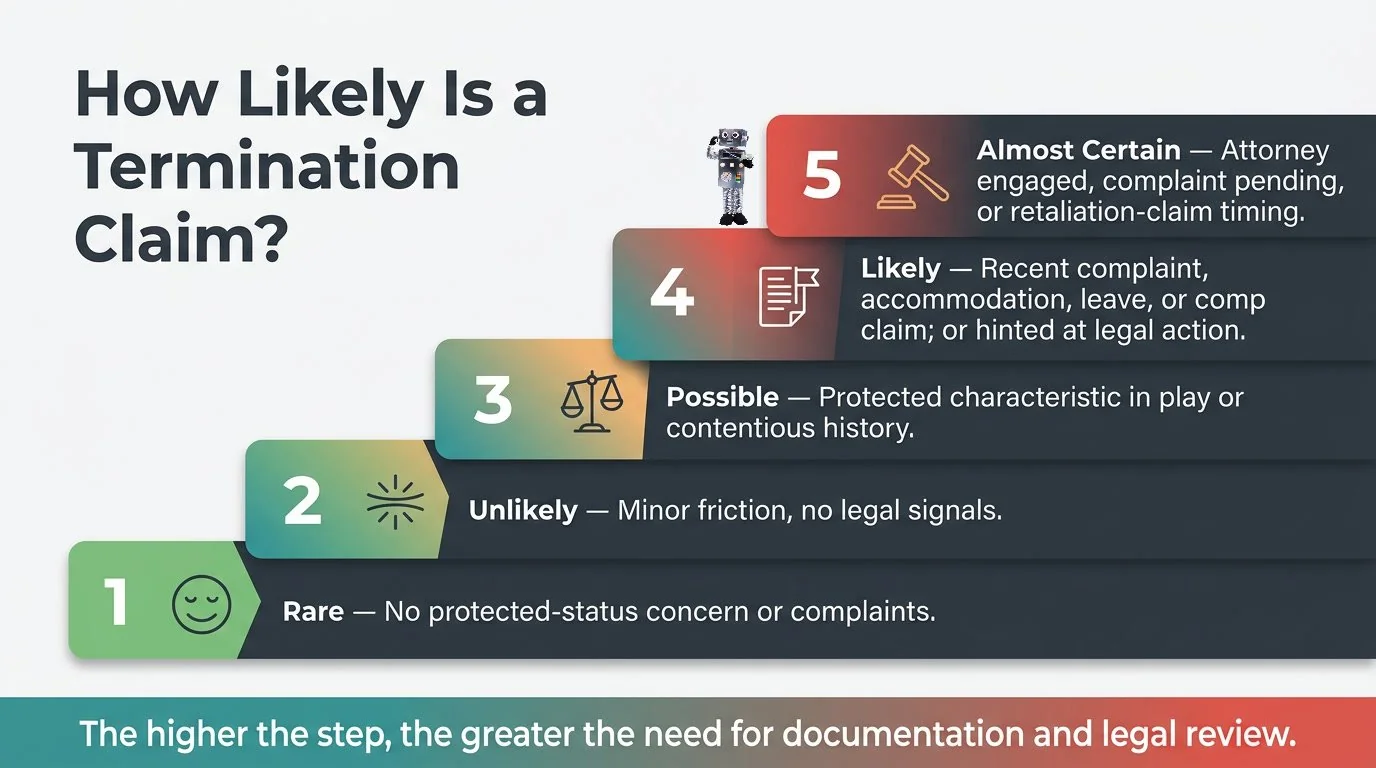
Step 1: Score Claim Likelihood (1-5)
- 1 - Rare: No protected-status concern, no recent complaints, the person seems likely to move on quietly.
- 2 - Unlikely: Some friction, but nothing that points toward a legal challenge.
- 3 - Possible: A protected characteristic is in play, or the relationship has been contentious.
- 4 - Likely: Recent protected activity (a complaint, accommodation request, leave, or workers' comp claim), or the person has hinted at legal action.
- 5 - Almost Certain: An attorney is already involved, a complaint is pending, or the timing makes a retaliation claim almost automatic.
Step 2: Score Exposure if Challenged (1-5)
- 1 - Negligible: Thorough documentation, clear policy violation, fully consistent with how you've treated others.
- 2 - Minor: Solid record with one or two small gaps; low potential damages.
- 3 - Moderate: Documentation is incomplete, or the reason is partly subjective ("not a fit"); some inconsistency with past practice.
- 4 - Major: Little documentation, long tenure, or meaningful inconsistency; a claim would be costly to defend.
- 5 - Severe: Essentially no record, a possible contract or public-policy issue, and high potential damages.
Step 3: Plot the Termination on the Matrix
Multiply or plot the two scores. Where the termination lands tells you how to proceed: the lower-left corner (unlikely to be disputed and well-documented) is a routine, proceed-on-normal-process firing; the upper-right corner (likely to be challenged and poorly supported) is a stop-and-get-review-first case where rushing is the most expensive thing you can do.
| Claim Likelihood → | ||||||
|---|---|---|---|---|---|---|
| 1 Rare | 2 Unlikely | 3 Possible | 4 Likely | 5 Almost Certain | ||
| ← Exposure | 5 Severe | 5 | 10 | 15 | 20 | 25 |
| 4 Major | 4 | 8 | 12 | 16 | 20 | |
| 3 Moderate | 3 | 6 | 9 | 12 | 15 | |
| 2 Minor | 2 | 4 | 6 | 8 | 10 | |
| 1 Negligible | 1 | 2 | 3 | 4 | 5 | |
- Low (1-3): proceed on normal process
- Medium (4-9): tighten documentation first
- High (10-15): pause & get HR review
- Critical (16-25): stop & get legal review
Step 4: For High and Critical Cases, Build a Pre-Termination File
Anything landing in the high or critical zone gets a short pre-termination review before you set a date: a single page capturing the reason, the documentation that supports it, how comparable situations were handled, any protected status or recent protected activity, and what HR or counsel advised. That page is both a decision tool and a defense: if the firing is ever challenged, a dated record showing you identified the risk, checked it, and acted deliberately is exactly the kind of evidence that demonstrates a reasonable, good-faith process.
The matrix also tells you where to spend money. A low-risk termination needs your normal process and nothing more; a critical one is worth an hour of an employment attorney's time before you act, which is far cheaper than the claim you'd be defending afterward. Keep the completed self-check with the employee's file.

Employee Termination Checklist
Use this checklist as the backbone of any termination, whether a routine performance firing, a layoff, or a negotiated exit. Adapt it to your business and your state's rules, but keep every item something you can mark done or not done. None of it requires a big system; a shared document works fine, and an HR or PEO partner can handle the compliance and recordkeeping pieces if you'd rather not.
Before the Decision
- The reason for termination stated in one clear sentence, with the documentation that supports it identified.
- The record reviewed for warnings, performance plans, and policy acknowledgments, with any gaps noted.
- Legal red flags checked: protected status, recent complaints, accommodation requests, leaves, or workers' comp claims.
- Consistency confirmed: comparable situations were handled the same way.
- The legal-risk self-check completed; HR or counsel consulted for any high or critical case.
Preparing for the Meeting
- Final-pay amount and legal due date calculated, including any required PTO payout.
- Benefits, COBRA, and unemployment information prepared in writing.
- The brief script written: outcome, effective date, and next steps.
- The person delivering the news and the witness confirmed; time and private location set.
- IT coordinated on the exact timing of access cutoff; property to be returned listed.
The Day Of
- The meeting held privately, briefly, and respectfully, with a witness present.
- The decision delivered plainly; no improvised reasons or arguments.
- Final pay and written materials provided per your state's timeline.
- Company property collected; outstanding items documented.
- System and building access disabled at the agreed moment.
After the Termination
- A dated summary of the decision and the meeting written and filed.
- The team notified appropriately: who's left and who to go to now, not why.
- COBRA and any final benefits paperwork sent on the required timeline.
- Unemployment claim responded to accurately if one is filed.
- The complete file retained for the required period, the piece an HR or PEO partner can take off your plate.

Statistics & Outlook
Terminating employees isn't just a procedural chore; it's where a large share of employment claims begin, and the numbers make the case for doing it carefully. The U.S. Equal Employment Opportunity Commission reported securing roughly $660 million for about 17,680 workers in fiscal year 2025, and in its FY 2025 litigation, discharge or constructive discharge was the most commonly asserted issue, the single most frequent thing employees sued over. Retaliation has been the most-filed charge category for well over a decade, which is why the timing of a firing relative to a complaint matters as much as the reason itself.
The legal backdrop favors employers but only up to a point. In 49 states (every state except Montana) employment is at-will, so a business generally doesn't have to give a reason to let someone go. What at-will status never does is permit an illegal reason, so the protection comes entirely from being able to show the real reason was legitimate and consistently applied. Final-pay rules add a state-by-state layer: there's no single federal deadline, and timing and PTO payout vary widely, so a firing that's lawful in substance can still create penalties if the last check is late. And for larger actions, the federal WARN Act requires employers with 100 or more employees to give 60 days' advance notice of a qualifying plant closing or mass layoff, with several states imposing stricter "mini-WARN" rules. For a small business, the takeaway is that termination risk is concentrated and manageable: a consistent, documented process, with an HR or PEO partner handling the compliance and recordkeeping pieces, neutralizes most of it.
Verified Sources
- U.S. Equal Employment Opportunity Commission (EEOC): Secured approximately $660 million for about 17,680 workers in FY 2025; discharge or constructive discharge was the most commonly asserted issue in the agency's FY 2025 litigation. (eeoc.gov)
- U.S. Department of Labor / USA.gov: All states except Montana follow at-will employment; employers may end the relationship for any legal reason but never for an illegal one such as discrimination or retaliation. (usa.gov)
- U.S. Department of Labor (Final Pay): There is no federal requirement for the timing of a final paycheck; final-pay deadlines and PTO-payout rules are set by state law and vary widely. (dol.gov)
- U.S. Department of Labor (WARN Act): Employers with 100 or more employees generally must provide 60 calendar days' advance written notice of a qualifying plant closing or mass layoff (29 U.S.C. § 2101 et seq.). (dol.gov)

Technology & Tools for Employee Termination
You Don't Need an Enterprise HR Platform
Large companies run terminations through full HRIS and case-management systems wired into legal and payroll. A small business doesn't need to buy or run any of that. What you need is a way to capture the documentation behind each decision, a repeatable offboarding process, and a place to keep the records, and you can get all three without enterprise software. The most common path for a small business is a simple set of templates plus a compliance and recordkeeping platform provided through an HR or PEO partner, which comes pre-loaded with state-specific rules and handles the tracking for you.
Simple Tools That Do the Job
For most of this, the tools you already have are enough. A documentation habit (performance notes, warnings, and policy acknowledgments captured in real time in a shared employee file) is the single most valuable "tool" in a termination. A standard offboarding checklist makes sure final pay, COBRA, property, and access never slip. A short script template keeps the meeting consistent. The goal isn't sophistication; it's that the reason, the record, and the steps live somewhere other than one manager's memory.
Keep Records Audit-Ready Without the Busywork
Terminations generate paperwork that matters precisely when it's challenged: the performance trail, the signed acknowledgments, the final-pay calculation, the COBRA notice, the meeting summary. For a small business the danger isn't the wrong system; it's letting these slip until an EEOC charge or a wage complaint makes them urgent. Date-stamped electronic records stored in one place solve most of it, and an HR or PEO partner's platform typically retains them on the required schedule automatically, which is much of the value for a company without an HR staffer to chase it.
Where AI Can Help a Small Team
AI tools have made it inexpensive to do termination work that used to need a specialist. You can use them to draft a performance-improvement plan, turn rough manager notes into clear documentation, generate a state-aware offboarding checklist, or produce a first-draft separation letter. That lets a busy owner produce the kind of written record that used to require an outside consultant. Just keep a human who knows the situation and the law reviewing anything AI produces before you rely on it, especially on a firing that could be challenged.
What to Prioritize
If you only fix a few things, fix these: build a real documentation habit so no firing rests on memory, use one standard offboarding checklist on every exit, and confirm the final-pay and COBRA requirements for your state. Skip the temptation to buy a complex HR suite you won't fully use. A small business is far better served by good templates, a consistent process, and an HR partner for the compliance heavy lifting than by an enterprise platform no one has time to administer.

Key Performance Indicators (KPIs)
If you handle terminations but never check whether they're being done cleanly, you're guessing, and termination is the one area where guessing is expensive. The good news for a small business is that you don't need a dashboard or an analyst; you need a short list of honest signals you can glance at a few times a year. The handful below connects the process to the things you care about: staying compliant, avoiding claims, and treating people consistently. Track these and you'll know what's working without drowning in metrics.
A Few Metrics Worth Tracking
| What to Track | How to Read It | Target |
|---|---|---|
| Documented Terminations | Involuntary terminations with a clear reason and a contemporaneous record on file | 100%; no firing should rest on memory |
| Employment Claims & Charges | EEOC charges, wrongful-termination claims, and final-pay complaints over time | Zero, or a downward trend as the process matures |
| Process Consistency | Comparable situations handled the same way; discipline policy followed | No unexplained inconsistencies, the basis of most claims |
| Final Pay On Time | Final checks issued within the state-required deadline | 100%; late pay creates penalties on top of wages |
| Offboarding Completed | COBRA sent, property recovered, access cut off, records filed | 100% on every exit, tracked by checklist |
| Records Complete & Retained | Performance trail, acknowledgments, and meeting notes kept for the required period | 100%; this is your defense if you're ever challenged |
Look at these a few times a year, more often for the final-pay and offboarding items, less often for the rest. You don't need to model anything; for a small business a quick review is enough to tell you whether your terminations are clean and consistent. If pulling even these together feels like one more thing you don't have time for, it's exactly the kind of tracking an HR or PEO partner's platform handles in the background.

Frequently Asked Questions
What is the right way to terminate an employee?
The right way is to make sure the reason is legitimate, consistent, and documented; check that the timing isn't tied to a protected characteristic or a recent complaint; plan the logistics; and deliver the decision in a short, respectful, witnessed meeting, and then keep the records.
In a small company you don't have an HR department to run this for you, so keep it simple and deliberate. Separate the decision from the event: weeks before the meeting, confirm you can state the reason in one sentence and point to the record that backs it up, then run the timing past the obvious legal tripwires: a recent complaint, an accommodation request, a leave, a workers' comp claim, or a protected class.
The part most small businesses skip is what protects them most: consistency and documentation. Treat like situations alike, follow your own discipline policy, plan the final pay and offboarding before you walk in, keep the meeting brief and witnessed, and file a dated summary afterward. If finding the right process and keeping the records is your bottleneck, that's exactly where an HR or PEO partner earns its keep.
Can you fire someone without giving a reason?
In 49 states (all but Montana) employment is at-will, so you can generally end the relationship without giving a reason. What you can never do is fire for an illegal reason, like discrimination or retaliation, even if you give no reason at all.
At-will employment means either side can end the relationship at any time for any lawful reason, or no stated reason. That sounds like broad freedom, and it is, but it comes with a hard limit. If the real reason is the person's race, sex, age, disability, religion, national origin, pregnancy, or genetic information, or retaliation for a protected activity like filing a complaint, the firing is unlawful regardless of whether you said anything.
That's why "we didn't have to give a reason" isn't a strategy. The practical protection is being able to show the actual reason was legitimate and applied consistently, which means documentation. Montana is the one exception to at-will: after a probationary period, employers there generally need good cause to terminate. Everywhere else, at-will plus a clean record is the combination that holds up.
What counts as wrongful termination?
Wrongful termination is firing someone for an illegal reason (discrimination, retaliation, breach of an employment contract, or a violation of public policy) as opposed to a reason that's simply unfair or unpopular.
It's a common and costly misunderstanding to think any firing an employee dislikes is "wrongful." At-will employment means a termination can be harsh, abrupt, or even unfair without being unlawful. What makes it wrongful is an illegal basis: firing because of a protected characteristic, in retaliation for a complaint or a workers' comp claim, in breach of a contract that promised job security, or in violation of public policy, such as firing someone for refusing to do something illegal.
The reason wrongful-termination claims are so common is that the line is about the real reason, not the stated one, and a court will look at timing, consistency, and documentation to infer it. A firing that lands days after a complaint, or that singles out one person for conduct you tolerated in others, can look wrongful even when your intent was clean. A consistent, well-documented process is what keeps a lawful decision from looking like an unlawful one.
What do you legally have to give a terminated employee?
At a minimum, the wages they've earned, paid on your state's required timeline, plus a COBRA or state-continuation notice for group health coverage and information they'll need for unemployment. Severance is generally optional unless a contract or policy requires it.
Final pay is the big one, and it's governed by state law, not a single federal rule. Some states require the final paycheck on the last day of work, others by the next regular payday, and some require accrued, unused PTO to be paid out, so the exact obligation depends entirely on where you are. Getting the timing wrong can add penalties on top of the wages owed, which is why this is worth confirming for your state every time.
Beyond final pay, you generally must offer continued health coverage (COBRA for larger employers, a state "mini-COBRA" for smaller ones) within the required window, and terminated employees can typically file for unemployment. Severance, references, and the like are business decisions, not legal requirements, unless you've promised them in a contract or handbook. An HR or PEO partner is the easiest way to make sure the required pieces happen correctly on every exit.
How do you reduce the risk of a wrongful-termination claim?
Document performance and conduct in real time, apply your standards consistently, check the timing against protected activity before you act, deliver the decision in a brief witnessed meeting, and handle final pay and offboarding correctly, and then keep the whole file.
Most wrongful-termination claims are not won on the firing itself; they're won on what surrounds it. A thin file, an inconsistent standard, or a firing that happens right after a complaint is what gives a claim its legs. So the defense is built long before the meeting: clear expectations set in advance, issues and feedback documented in real time, and the same treatment for like situations across your team.
Right before you act, run the planned termination through a quick legal-risk check: is the person in a protected class, did they recently engage in protected activity, is the documentation strong, would a comparable employee have been treated the same? For anything that scores high, get HR or an employment attorney involved before the meeting, not after the claim. The cost of an hour of review is trivial next to the cost of defending a firing you rushed.
Key Takeaways
Handling a termination well is within reach of any small business; it takes a consistent habit, not an HR department. The same anti-discrimination and anti-retaliation rules apply to a team of 10 as to one of 1,000, and the downside arguably matters more when one mishandled firing can pull a small company into a claim it can't easily absorb.
Keep it simple and deliberate: separate the decision from the event, confirm the reason is legitimate and documented, check the timing against protected activity, treat like situations alike, plan the logistics, deliver the news in a short witnessed meeting, and keep the file. In 49 states at-will employment lets you act without giving a reason, but only clean documentation protects you from a claim that the reason was an illegal one.
You don't have to build the infrastructure yourself. An HR or PEO partner can supply a defensible termination process, state-specific final-pay and COBRA handling, and audit-ready records, giving a small business the protection and consistency of a much larger one without the overhead of staffing for it.