

What Is the FLSA (Fair Labor Standards Act)?
Quick Answer
The Fair Labor Standards Act (FLSA) is the 1938 federal law that sets the baseline rules for how American workers get paid: the federal minimum wage ($7.25 an hour), overtime at one and a half times an employee's regular rate for hours worked over 40 in a workweek, recordkeeping standards, and child labor protections. It's enforced by the U.S. Department of Labor's Wage and Hour Division (WHD). Most small businesses are covered, either as an "enterprise" (generally $500,000 or more in annual sales) or because individual employees do work that touches interstate commerce, so "we're too small for the FLSA" is rarely true. The single costliest mistake employers make is misclassifying an employee as exempt (not owed overtime). Exemption isn't about a job title or being paid a salary; an employee is exempt only if they meet all three tests: paid on a salary basis, at or above the salary level ($684 a week, or $35,568 a year, as of 2026), and performing exempt duties. Note what the FLSA does not require: meal or rest breaks, paid time off, holiday pay, or premium pay for nights and weekends. And where a state's wage-and-hour law is stricter (a higher minimum wage, a higher exempt-salary floor, daily overtime), the state rule wins. The FLSA itself is straightforward; the work of classifying people correctly, tracking hours, and keeping the records to prove it is where small businesses fall short, and is the load an HR or PEO partner is built to carry.
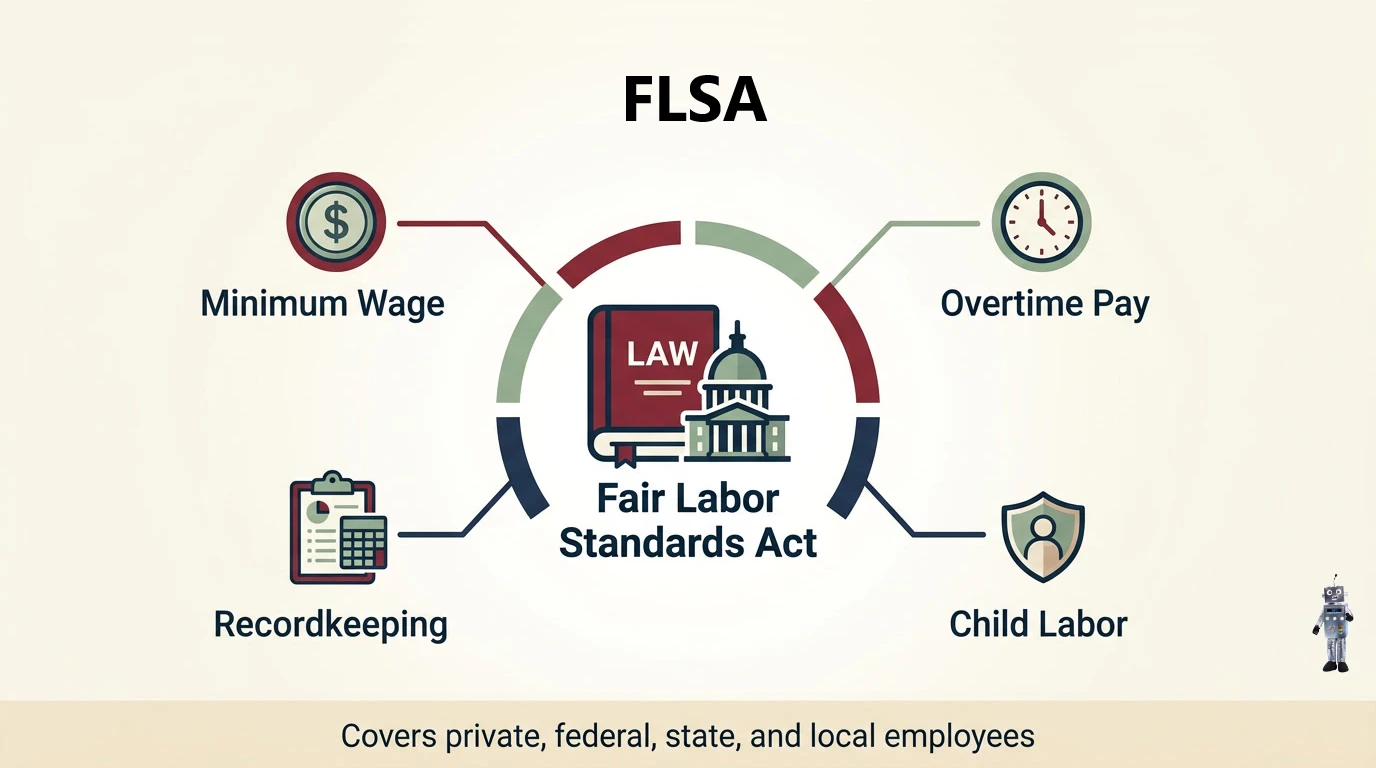

FLSA Defined
The Fair Labor Standards Act is the federal law, first passed in 1938 and amended many times since, that establishes minimum wage, overtime pay, recordkeeping, and child labor standards for employees in the private sector and in federal, state, and local governments. It's often called the "wage and hour law," and it's administered and enforced by the Wage and Hour Division of the U.S. Department of Labor. The FLSA sets a national floor: states and cities can require more (a higher minimum wage, stricter overtime), but they can't offer employees less than the FLSA guarantees. It applies to the employment relationship, which means independent contractors fall outside it, but whether someone is truly a contractor or actually an employee is itself an FLSA question, and getting it wrong carries the same risk as misclassifying an employee as exempt. This is general information, not legal advice, and some rules vary by state.
Key Terms
- Non-Exempt: An employee who is entitled to the federal minimum wage and to overtime pay for hours over 40 in a workweek. When in doubt, a worker is non-exempt; exemptions are the exception, and the employer has to prove one applies.
- Exempt: An employee who is not owed overtime (and in some cases not minimum wage) because they meet a specific FLSA exemption. Exemption requires meeting all three tests below, not simply being salaried or holding a particular title.
- Workweek: A fixed, recurring period of seven consecutive 24-hour days (168 hours). Overtime is calculated within a single workweek; you can't average hours across two weeks to avoid it.
- Regular Rate: The hourly rate an employee actually earns, used to calculate overtime. It includes most compensation (not just base pay, but also nondiscretionary bonuses, commissions, and shift differentials), which is why overtime is often owed on more than the base hourly wage.
- Enterprise Coverage: When an entire business is covered by the FLSA, generally because it has at least $500,000 in annual gross sales (with certain entities like hospitals and schools always covered). Every employee of a covered enterprise is protected.
- Individual Coverage: When a specific employee is covered because their own work regularly involves interstate commerce, making goods, handling orders, processing payments, or even sending email across state lines, even if the business as a whole isn't a covered enterprise.
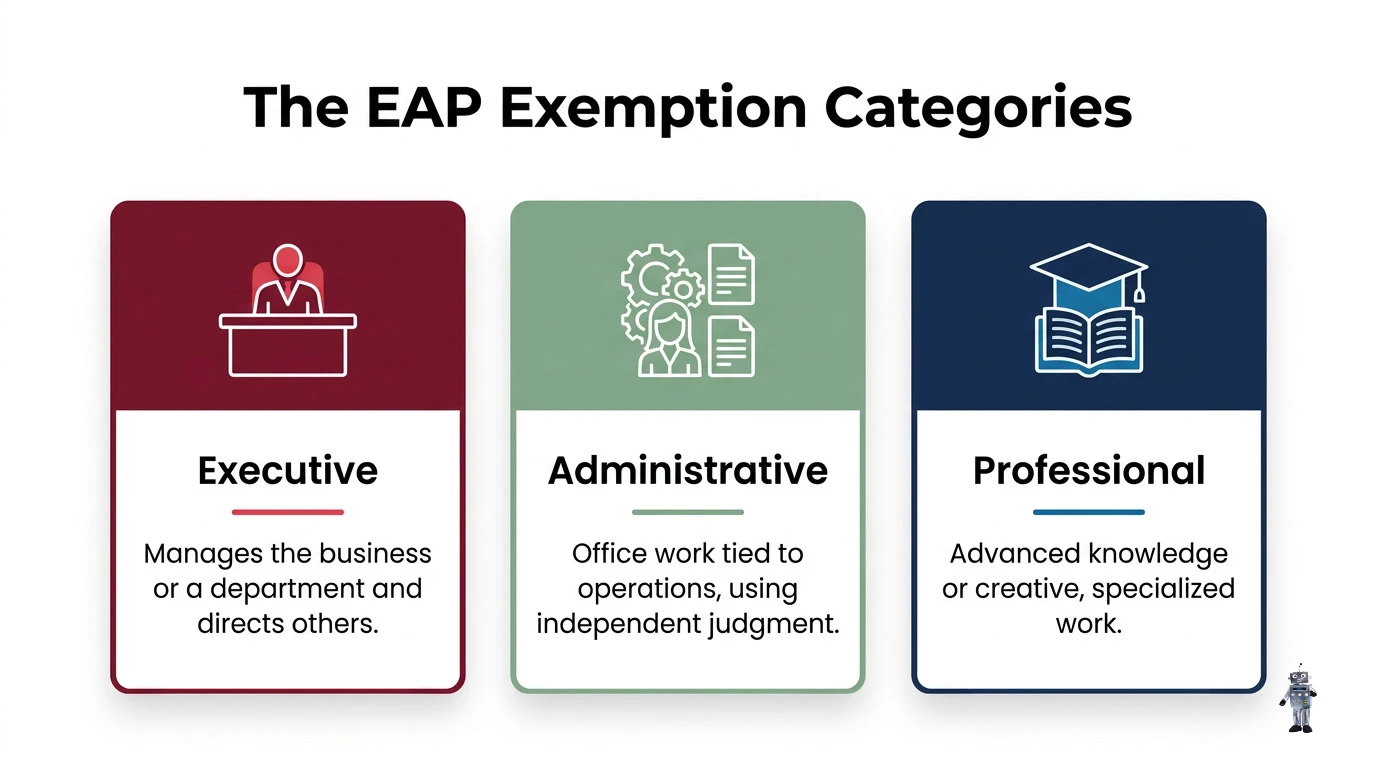
- EAP Exemptions: The "white-collar" exemptions for bona fide Executive, Administrative, and Professional employees. These are the exemptions most small businesses rely on, and the ones most often applied incorrectly.
Overview of Related Topics
- Who the FLSA Covers: The two ways coverage attaches (enterprise and individual) and why nearly every small business has at least some covered employees.
- Exempt vs. Non-Exempt: The three-part test that determines whether an employee is owed overtime, and the myths (salary, title) that lead employers astray.
- Minimum Wage & Overtime: The two headline entitlements, including how to build the regular rate that overtime is actually calculated on.
- FLSA vs. State Law: How to handle the common situation where your state requires more than federal law does.
- Penalties & Common Violations: What it costs to get it wrong: back wages, doubled damages, and the misclassification traps that catch good-faith employers.

The FLSA in a Small Business
The most common, and most expensive, assumption a small employer makes is "the FLSA is for big companies; we're too small to worry about it." It almost never holds up. Even when a business doesn't hit the $500,000 enterprise threshold, individual coverage usually does the job: the moment an employee handles a credit-card payment, ships an order out of state, orders supplies across state lines, or emails a customer in another state, that employee is individually covered. In practice, that's nearly everyone. The right starting assumption for a small business isn't "does this apply to us?"; it's "which of our people are non-exempt, and are we paying and tracking them correctly?"
The Owner Is the Wage-and-Hour Department
A large company has a payroll team and an employment lawyer on call. In a small business, the owner or office manager is the person deciding who's exempt, whether overtime was calculated right, and whether the timesheets would survive an audit, usually while running everything else. That's not a knock; it's the reality, and it's why FLSA mistakes in small businesses tend to be honest ones that simply repeat, quietly, every pay period until someone notices.
Misclassification Is the Risk That Compounds
Call a worker "salaried" and treat them as exempt without checking the duties test, and you don't make one mistake; you make the same overtime mistake every week for years. Because back wages can reach back two years (three for willful violations) and can be doubled as liquidated damages, a single misclassified role can turn into a five-figure liability before anyone files a complaint. The fix is cheap (classify correctly up front); the cleanup is not.
Where a Partner Carries the Load
Classifying roles, building the regular rate correctly, keeping compliant time and pay records, and watching for the state rules that override federal law are precisely the specialist work a small company can't justify hiring for full-time. An HR or PEO partner does it as a matter of course, giving a small business the wage-and-hour infrastructure of a much larger one without the overhead.

Who the FLSA Covers
FLSA coverage attaches in two ways, and a business only has to meet one of them for employees to be protected. The practical takeaway for a small business: assume you're covered until you've confirmed otherwise, because individual coverage sweeps in far more workers than most owners expect.
Enterprise Coverage
An entire business is covered as an "enterprise" if it has at least two employees and either:
- Brings in $500,000 or more in annual gross sales or business done; or
- Is a hospital, a business providing medical or nursing care for residents, a school or preschool, or a government agency; these are covered regardless of sales volume.
When an enterprise is covered, every employee in it is protected by the FLSA.
Individual Coverage
Even if a business isn't a covered enterprise, an individual employee is covered if their work regularly involves interstate commerce. Courts read this broadly. It includes making or handling goods that move across state lines, but also everyday tasks like processing out-of-state orders, taking payments by phone or card, booking interstate travel, or regularly communicating with people in other states. For most modern businesses (anyone using the internet, accepting cards, or shipping anything), at least some employees are individually covered.
Covered Is Not the Same as Non-Exempt
"Covered" means the FLSA applies to the employee at all. Whether that covered employee is exempt (not owed overtime) or non-exempt (owed overtime) is the separate question answered by the three tests in the next section. A worker can be fully covered by the FLSA and still be properly exempt, but you have to run the test to know.
Who Falls Outside
Genuine independent contractors aren't employees, so the FLSA's wage rules don't apply to them, but labeling someone a contractor doesn't make them one. The classification turns on the economic reality of the relationship, not on a 1099 or a signed agreement, and treating an employee as a contractor carries the same kind of back-pay exposure as treating a non-exempt employee as exempt.

Exempt vs. Non-Exempt: The Three Tests
This is the heart of FLSA compliance and the place small businesses most often go wrong. To treat an employee as exempt from overtime under the common "white-collar" (EAP) exemptions, you must be able to answer yes to all three of the tests below. Fail even one, and the employee is non-exempt and owed overtime, no matter what their offer letter says.
| Test | What It Requires | 2026 Federal Standard |
|---|---|---|
| 1. Salary Basis | The employee is paid a predetermined, fixed amount each pay period that doesn't go up or down based on the quality or quantity of work. Paying by the hour generally defeats this test. | Must be a genuine salary, with only limited, specific deductions allowed. |
| 2. Salary Level | The salary meets or exceeds the federal minimum threshold. Earning below it makes an employee non-exempt automatically, regardless of duties. | $684 per week ($35,568 per year). (Highly compensated employees: $107,432 per year total, including at least $684/week on a salary basis.) |
| 3. Duties | The employee's primary duties actually match an executive, administrative, or professional exemption. This is about what they really do day to day, not their title. | Based on actual job duties as defined in DOL regulations (Part 541), not job titles or descriptions. |
The Two Myths That Cause Most Misclassification
- "They're salaried, so they're exempt." False. A salary is necessary but not sufficient. A salaried employee who fails the salary-level or duties test is non-exempt and owed overtime.
- "We gave them a 'manager' title, so they're exempt." False. Calling someone a manager doesn't matter if their primary duty is doing the same work as the people they nominally supervise. The executive exemption looks at real authority: managing, directing other employees, and meaningful input on hiring and firing.
A Quick Word on the EAP Categories
- Executive: Primary duty is managing the business or a department, regularly directing at least two full-time employees, with genuine authority (or weighty input) over hiring, firing, and advancement.
- Administrative: Primary duty is office or non-manual work directly related to management or general business operations, exercising independent judgment on significant matters, not routine clerical work.
- Professional: Primary duty requires advanced knowledge in a field of science or learning, usually from prolonged specialized education (the "learned professional"), or work requiring invention, imagination, or talent in a creative field.
A few exemptions work differently and don't require the salary tests: outside sales employees, certain computer professionals (who may be paid hourly above a set rate), and bona fide teachers, doctors, and lawyers. Because exemptions are read narrowly and the employer bears the burden of proving one, the safe default is to treat a role as non-exempt unless you've documented that it clears all three tests.

Minimum Wage & Overtime
These are the two entitlements the FLSA is best known for, and they apply to every non-exempt employee.
Minimum Wage
The federal minimum wage is $7.25 per hour and has been since 2009. Employers must pay at least this for every hour worked. For tipped employees, federal law allows a cash wage as low as $2.13 per hour if tips bring the worker up to at least $7.25 (a "tip credit"); if they don't, the employer must make up the difference. Many states and cities set minimum wages well above $7.25, and where they do, you pay the higher rate.
Overtime
Non-exempt employees must be paid 1.5 times their regular rate for every hour worked beyond 40 in a single workweek. A few points trip people up:
- It's per workweek, not per pay period. You can't average a 30-hour week and a 50-hour week to avoid the 10 overtime hours; the 50-hour week owes overtime on its own.
- There's no federal daily overtime. Federal law only counts hours over 40 in a week, but some states (notably California) require overtime after 8 hours in a day, so check your state.
- The "regular rate" is usually more than base pay. Overtime is calculated on the regular rate, which includes nondiscretionary bonuses, commissions, and shift differentials, not just the hourly base. Forgetting to fold those in is one of the most common ways employers underpay overtime without realizing it.
- "Comp time" generally isn't allowed in the private sector. Private employers can't substitute paid time off for overtime owed in cash; that option is limited to government employers.
- All hours worked count. That includes time the employee was "suffered or permitted" to work: early starts, working through lunch, answering messages after hours. If you knew or should have known the work happened, it's compensable.

How to Comply with the FLSA: Step-by-Step
FLSA compliance isn't a project you finish; it's a short routine you keep. Here's the sequence that keeps a small business on the right side of it.
- Confirm Coverage: Assume the FLSA applies. Check enterprise coverage (roughly $500,000 in annual sales, or an always-covered entity type), and remember that individual coverage likely catches employees even if the enterprise test doesn't.
- Classify Every Role: Go position by position and decide exempt or non-exempt by running all three tests: salary basis, salary level ($684/week), and duties. Base it on what the person actually does, not the title, and write down your reasoning.
- Set Compliant Pay: Make sure every non-exempt employee earns at least the highest applicable minimum wage (federal, state, or local) for all hours worked, and that exempt employees clear the salary threshold that applies in their state.
- Track Hours for Non-Exempt Employees: Use a reliable timekeeping system to record actual hours worked each day and week. Accurate time data is the foundation everything else rests on, and the first thing an investigator asks for.
- Calculate Overtime on the Full Regular Rate: Pay 1.5x for hours over 40 in a workweek, and build the regular rate correctly by including nondiscretionary bonuses, commissions, and differentials, not just base pay.
- Keep the Required Records: Retain payroll records for at least three years and the records overtime calculations are based on (time cards, schedules) for at least two. There's no required format, but the required information must be there.
- Post the FLSA Poster: Display the official DOL minimum-wage/FLSA poster where employees can see it. It's free from the Wage and Hour Division.
- Audit Periodically and Check State Law: Re-review classifications and pay practices at least annually and whenever a role changes, a salary threshold moves, or you hire in a new state, and apply the stricter of federal or state rules every time.

FLSA vs. State Wage & Hour Laws
The FLSA is a floor, not a ceiling. When a state or local law is more protective of the employee, that's the one you have to follow. For a small business, especially one with remote or multi-state employees, this is where compliance gets genuinely tricky, because the rule that governs depends on where the employee works.
| Provision | Federal FLSA | Where State Law Is Stricter |
|---|---|---|
| Minimum wage | $7.25 / hour | Many states and cities are well above $7.25; pay the higher rate. |
| Overtime | 1.5x over 40 hours in a workweek | Some states add daily overtime (e.g., over 8 hours/day) and double-time rules. |
| Exempt salary threshold | $684 / week ($35,568 / year) | States such as California, New York, Washington, and Colorado set higher salary floors that you must meet to keep an employee exempt there. |
| Duties tests | Federal "primary duty" standard | Several states apply stricter duties tests or don't recognize certain federal exemptions. |
| Meal & rest breaks | Not required | Many states require paid rest breaks and/or meal periods. |
Because the higher salary thresholds in some states rise with their minimum wage, an employee who is properly exempt in one state can become non-exempt simply by working in another. If you employ people in more than one state, the safest approach is to track each location's rules and apply the most protective one to each worker, which is exactly the kind of moving target an HR or PEO partner is set up to monitor for you.

Penalties & Common Violations
FLSA mistakes are expensive precisely because they tend to repeat across many pay periods and many employees before they're caught. Here's what's on the line and where small businesses most often go wrong.
What Getting It Wrong Costs
- Back Wages: You owe the unpaid minimum wage or overtime, generally reaching back two years, or three years for willful violations.
- Liquidated Damages: In many cases the employee can recover an additional amount equal to the back wages, effectively doubling the bill.
- Civil Money Penalties: Willful or repeated minimum-wage and overtime violations, and child labor violations, can carry civil penalties (the amounts are adjusted for inflation each year).
- Attorney's Fees and Lawsuits: Employees can sue (individually or as a collective action covering many workers), and prevailing employees can recover their attorney's fees, which often dwarf the wages themselves.
- Criminal Exposure: Willful violations can, in serious cases, lead to criminal prosecution.
The Most Common Traps
- The salaried-equals-exempt myth: Treating a salaried employee as exempt without confirming the salary-level and duties tests.
- Title inflation: Calling someone a "manager," "coordinator," or "supervisor" to justify exemption when their real duties don't qualify.
- Off-the-clock work: Not counting pre-shift setup, working lunches, or after-hours emails and remote work as hours worked.
- Miscalculating the regular rate: Paying overtime on base pay alone and leaving out nondiscretionary bonuses and commissions.
- Independent-contractor misclassification: Treating workers as contractors when the economic reality makes them employees.
Overtime is, by a wide margin, the most common FLSA violation: federal officials have said it accounts for nearly 80% of all FLSA back-wage violations, and most of it traces back to one of the traps above.

FLSA Compliance Checklist
Use this as a quick backbone for staying compliant. None of it is complicated on its own. The discipline is in doing it consistently and documenting it. An HR or PEO partner can carry the classification, payroll, and recordkeeping pieces if you'd rather not track them yourself.
Classify & Pay
- Every position reviewed and labeled exempt or non-exempt using all three tests, with the reasoning written down.
- Non-exempt employees paid at least the highest applicable minimum wage for all hours worked.
- Exempt employees confirmed to meet the salary threshold that applies in their work state.
- Overtime paid at 1.5x the full regular rate (bonuses and commissions included) for hours over 40 in a workweek.
Track & Record
- A reliable timekeeping system in place for all non-exempt employees, capturing actual hours worked.
- Payroll records kept at least three years; time and computation records kept at least two.
- The official FLSA/minimum-wage poster displayed where employees can see it.
Audit & Document
- Classifications and pay practices re-reviewed at least annually and whenever a role, salary threshold, or work location changes.
- State and local rules checked for every work location, with the stricter standard applied.
- Independent-contractor relationships reviewed against the economic-reality test, not just the paperwork.

Topics
Child Labor Rules
- Under 14: Generally can't be employed in non-agricultural jobs, with narrow exceptions (such as acting, newspaper delivery, or work for a parent's business).
- Ages 14–15: May work limited hours in non-hazardous jobs, outside school hours, within daily and weekly caps and set time-of-day windows.
- Ages 16–17: May work unlimited hours but not in occupations the Department of Labor has declared hazardous.
- Age 18+: No FLSA child labor restrictions apply. (Agricultural rules differ and allow work at younger ages.)
Recordkeeping Requirements
For non-exempt employees, the FLSA requires specific records: identifying information, hours worked each day and week, regular hourly rate, straight-time and overtime earnings, additions to and deductions from pay, and the dates and amounts of each payment. No particular format is required, but the information must be accurate and available for inspection. Payroll records are kept for at least three years; records the wage computations rest on (time cards, schedules) for at least two.
Who Does What
- Owner / Manager: Decides classifications, sets pay, ensures hours are tracked and overtime is paid correctly, and keeps the records. In a small business this is usually one person.
- HR / PEO Partner: Handles the specialist work: classifying roles, building the regular rate, maintaining compliant time and pay records, posting requirements, and tracking the state rules that override federal law, the load a small company can't justify staffing for full-time.
- DOL Wage and Hour Division: Enforces the FLSA, investigates complaints, recovers back wages, and provides free compliance assistance and posters.
- Employment Counsel: Advises on close classification calls, contractor questions, and anything that escalates toward a complaint, audit, or lawsuit.
Key Compliance Considerations
- When in doubt, non-exempt: Exemptions are read narrowly and the employer must prove them, so the safe default for an uncertain role is non-exempt.
- What the FLSA does NOT require: No mandate for meal or rest breaks, paid time off, holiday or weekend premium pay, severance, raises, or pay stubs, though state law may require some of these.
- Stricter law wins: Always apply the most protective of federal, state, and local rules for each employee's work location.
- Document everything: For wage-and-hour compliance, if you can't show it was done, in practice it didn't happen.

Statistics & Outlook
Enforcement by the Numbers
- In fiscal year 2025, the DOL's Wage and Hour Division recovered more than $259 million in back wages for roughly 177,000 workers, an average of about $1,465 per worker, and the agency's highest recovery since 2019.
- FLSA violations alone accounted for more than $184 million of that total.
- Overtime is the dominant problem, making up nearly 80% of FLSA back-wage violations.
- The division assessed roughly $58.7 million in penalties in FY2025, up from $35.9 million the prior year, and concluded more than 950 child labor cases with over $37 million in related civil money penalties.
The Salary-Threshold Story
The overtime exemption salary threshold has been a moving target. A 2024 rule sharply raised the threshold, but a federal court vacated it nationwide in November 2024. After the Department of Labor dropped its appeal, the WHD issued a technical amendment in May 2026 restoring the prior 2019 level of $684 per week ($35,568 per year), which is the governing federal standard as of 2026. The DOL has signaled it may revisit the threshold through future rulemaking, so the number could change again.
What to Watch
- State increases: Several states raised their own exempt-salary thresholds effective January 1, 2026 (with at least one taking effect mid-year), pushing many of them well above the federal floor.
- Future federal rulemaking: Any new DOL salary-threshold rule, and the litigation that typically follows, could reclassify salaried workers between exempt and non-exempt.
- Remote and multi-state work: As teams spread across states, applying the correct (stricter) state rules to each worker is becoming a bigger share of everyday compliance.
Because the federal threshold, state thresholds, and minimum wages all move on their own schedules, FLSA compliance rewards an annual review, which is also a good reason to revisit this article each year.

Frequently Asked Questions
Does the FLSA apply to small businesses?
Almost always, yes. A business is covered as an enterprise if it has at least two employees and $500,000 or more in annual sales (or is a hospital, school, or government entity). Even below that, individual employees are covered if their work touches interstate commerce, which today includes accepting card payments, shipping out of state, or emailing customers elsewhere.
The realistic question for a small business isn't whether the FLSA applies, but which employees are non-exempt and whether they're being paid and tracked correctly. Assuming you're too small to be covered is the assumption that most often leads to back-wage liability.
Who is exempt from the FLSA?
Employees who meet all three tests for a recognized exemption: paid on a salary basis, at or above the salary level ($684/week federally in 2026), and performing exempt executive, administrative, or professional duties. A few categories, like outside sales and certain computer professionals, follow different rules.
Exemptions are interpreted narrowly, and the employer has the burden of proving one applies. A job title or a salary alone never makes someone exempt; the actual duties have to qualify. When a role's status is unclear, the safe default is to treat it as non-exempt.
What is the FLSA salary threshold in 2026?
The federal salary threshold for the white-collar exemptions is $684 per week, or $35,568 per year, in 2026. This is the 2019 level, restored by the Department of Labor in May 2026 after a 2024 rule that would have raised it was vacated in court.
Several states set higher thresholds (including California, New York, Washington, and Colorado), and where a state's floor is higher, you must meet it to keep an employee exempt there. The DOL has indicated it may revisit the federal figure, so it's worth confirming the current number each year.
Does the FLSA require breaks, PTO, or holiday pay?
No. The FLSA does not require meal or rest breaks, paid vacation or sick time, holiday pay, or extra pay for working nights, weekends, or holidays. It governs minimum wage, overtime, recordkeeping, and child labor, not these benefits.
That said, two caveats matter: short rest breaks an employer does offer (typically under 20 minutes) generally must be paid and counted as hours worked, and many states do require meal and rest breaks even though federal law doesn't. Check your state before assuming you can skip them.
What's the difference between exempt and non-exempt employees?
Non-exempt employees must receive at least minimum wage and overtime (1.5x) for hours over 40 in a workweek. Exempt employees are not entitled to overtime because they meet a specific FLSA exemption. The difference comes down to the three tests (salary basis, salary level, and duties), not to whether someone is paid hourly or salaried.
Most employees are non-exempt; exemptions are the exception. Misclassifying a non-exempt employee as exempt is the most common and most costly FLSA mistake, because the unpaid overtime accumulates every week until it's caught.
What happens if you violate the FLSA?
You generally owe the unpaid back wages (reaching back two years, or three for willful violations), and often an equal amount again in liquidated damages, effectively doubling the bill. Willful or repeated violations can add civil money penalties, and employees can sue and recover their attorney's fees.
Because violations repeat across pay periods and employees, a single misclassified role can become a large liability before anyone complains. The least expensive moment to fix an FLSA problem is before it starts, by classifying correctly, tracking hours, and keeping the records to prove it.
Key Takeaways
The Fair Labor Standards Act is the federal floor for pay: minimum wage ($7.25), overtime at 1.5x the regular rate over 40 hours in a workweek, recordkeeping, and child labor rules, enforced by the DOL's Wage and Hour Division (WHD). Nearly every small business is covered, through enterprise coverage (about $500,000 in sales) or, far more often, because individual employees do work that touches interstate commerce. "We're too small" almost never holds.
The compliance battle is won or lost on classification. An employee is exempt from overtime only if they meet all three tests (salary basis, salary level of $684/week in 2026, and duties), and a salary or a title alone never qualifies. Pay at least the highest applicable minimum wage, calculate overtime on the full regular rate (bonuses and commissions included), track every hour your non-exempt employees work, keep the records (three years for payroll, two for time data), post the poster, and apply the stricter of federal or state law for each work location.
Get it wrong and the cost compounds: back wages reaching back two or three years, often doubled as liquidated damages, plus penalties and attorney's fees; overtime errors alone drive most FLSA back-wage violations. The FLSA itself is simple; the ongoing work of classifying people, building the regular rate, tracking hours, and keeping current with shifting state thresholds is where small businesses lose time and make costly mistakes. An HR or PEO partner carries exactly that work, giving a small business the wage-and-hour infrastructure of a much larger one without the overhead.