

Americans with Disabilities Act (ADA): An Employer's Guide
Quick Answer
For an employer, the Americans with Disabilities Act comes down to a short list of duties that kick in once you have 15 employees. You can't make job decisions against a qualified person because of a disability, you must provide a reasonable accommodation that lets them do the job's essential functions unless it would be a genuine undue hardship, and when someone signals they're struggling because of a medical condition you have to engage in a good-faith "interactive process" to figure out what would help, even if they never use the word "accommodation." Alongside that, keep medical information confidential and stored separately from the personnel file, and skip disability and medical questions before you've made a job offer. Most accommodations turn out to be free or inexpensive, and most ADA claims don't come from an employer who weighed a request and said no for a documented reason; they come from one who ignored the request, fired the person instead of dealing with it, or never wrote anything down. You don't need an in-house employment lawyer to get this right; you need to recognize a request, run a real conversation, and document it, all of which an HR or PEO partner can help you put in place if you don't have it in-house.
Step-by-Step Guide to Staying ADA-Compliant
- Know Whether the ADA Applies to You: Title I, the employment part of the ADA, covers private employers with 15 or more employees, counted across full- and part-time staff over the year. If you're at or near that threshold, treat the rules as live; many states have their own disability laws that reach smaller employers, so being under 15 isn't a blanket exemption. When in doubt, assume the standard applies and act accordingly.
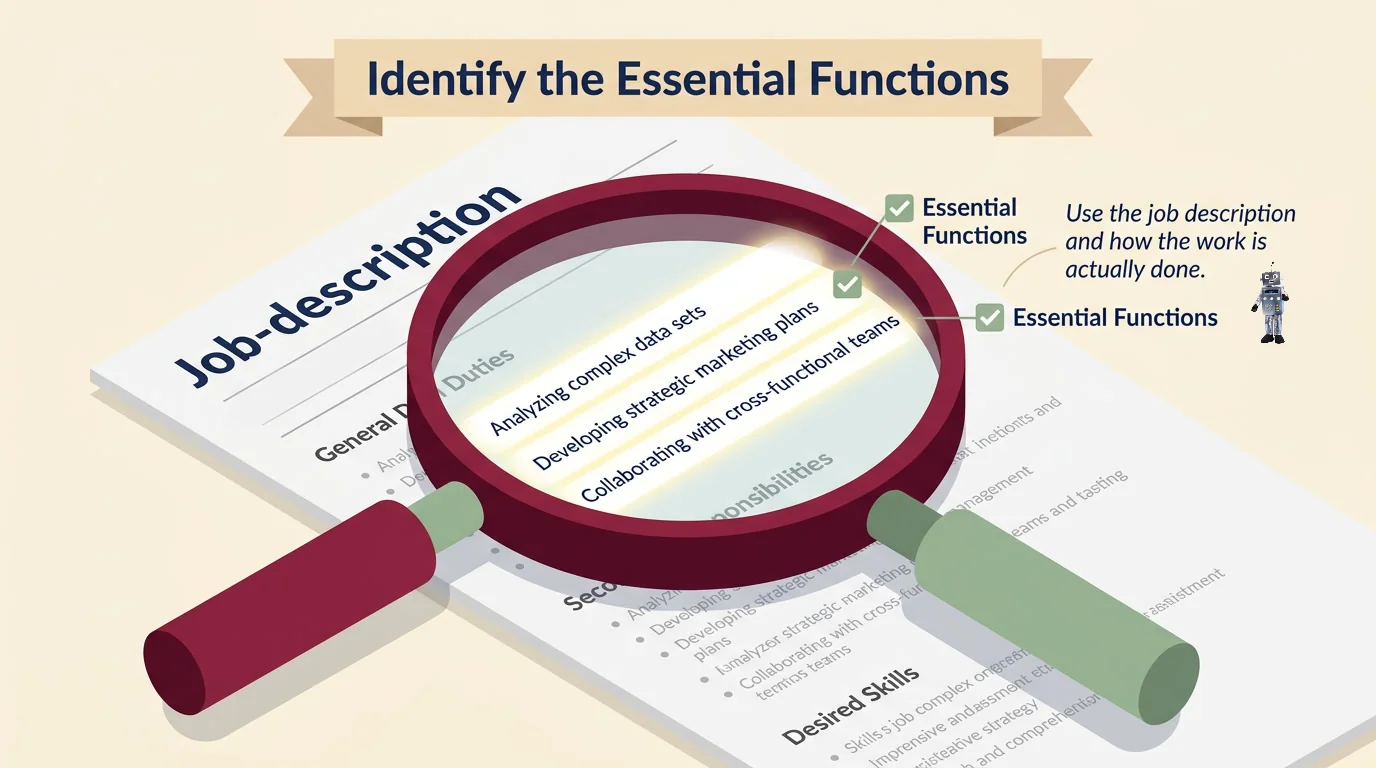
- Build Jobs Around Essential Functions: Write job descriptions that separate the essential functions (the core duties the role exists to do) from the marginal ones. This is the reference point for nearly every ADA decision: whether someone is "qualified," and what an accommodation actually needs to make possible. Honest, current descriptions written before any dispute are far more credible than ones produced after a request lands.
- Keep Hiring Disability-Blind Until the Offer: Before you make a job offer you may not ask whether someone has a disability or about the nature or severity of a condition. You can ask whether they can perform the job's functions, with or without accommodation. A medical exam can only be required after an offer, and only if you require it of everyone in that job category. Train anyone who interviews on this line.
- Recognize an Accommodation Request, No Magic Words Needed: An employee doesn't have to say "ADA" or "reasonable accommodation." "I'm having trouble getting in by 8 because of my treatment," or "my back can't handle the lifting anymore," is a request. The single most common and most expensive mistake is failing to recognize one of these as the start of the process. When you hear it, treat it as a request.
- Start the Interactive Process: Respond promptly with a conversation, not a brush-off. Talk with the employee about the limitation and what would help. You may ask for reasonable medical documentation confirming the condition and the need, but only what's necessary, not a fishing expedition into their full medical history. Keep the dialogue going; the law expects good faith from both sides.
- Identify Options and Weigh Reasonableness: Look at what would let the person do the essential functions: a schedule change, equipment or assistive technology, a modified workspace, remote work, a leave of absence, reassignment to a vacant role. You don't have to provide the employee's first choice (you can choose among effective options), but you do have to provide something that works unless every option is an undue hardship.
- Assess Undue Hardship Honestly: Undue hardship means significant difficulty or expense judged against your size and resources, a real bar, not "it's inconvenient" or "it costs a little." If you're going to deny on this ground, document the cost or disruption and the alternatives you considered. A bare "no" with nothing behind it is what turns a defensible decision into a claim.
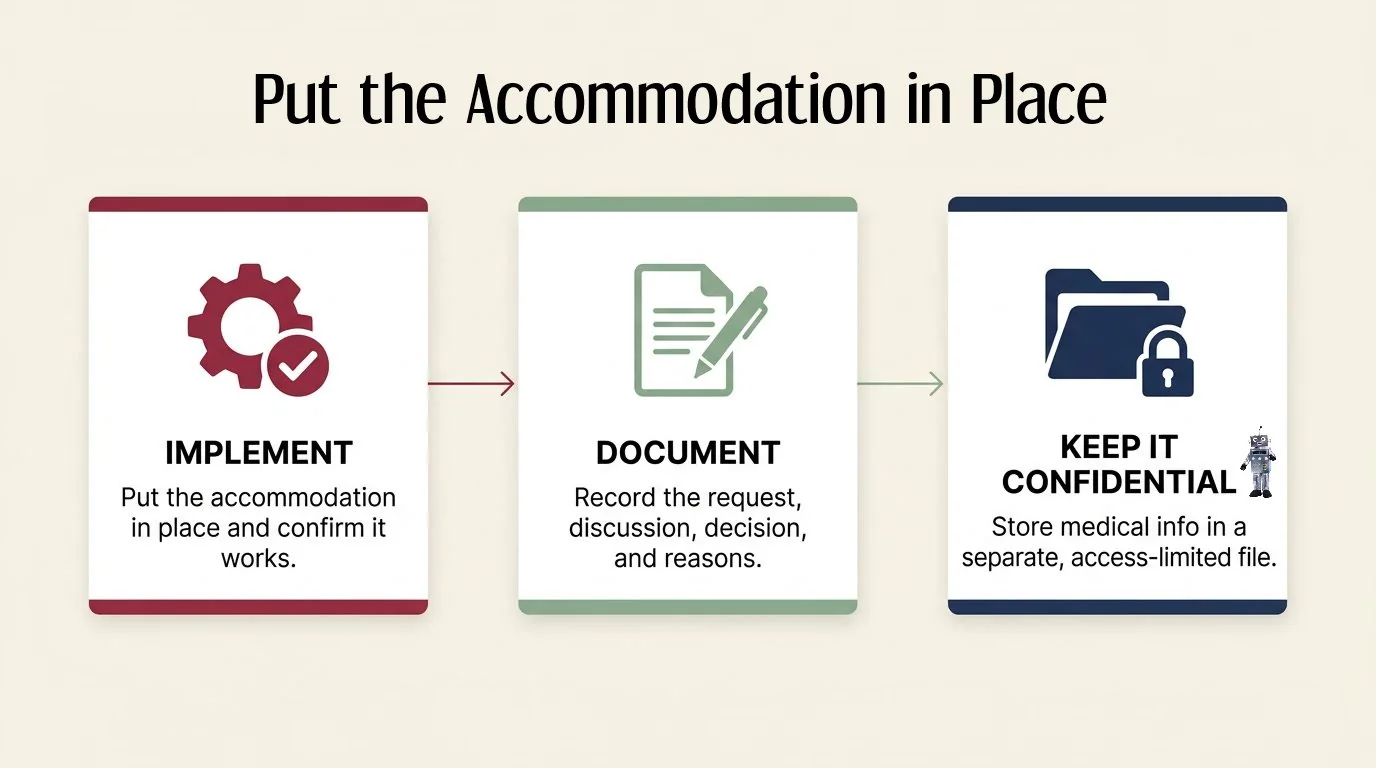
- Implement, Document, and Keep Medical Info Confidential: Put the accommodation in place, confirm it works, and write down the request, the discussion, the decision, and the reasons. Store any medical information in a separate, confidential file (not the general personnel folder) with access limited to those who need it. The record is both your compliance and your defense.
- Train Managers and Guard Against Retaliation: Make sure supervisors know how to spot a request, what they can and can't ask, and to route it correctly. And never punish someone for asking; pulling shifts, cooling toward them, or firing them soon after a request invites a retaliation claim that's often easier to prove than the underlying discrimination.

The ADA in a Small Business
In a small business, the ADA rarely shows up as a dramatic act of discrimination. It shows up as an ordinary moment (an employee mentions a diagnosis, asks to shift their hours, or struggles with a task they used to handle), and what happens next decides whether you've complied or created a problem. You don't have an HR department to catch these or a lawyer down the hall to call, so the outcome depends on whether an owner or manager recognizes the moment for what it is, has a calm conversation, finds something workable, and writes it down. Get those right and even a request you ultimately can't grant is defensible; miss the moment, and a routine ask becomes a charge.
Most Risk Is in the Response, Not the Answer
It's a common misread to think the ADA forces you to say yes to everything. It doesn't. What it requires is a good-faith process and a reasonable result, which means the dangerous move usually isn't a documented "no," it's ignoring the request, delaying for months, or reacting to it by managing the person out. Employers get into trouble far more often for how they handled the conversation than for the substance of the decision. A thoughtful "here's what we can do instead" is a strong position; silence or retaliation is a weak one.
Recognize a Request Even Without the Word "Accommodation"
Employees almost never cite the statute. They say they're having a hard time because of a condition, or ask for a change that happens to be tied to one. The law puts the burden on you to recognize that as a request and respond, not on the employee to phrase it correctly. So treat any time a medical issue and a work difficulty come up together as the trigger to start the process, and make sure your front-line managers know to do the same rather than waving it off.
The Interactive Process Is a Conversation, Not a Form
The heart of ADA compliance is a back-and-forth: the employee describes the limitation, you talk through what would help, you ask for only the medical documentation you actually need, and together you land on something that works. It doesn't require an enterprise system or perfect legal language; it requires that you engage, promptly and in good faith, and don't let a request sit. The free, federally funded Job Accommodation Network will even talk through options with you at no cost.
Keep Medical Information Confidential and Separate
Anything you learn about an employee's condition is confidential and has to live in a separate medical file, not the personnel folder, with access limited to those who genuinely need it. This trips up small businesses where one person handles everything and files tend to pile into a single drawer. Treating medical information as need-to-know, and saying nothing to coworkers beyond what's operationally necessary, is both a legal duty and a matter of basic dignity.
Documentation Is What Protects You
"We tried to help" tells an investigator nothing; a dated record tells them everything. The request, the conversation, the documentation you reviewed, the options you weighed, the decision and why: that file is the difference between a process you can show and one you have to reconstruct from memory. In a small business this is the piece most likely to be skipped, and it's the easiest piece to hand to an HR or PEO partner whose job is to keep it clean and current.

Americans with Disabilities Act Definition
The Americans with Disabilities Act of 1990 is a federal civil-rights law that prohibits discrimination against people with disabilities. Its employment provisions, known as Title I, make it unlawful for a covered employer to discriminate against a qualified individual with a disability and require employers to provide reasonable accommodations unless doing so would impose an undue hardship. For a small business, the ADA isn't an abstract policy; it's the framework that governs how you hire, what you can ask, and how you respond when an existing employee needs an adjustment to keep doing their job. Note that this article addresses Title I (employment); the ADA also covers public accommodations and government services under other titles. This is general information, not legal advice, and some rules vary by state, so confirm the specifics for yours.
Who and What the ADA Covers
- Covered Employer: Title I applies to private employers (and state and local governments) with 15 or more employees. The count includes full- and part-time workers across the calendar year. State disability laws often reach smaller employers, so being under 15 doesn't always mean you're outside the rules.
- Disability: A physical or mental impairment that substantially limits a major life activity (such as seeing, hearing, walking, concentrating, or working), or a record of such an impairment, or being regarded as having one. Since the 2008 ADA Amendments Act, this definition is read broadly, in favor of coverage, so the focus is meant to be on accommodation rather than on debating whether a condition "counts."
- Qualified Individual: Someone who meets the job's requirements (skills, experience, licenses) and can perform its essential functions with or without a reasonable accommodation. The ADA protects qualified individuals; it doesn't require keeping someone who can't do the core job even with help.
- Essential Functions: The fundamental duties a job exists to perform, as opposed to marginal tasks. Whether someone is qualified, and what an accommodation must enable, both turn on this distinction, which is why clear, current job descriptions matter so much.
Key Terms
- Reasonable Accommodation: A change to the job, the workplace, or how things are usually done that lets a qualified person with a disability perform the role or enjoy equal employment benefits, from a modified schedule to assistive technology to leave or reassignment.
- Undue Hardship: The legal limit on accommodation: significant difficulty or expense relative to the employer's size and resources. It's a high bar and a case-by-case judgment, not a label for any cost or inconvenience.
- Interactive Process: The good-faith, back-and-forth dialogue between employer and employee to identify the limitation and an effective accommodation. The law doesn't mandate a specific form, but failing to engage at all is itself a frequent basis for liability.
- Direct Threat: A narrow defense for declining to employ or accommodate when a person poses a significant risk of substantial harm to health or safety that accommodation can't reduce, based on objective evidence, not stereotype or fear.
Overview of Related Topics
- Step-by-Step Guide to ADA Compliance: A practical process, from knowing whether you're covered, through recognizing a request and running the interactive process, to implementing, documenting, and keeping medical information confidential, sized for a team without an HR department.
- Common Reasonable Accommodations: The adjustments small businesses actually face: schedule flexibility, leave, equipment, remote work, modified duties, and reassignment.
- Who Does What: ADA compliance in a small business is carried by a few people: the owner or manager who decides, the supervisor who fields the request, an HR or PEO partner who supplies process and compliance, and an employment attorney for the hard cases.
- Compliance Considerations: The 15-employee threshold, the broad post-ADAAA definition, EEOC enforcement, confidentiality of medical records, limits on disability inquiries and exams, and the overlap with FMLA, the Pregnant Workers Fairness Act, workers' comp, and state law.
- Measuring Effectiveness: A few simple signals (were requests logged, was the process run and documented, were medical records kept separate, were claims avoided) that tell you whether your approach is working.

Topics
Common Reasonable Accommodations
- Schedule & Leave Flexibility: Adjusted start times, modified shifts, breaks for treatment, or a finite leave of absence. Often the simplest fix and frequently free, and useful for conditions tied to medical appointments, fatigue, or recovery.
- Equipment & Assistive Technology: Ergonomic furniture, screen-reading or voice-to-text software, amplified phones, magnifiers, or specialized tools. Many are inexpensive one-time purchases, and built-in accessibility features in software you already own often do the job.
- Remote or Modified Work Location: Working from home, moving a workstation away from a trigger, or a quieter space. Whether remote work is reasonable depends on the job's essential functions, but it's an increasingly common and low-cost option.
- Job Restructuring & Modified Duties: Reallocating marginal (non-essential) tasks, adjusting how a duty is performed, or providing additional training. You're not required to remove essential functions, but you can reshape the rest.
- Reassignment to a Vacant Position: When no accommodation lets the person do their current job, reassignment to an existing vacancy they're qualified for is the accommodation of last resort. You don't have to create a new role or bump another employee.
- Policy Adjustments: Modifying a rule (a no-food-at-desk policy for a diabetic employee, a uniform requirement, a fixed-seating arrangement) where the modification doesn't undermine a legitimate business need.
Who Does What
- Owner / Manager: Makes the call on accommodations and undue hardship, checks it against the law and the job's essential functions, and owns the outcome. In a small business this one person carries decisions a large company would split across a manager, an HR business partner, and a legal team.
- Direct Supervisor: Usually the first to hear a request and the one who has to recognize it as one, respond without overstepping, and route it correctly, while never punishing the person for asking. Their training is often the weakest link and the easiest to fix.
- HR / PEO Partner: Supplies the process and compliance layer: request and interactive-process templates, confidential medical recordkeeping, guidance on reasonableness and undue hardship, manager training, and state-law overlays. It is the specialist knowledge a small company can't justify hiring full-time.
- Employment Attorney: Brought in for the harder cases: a contested undue-hardship denial, a direct-threat or safety question, a request tangled up with leave or a possible termination, or anything likely to be challenged. Cheaper before the decision than after a charge.
- Employee & Their Provider: The employee initiates the request and participates in good faith; their medical provider supplies the limited documentation needed to confirm the condition and the need. The process is a two-way street, and the employee's engagement matters too.
Regulatory & Compliance Considerations
- Coverage & the EEOC: Title I applies at 15+ employees and is enforced by the U.S. Equal Employment Opportunity Commission. Employees generally have 180 days (300 in many states with their own agency) to file a charge, and the EEOC investigates, may attempt conciliation, and can sue. The ADA is one of the two statutes behind the largest share of EEOC lawsuits.
- Broad Definition (ADAAA): The 2008 amendments direct that "disability" be construed broadly in favor of coverage, which means employers should generally skip the debate over whether a condition qualifies and move to the accommodation question instead.
- Disability Inquiries & Medical Exams: No disability questions or required medical exams before a job offer; post-offer exams only if required of everyone in the job category; and during employment, inquiries must be job-related and consistent with business necessity. Genetic information is separately protected under GINA.
- Confidentiality: Medical information must be kept in a separate, confidential file with limited access. This applies even to a one-person back office where everything otherwise lives in a single folder.
- Overlap With Other Laws: A single situation can implicate the ADA, the FMLA (job-protected leave at 50+ employees), the Pregnant Workers Fairness Act (accommodations for pregnancy and related conditions), workers' compensation, and stricter state or local disability laws; they don't cancel each other out, so the most protective rule usually governs.
- Retaliation & Interference: It's unlawful to retaliate against someone for requesting an accommodation or asserting ADA rights, or to interfere with those rights, and retaliation is frequently easier to prove than the underlying discrimination claim.
Measuring Effectiveness
- Were Requests Recognized & Logged: Every accommodation request, however informally raised, should be captured and tracked, not lost in a hallway conversation.
- Was the Process Run & Documented: An interactive process opened promptly, options weighed, and a documented outcome for each request. Failure to engage is a leading basis for claims.
- Was Medical Information Kept Separate: Confidential records stored apart from personnel files, access limited: a simple yes/no you can audit.
- Were Claims & Charges Avoided: EEOC charges and disability complaints tracked over time; a clean run is the clearest sign the process is working.

The Interactive Process: A Reasonable-Accommodation Roadmap
The interactive process is the part of the ADA that most often decides whether an employer is compliant, and it's the part small businesses are least sure how to run. It isn't a legal form or a software system; it's a structured, good-faith conversation that moves from "an employee is struggling" to "here's what we'll do, and here's why." The roadmap below lays out that conversation step by step so you can follow it the moment a request lands, rather than improvising under pressure. It takes the guesswork out of the highest-risk ADA situation a small business faces and gives you a record you can stand behind afterward.
A request comes in (in any words)
An employee links a work difficulty to a medical condition, or asks for a change that's tied to one. They don't need to say "ADA" or "accommodation." Treat it as the start of the process and respond promptly; don't let it sit.
Confirm there's a covered need
Is there an impairment that limits a major life activity, and a connection to the job? If it isn't obvious, you may ask for limited medical documentation confirming the condition and the need, but only what's necessary, not the full medical history.
Identify the essential functions
Pin down the core duties the role exists to perform, using the job description and how the work is actually done. The accommodation has to make these possible; it doesn't have to remove them.
Explore options together
Talk through what would help: schedule change, equipment, remote work, modified duties, leave, reassignment. Consider the employee's preference, but you may choose among options that are equally effective. The free Job Accommodation Network can suggest ideas at no cost.
Is there an effective, reasonable option?
Weigh each option against the limit: would it cause significant difficulty or expense relative to your size and resources, a real undue hardship rather than mere inconvenience?
Implement and check that it works
Put the accommodation in place, tell only those who need to know, and follow up to confirm it's actually doing the job. Adjust if it isn't; the process can reopen as conditions change.
Document and store medical info confidentially
Write down the request, the conversation, the documentation reviewed, the options weighed, and the decision with its reasons. Keep any medical information in a separate, confidential file with limited access.
Where the Roadmap Saves a Small Business
The value of following these steps is the same as the value of any checklist for a rare, high-stakes task: it forces the right questions in the right order before pressure or emotion takes over. It also tells you where to spend money: most requests run start to finish without any outside help, while a contested undue-hardship denial, a direct-threat safety question, or a request that's bound up with a possible termination is worth an employment attorney's time before you act. Keep the completed record with the employee's confidential file.

ADA Compliance Checklist
Use this checklist as the backbone of ADA compliance, both for setting up your basics and for handling each request as it comes. Adapt it to your business and your state's rules, but keep every item something you can mark done or not done. None of it requires a big system; a shared document and a separate, locked medical file will do, and an HR or PEO partner can handle the templates, recordkeeping, and training if you'd rather not.
Policies & Setup
- Job descriptions written with essential functions clearly separated from marginal tasks.
- Interviewers and managers trained on what they can and can't ask before a job offer.
- A simple way to receive and log accommodation requests, however informally they're raised.
- A separate, confidential medical file set up, apart from personnel records, with limited access.
- A written reasonable-accommodation and anti-retaliation policy employees can see.
When a Request Comes In
- The request recognized and acknowledged promptly, with no waiting it out.
- The limitation and the connection to the job identified; only necessary medical documentation requested.
- The interactive process opened in good faith, with the conversation noted.
- Accommodation options explored: schedule, equipment, remote work, modified duties, leave, reassignment.
- The Job Accommodation Network or an HR/PEO partner consulted if you're unsure of options.
Deciding & Implementing
- An effective accommodation selected, or a reasoned undue-hardship denial with the cost and alternatives documented.
- The decision communicated to the employee; only those who need to know informed.
- The accommodation put in place and checked to confirm it works.
- The request, conversation, documentation, and decision recorded with dates.
- No adverse action taken against the employee for having asked.
Ongoing
- Accommodations revisited if the job or the employee's condition changes.
- Medical records kept confidential and retained for the required period.
- Managers refreshed periodically on recognizing requests and avoiding retaliation.
- Overlap with FMLA, the Pregnant Workers Fairness Act, workers' comp, and state law checked on complex cases.

Statistics & Outlook
Disability is one of the busiest corners of employment law, and the numbers make the case for handling it deliberately. The U.S. Equal Employment Opportunity Commission reported securing roughly $660 million for about 17,680 workers in fiscal year 2025, the bulk of it before any lawsuit was filed. Disability remains among the most frequently filed charge categories year after year, and in the EEOC's own FY 2025 litigation, disability was the second most common basis behind sex and pregnancy, while failure to provide a reasonable accommodation was the second most commonly asserted issue. The vast majority of the agency's lawsuits are brought under just two statutes (Title VII and the ADA), which tells a small employer where the enforcement attention actually goes.
The encouraging counterpoint is cost. Data compiled for the U.S. Department of Labor's Office of Disability Employment Policy by the Job Accommodation Network consistently finds that most workplace accommodations are inexpensive, and that those carrying a one-time cost run only a few hundred dollars on average, with a median around $300. In other words, the thing employers most fear about the ADA, the expense, is low, while the thing that actually generates claims (failing to engage with a request, mishandling the process, or retaliating) is inexpensive to avoid. For a small business the takeaway is that ADA risk is concentrated and manageable: recognize the request, run a real interactive process, keep medical information confidential, and document it, with an HR or PEO partner supplying the process and recordkeeping if you don't have it in-house.
Verified Sources
- U.S. Equal Employment Opportunity Commission (EEOC) Employer Coverage: Title I of the ADA applies to employers with 15 or more employees and prohibits discrimination against a qualified individual with a disability. (eeoc.gov)
- U.S. Equal Employment Opportunity Commission (FY 2025 Results): The EEOC secured approximately $660 million for about 17,680 workers in FY 2025; disability was the second most common basis and reasonable accommodation the second most asserted issue in the agency's FY 2025 litigation. (eeoc.gov)
- EEOC Disability Discrimination & Reasonable Accommodation: Employers must provide reasonable accommodation to a qualified individual with a disability unless it would cause an undue hardship; medical information must be kept confidential. (eeoc.gov)
- Job Accommodation Network / U.S. DOL Office of Disability Employment Policy: A majority of workplace accommodations cost employers nothing, and those with a one-time cost carry a median expense of about $300. (askjan.org)

Technology & Tools for ADA Compliance
You Don't Need an Enterprise HR Platform
Large companies run accommodations through case-management systems wired into HRIS, leave administration, and legal. A small business doesn't need to buy or run any of that. What you need is a way to capture each request, a repeatable interactive-process workflow, a confidential place to store medical information, and current job descriptions, and you can get all four without enterprise software. The most common path for a small business is a simple set of templates plus a compliance and recordkeeping platform provided through an HR or PEO partner, which comes pre-loaded with the right forms and state-specific rules.
Simple Tools That Do the Job
For most of this, the tools you already have are enough. A request log (even a shared spreadsheet) makes sure no accommodation request gets lost. A short interactive-process template keeps each conversation consistent and documented. A separate, locked or access-restricted medical file keeps you on the right side of the confidentiality rule. And the Job Accommodation Network (askjan.org) is a free, federally funded service that will help you think through options for almost any condition at no cost, often the single most useful "tool" a small employer can reach for.
Keep Records Audit-Ready
ADA situations generate paperwork that matters precisely when they're challenged: the request, the interactive-process notes, the documentation you reviewed, the decision and its reasons, the confidential medical file. For a small business the danger isn't the wrong system; it's letting these slip until an EEOC charge makes them urgent. Date-stamped electronic records, with medical information stored separately, solve most of it, and an HR or PEO partner's platform typically handles retention and access controls automatically, which is much of the value for a company without an HR staffer to chase it.
Where AI Can Help a Small Team
AI tools have made it inexpensive to do work that used to need a specialist. You can use them to draft a job description with clearly separated essential functions, turn rough notes into a clean interactive-process summary, brainstorm accommodation options for a given limitation, or produce a first-draft accommodation or denial letter. That lets a busy owner generate the kind of written record that used to require an outside consultant. Just keep a human who knows the situation and the law reviewing anything AI produces, and never feed confidential medical details into a tool that doesn't protect them.
What to Prioritize
If you only fix a few things, fix these: a reliable way to recognize and log requests so none gets ignored, a simple interactive-process template so every conversation is run and documented, and a separate confidential medical file. Skip the temptation to buy a complex HR suite you won't fully use. A small business is far better served by good templates, a consistent process, the free help of JAN, and an HR partner for the compliance heavy lifting than by an enterprise platform no one has time to administer.

Key Performance Indicators (KPIs)
If you handle accommodation requests but never check whether you're handling them well, you're guessing, and the ADA is one area where guessing is expensive. The good news for a small business is that you don't need a dashboard or an analyst; you need a short list of honest signals you can glance at a few times a year. The handful below connects the process to what you care about: staying compliant, treating people fairly, and avoiding claims. Track these and you'll know what's working without drowning in metrics.
A Few Metrics Worth Tracking
| What to Track | How to Read It | Target |
|---|---|---|
| Requests Logged | Accommodation requests captured, however informally raised | 100%; no request should be lost in a hallway conversation |
| Interactive Process Run | Requests with a documented good-faith process and a recorded outcome | 100%; failure to engage is a leading basis for claims |
| Time to First Response | Days from request to the start of the conversation | As short as practical; days, not weeks |
| Accommodations Provided | Requests granted vs. denied with a documented undue-hardship reason | Most granted; every denial reasoned and recorded |
| Medical Info Separated | Medical records stored apart from personnel files, access limited | 100%; a confidentiality requirement, not a preference |
| Claims & Charges | EEOC charges and disability complaints over time | Zero, or a downward trend as the process matures |
Look at these a few times a year, more often for the response-time and logging items, less often for the rest. You don't need to model anything; for a small business a quick review is enough to tell you whether your accommodations are being handled consistently. If pulling even these together feels like one more thing you don't have time for, it's exactly the kind of tracking an HR or PEO partner's platform handles in the background.

Frequently Asked Questions
What does the ADA require employers to do?
It requires covered employers not to discriminate against a qualified person with a disability, to provide a reasonable accommodation unless it's a genuine undue hardship, to engage in a good-faith interactive process when an accommodation is needed, and to keep medical information confidential.
In plain terms, the ADA's employment rules ask you to do two things well: make job decisions based on ability rather than disability, and respond constructively when an employee needs an adjustment to do their job. That means writing jobs around their essential functions, avoiding disability questions before a job offer, and treating any request for help, in whatever words, as the start of a conversation about what would work.
The part small businesses most often miss is that the obligation is about process as much as outcome. You don't have to grant every request, but you do have to engage, weigh real options, and document the decision, and you can never retaliate against someone for asking. If recognizing requests, running the process, and keeping the records is your bottleneck, that's exactly where an HR or PEO partner earns its keep.
How many employees do you need before the ADA applies?
The ADA's employment provisions (Title I) apply to private employers with 15 or more employees, counted across full- and part-time staff over the year. Many states have their own disability laws that reach smaller employers, so being under 15 doesn't always mean you're exempt.
The 15-employee threshold is the federal trigger, and it's measured by headcount across the calendar weeks of the year, not by full-time-equivalents. If you're hovering around that line as you grow, the safest approach is to assume the rules apply and build the basic process now, rather than scramble after a request lands.
State and local law is the bigger catch. A number of states extend disability-discrimination and accommodation duties to employers with far fewer than 15 employees, some to just one. So a small business under the federal threshold may still be fully obligated under its own state's law. Confirming your state's rule is the one step that keeps "we're too small for the ADA" from becoming a costly assumption.
Do I have to grant every accommodation request?
No. You must provide a reasonable accommodation that lets a qualified person perform the job's essential functions unless doing so would be an undue hardship, meaning significant difficulty or expense relative to your size and resources. You can also choose among options that are equally effective.
"Reasonable" doesn't mean "whatever the employee prefers." If two accommodations would both let the person do the essential functions, you may pick the one that works better for the business. What you can't do is refuse to provide anything effective, or remove an essential function of the job, which the ADA doesn't require.
Undue hardship is a real limit, but a high one; it's significant difficulty or expense weighed against your specific resources, not mere cost or inconvenience, and most accommodations turn out to be free or inexpensive. If you do deny on undue-hardship grounds, document the cost or disruption and the alternatives you considered. A reasoned, recorded "no" is defensible; an unexplained one is where claims begin.
Can I ask a job applicant or employee about a disability or medical condition?
Before a job offer, no; you can't ask about disabilities or require a medical exam. You can ask whether someone can perform the job's functions. After an offer you can require a medical exam only if you require it of everyone in that job category, and during employment, inquiries must be job-related and consistent with business necessity.
The pre-offer line is strict and easy to cross in a friendly interview. You may describe the job's duties and ask whether the candidate can perform them, with or without accommodation, and you may ask them to demonstrate how, but not whether they have a condition or how severe it is. Training everyone who interviews on this distinction prevents one of the most common ADA missteps.
Once someone is employed, you can ask for limited medical documentation when they request an accommodation, or make job-related inquiries supported by business necessity, but only what's necessary, never a sweep of their full medical history. Whatever you learn is confidential and has to be stored in a separate medical file with restricted access, even in a one-person back office.
How do you reduce the risk of an ADA claim?
Recognize a request even without the word "accommodation," respond promptly with a good-faith interactive process, weigh real options, keep medical information confidential, never retaliate for asking, and document the whole thing.
Most ADA claims aren't won on the substance of a hard accommodation decision; they're won on a failure to engage. An ignored request, a months-long silence, or a firing that lands soon after someone asks for help is what gives a claim its legs. So the defense is built in the response: treat the request seriously, open the conversation quickly, and keep it going in good faith.
For anything contested (a possible undue-hardship denial, a safety or direct-threat question, or a request tangled up with leave or a possible termination), get HR or an employment attorney involved before you act, not after a charge. The cost of an hour of review is trivial next to the cost of defending a decision you rushed, and a consistent, documented process is what keeps a lawful decision from looking like an unlawful one.
Key Takeaways
ADA compliance is within reach of any small business; it takes a habit of recognizing requests and a willingness to have a conversation, not an HR department. Once you hit 15 employees the same duties apply to a team of 15 as to one of 1,500, and the downside arguably matters more when one mishandled request can pull a small company into a charge it can't easily absorb. Many states extend these rules to even smaller employers, so don't assume you're exempt.
Keep it simple and deliberate: build jobs around essential functions, keep hiring disability-blind until the offer, treat any work-plus-medical difficulty as a request, run a prompt good-faith interactive process, provide a reasonable accommodation unless it's a true undue hardship, keep medical information confidential, and never retaliate for asking. Most accommodations cost little, and the failures that generate claims cost little to avoid.
You don't have to build the infrastructure yourself. An HR or PEO partner can supply request and interactive-process templates, confidential recordkeeping, manager training, and state-law guidance, giving a small business the protection and consistency of a much larger one without the overhead of staffing for it. And the federally funded Job Accommodation Network will help you think through options for free.