

What Is a Pulse Survey?
Quick Answer
A pulse survey is a short, recurring employee survey, usually 5 to 15 questions that take just a few minutes to answer, sent on a regular cadence to take a fast read on engagement, morale, and sentiment. The name is the idea: instead of one big annual check-up, you take the team's "pulse" often enough to feel changes as they happen. Here's the core distinction that trips people up: an annual engagement survey is a deep, once-a-year snapshot of where you stand and why; a pulse survey is a quick, frequent reading that tells you whether things are getting better or worse right now. One measures the level; the other measures the trend. Pulse surveys typically run weekly, monthly, or quarterly, stay anonymous to encourage honesty, and often track a few standard measures over time: an engagement score, a favorability rating, or eNPS (how likely employees are to recommend the company as a place to work). Why it matters for a small business: a pulse survey is one of the cheapest early-warning systems you can run. A simmering problem (a frustrated team, a manager who's lost the room, a new policy that landed badly) shows up in a monthly pulse weeks before it shows up in turnover. But there's a catch that sinks most pulse programs: the survey is worthless if nobody acts on it. Employees stop answering surveys that disappear into a void. The discipline that makes pulse surveys work (running them on a steady schedule, protecting anonymity, and closing the loop by telling people what changed) is exactly the kind of recurring process a small business tends to let slip, and the kind an HR or PEO partner can set up and keep running.

Pulse Surveys Defined
A pulse survey is a brief, repeatable questionnaire designed to measure how employees are feeling about work at a single moment, and, because it repeats, to reveal how that feeling is changing over time. The power isn't in any one survey; it's in the rhythm. A single pulse tells you where the team is this week; a year of monthly pulses tells you the direction you're heading and whether the changes you've made are actually working. The format is deliberately small so that answering it never feels like a chore, which is what keeps people responding month after month. This is general HR guidance on a listening practice, not a rigid formula, so adapt the cadence and questions to your business.
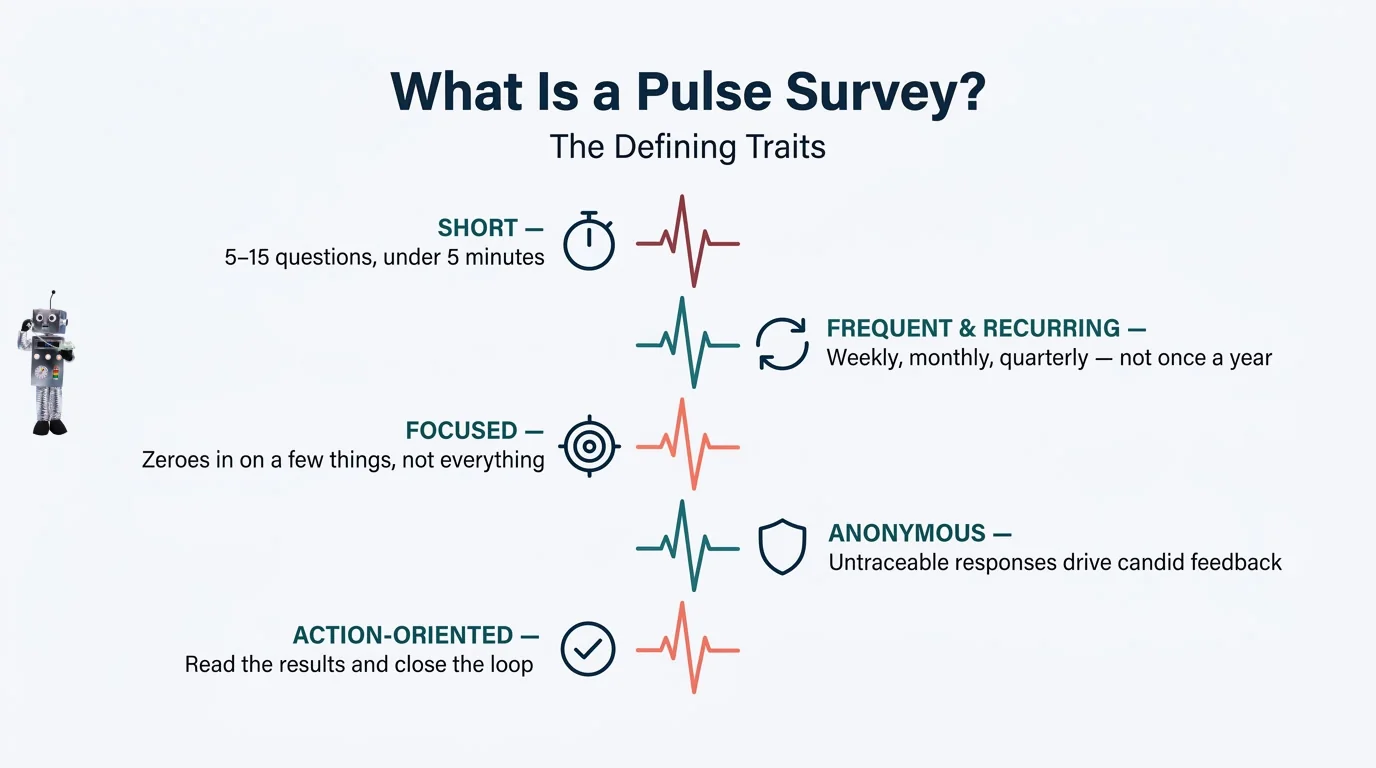
The Defining Traits
- Short: Most pulse surveys run 5 to 15 questions and close in under five minutes. The brevity is a feature; it lowers the cost of answering and keeps response rates high.
- Frequent & recurring: They run on a set cadence (weekly, bi-weekly, monthly, or quarterly) rather than once a year. Repetition is what turns isolated answers into a trend line.
- Focused: A pulse zeroes in on a few things (current engagement, a recent change, a specific initiative) instead of trying to measure everything at once.
- Anonymous: Honest answers depend on people trusting that their responses can't be traced back to them. Anonymity is the single biggest driver of candid feedback.
- Action-oriented: A pulse survey is only half the process. The other half is reading the results and doing something visible about them, which is what HR teams call "closing the loop."
Key Terms
- Engagement: The level of commitment and enthusiasm an employee has for their work. Most pulse surveys are built primarily to track it.
- eNPS (Employee Net Promoter Score): A single-question measure ("How likely are you to recommend us as a place to work?") scored from -100 to +100. A popular, easy-to-track pulse metric.
- Favorability Score: The percentage of respondents who answered a question positively. A simple way to summarize sentiment on any single item.
- Participation Rate: The share of invited employees who answered at least one question, the first signal of whether people find the survey worth their time.
- Closing the Loop: Telling employees what you heard and what you'll do about it. The step that separates a listening program from a checkbox exercise.
- Survey Fatigue: The drop in participation that sets in when people feel over-surveyed, usually caused less by frequency than by never seeing anything change.
Overview of Related Topics
- Running a Pulse Survey Step by Step: The method for going from "we should ask the team" to a survey people actually complete.
- Sample Questions: What good pulse survey questions look like across engagement, management, wellbeing, and recent change.
- The Pulse Survey Cycle: Launching a survey is the easy part; analyzing, acting, and following up is where results come from.
- Pulse vs. Annual Surveys: How the two listening tools differ and why most companies eventually run both.
- Common Mistakes: The handful of errors that quietly turn a pulse program into noise employees ignore.

Pulse Surveys in a Small Business
Big companies have people analytics teams, engagement platforms, and managers whose job includes watching morale. A small business has none of that, which is exactly why a simple, repeatable listening habit matters more, not less. In a 20-person company, the owner can't be everywhere, and the cost of finding out about a problem too late is proportionally higher: one unhappy key employee walking out can hurt far more than it would at a company of 2,000. A pulse survey gives a small team an early-warning system without the overhead. Here's where it earns its keep.
A Cheap Early-Warning System
Turnover is expensive and usually preventable, but only if you see it coming. A monthly pulse catches the dip in morale, the manager friction, or the policy that landed badly weeks before someone updates their resume. For a small business, that lead time is the difference between a conversation and a resignation. The survey itself costs almost nothing; the value is in acting early.
Honest Feedback the Owner Won't Hear Otherwise
In a small shop, people are often reluctant to bring problems straight to the owner, the person who signs their checks. An anonymous pulse survey creates a safe channel for the feedback that never comes up in the hallway. It surfaces the quiet concerns that, left unspoken, slowly curdle into disengagement.
Structure a Small Team Usually Lacks
Most small businesses "check in informally," which means they check in inconsistently and forget what they heard last time. A pulse survey replaces vibes with a trend line: the same few questions, asked on a schedule, tracked over time. That turns "I think morale is fine" into something you can actually see and manage.
The Part That Tends to Slip
Running the survey is easy; running the loop is hard. Analyzing results, deciding what to do, telling the team what changed, and keeping the cadence steady month after month are real, recurring work, and it's the first thing to fall off a busy owner's plate. That ongoing discipline is exactly the kind of structure an HR or PEO partner can install and maintain, giving a small company a real employee-listening program without hiring a full HR department to run it.

Step-by-Step Guide: How to Run a Pulse Survey
Running a pulse survey is less about the questionnaire and more about the loop around it. Here's the sequence that takes you from "we should ask the team" to a survey people trust and answer, and that actually changes something.
- Define What You Want to Learn: Decide the one or two things this survey is for: general engagement, a recent reorganization, a new manager, return-to-office sentiment. A pulse that tries to measure everything measures nothing. Clarity here shapes every question that follows.
- Write a Short, Focused Question Set: Keep it to roughly 5 to 15 questions, mostly rating-scale items you can track over time, plus one open-ended box for context. Hold the bulk of your questions steady from cycle to cycle so you can compare results; change only a small portion to probe whatever's current.
- Choose Your Cadence: Match frequency to question count and to your capacity to act. Weekly or bi-weekly suits 3-5 questions for fast-moving teams; monthly works well with 5-10; quarterly can carry 15-20. Pick a rhythm you can sustain, then hold to it.
- Protect Anonymity and Say So: Collect no names or identifying data, and don't report results for any group too small to stay anonymous. State the confidentiality promise inside the survey itself, not just the invitation, because that promise is what buys you honest answers.
- Distribute the Survey: Send it through whatever your team actually uses: email, Slack or Teams, a survey tool, even a kiosk for frontline staff. Make it work on a phone. Give a clear, short window to respond and send one friendly reminder before it closes.
- Analyze the Results: Look at the trend, not just the snapshot: how did this month compare to last? Segment by team, location, or tenure before drawing conclusions, since a company-wide average hides the group that needs attention most. Read the open-text comments; that's where the "why" lives.
- Act on What You Learn: Pick one or two things you can realistically change and do them. You don't have to fix everything; visible action on a single issue does more for trust than a long plan that never ships.
- Close the Loop: Tell the team what you heard and what you're doing about it, ideally within a couple of weeks of the survey closing. This is the step most programs skip and the single biggest reason people keep, or stop, participating. Then run the next cycle and watch the line move.

Sample Pulse Survey Questions
Good pulse questions are short, specific, and answerable on a simple scale; most use a 1-to-5 agreement scale ("Strongly disagree" to "Strongly agree") so you can track a number over time. Below are examples grouped by what they measure. You won't use all of them at once; pick a handful that fit this cycle's purpose, keep most of them consistent month to month, and pair the rating items with one open-text question for context.
Engagement & Motivation
- I feel motivated to do my best work most days.
- I would recommend this company as a great place to work. (the eNPS question)
- I rarely think about looking for a job at another company.
Manager & Recognition
- My manager gives me useful feedback on my work.
- Someone at work seems to care about me as a person.
- In the last week, I've received recognition for good work.
Role Clarity & Growth
- I know what's expected of me at work.
- I have opportunities here to learn and grow.
- I have the tools and resources I need to do my job well.
Wellbeing & Workload
- My workload is manageable.
- I'm able to maintain a healthy balance between work and personal life.
- I feel comfortable taking time off when I need it.
Trust & Communication
- Leadership keeps people informed about what's going on.
- I trust the leaders of this company to do the right thing.
- I feel safe speaking up when I disagree.
Open-Ended (Always Include One)
- What's one thing we could do to make this a better place to work?
- What's working well right now that we should keep doing?
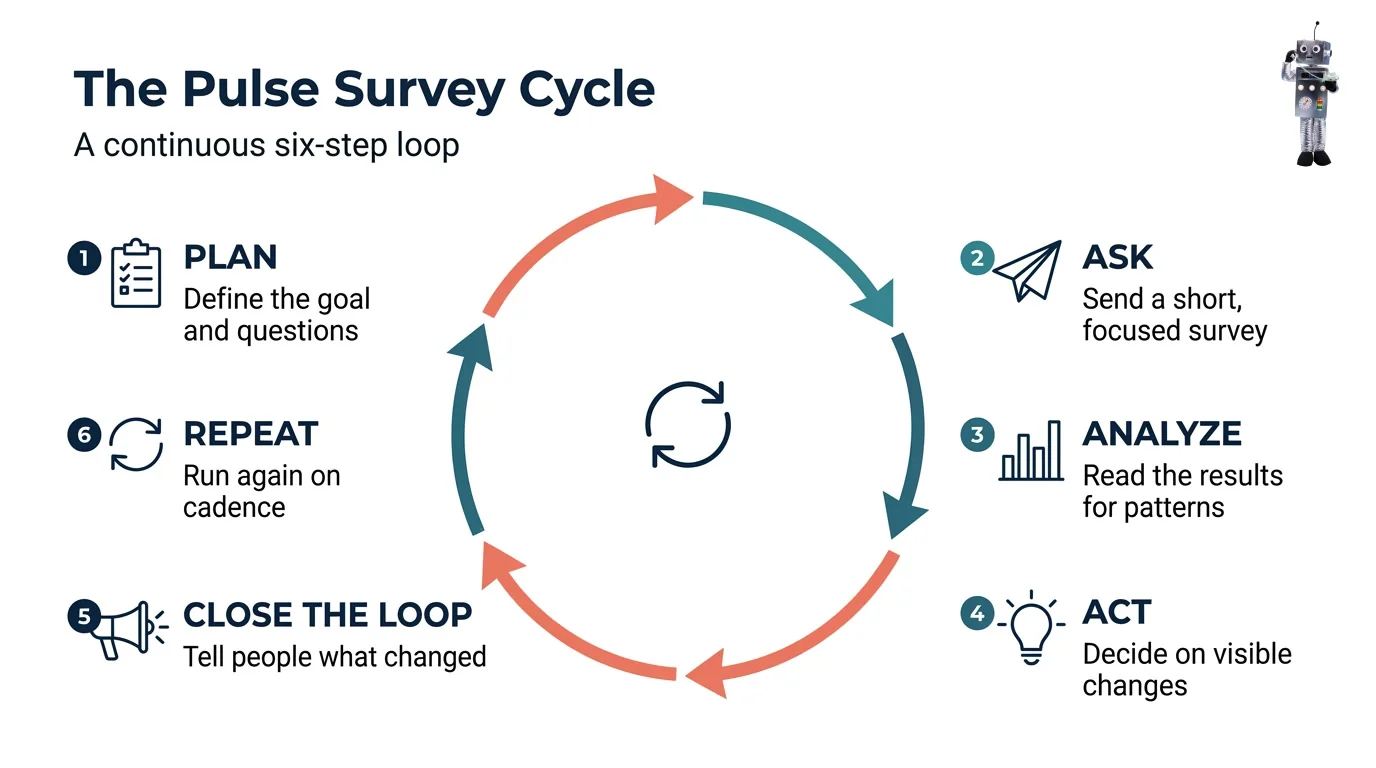

The Pulse Survey Cycle: A Roadmap
A pulse survey isn't an event; it's a loop. Sending the survey is the beginning, not the end, and a pulse that's collected but never acted on does more harm than good, because it quietly teaches people that answering is a waste of time. Walking every survey through the same cycle is what builds the trust that keeps participation high and turns feedback into change.
1. Plan
Decide what this cycle is for, choose the questions, and set the cadence. Keep most questions consistent with prior cycles so you can compare, and add a small number tied to whatever's current. A clear purpose up front is what keeps the survey short and focused.
2. Ask
Distribute the survey, reaffirm anonymity inside it, and give a short, defined window to respond. Send one reminder. Make participating effortless; the easier it is to answer, the more honest and complete your data will be.
3. Analyze
Read the trend against previous cycles, segment before you generalize, and dig into the open-text comments for the "why" behind the numbers. The goal is one or two clear, actionable findings, not a forty-slide deck nobody reads.
4. Act
Choose something you can actually change and change it. Small, visible action beats an ambitious plan that never ships. This is the step that converts a survey from data collection into management.
5. Close the Loop
Tell the whole team what you heard and what you're doing, even when the news is uncomfortable. Sharing results promptly is the strongest predictor of whether people keep responding. Silence after a survey is how trust dies.
6. Repeat
Run the next cycle on schedule and watch whether the line moves. The trend is the whole point. For a small business, keeping that loop turning month after month is the part most likely to slip, and exactly the recurring discipline an HR or PEO partner can help install and keep running.

Pulse Survey Best-Practices Checklist
Use this as a quick self-audit before, during, and after each cycle. This isn't legal compliance (there's no rulebook that governs pulse surveys), but a few of these items protect employee privacy and trust, and skipping them is how good intentions turn into a program people stop trusting. None of it is complicated; the discipline is doing it every time.
Before You Send
- The survey has a clear purpose, and the questions actually measure it.
- It's short enough to finish in a few minutes.
- Most questions are consistent with prior cycles so you can track trends.
- You've decided in advance what you'll do with the results, including who reviews them and how fast.
Protecting Trust
- No names or identifying data are collected.
- Results are never reported for groups too small to stay anonymous (a common threshold is five or more respondents).
- The anonymity promise is stated inside the survey, not just the invite.
- Questions avoid health, protected characteristics, and anything that could create legal or privacy exposure.
After It Closes
- You segmented the results before drawing conclusions.
- You acted on at least one finding.
- You closed the loop with the whole team, promptly, typically within two weeks.
- The next cycle is already on the calendar.

Statistics & Outlook
The numbers explain why employee listening has become a priority, and why so many companies have shifted from one annual survey to continuous pulse checks. A few figures worth knowing (these change over time, so treat them as a snapshot and verify current data before quoting):
Why Listening Matters
- Engagement is low and slipping. Gallup found U.S. employee engagement was about 32% in 2025, down from a 2020 peak near 36%; globally the figure slipped to around 20%. That means most employees aren't fully engaged, and a small business can't afford to guess which of its employees are engaged.
- Disengagement is costly. Gallup estimates low engagement costs the global economy roughly $10 trillion in lost productivity each year, about 9% of global GDP.
- Engagement pays off. Highly engaged teams have been found to be meaningfully more productive and more profitable than disengaged ones, with lower turnover, which is exactly the gap a listening habit helps close.
Pulse Survey Benchmarks
- Participation: Over 50% is a common benchmark for a healthy pulse survey, and above 60% is considered strong. Small companies (under ~100 people) can aim higher, often 75-85%, since reaching everyone is easier on a small team.
- Length & time: Pulse surveys typically run 5-15 questions and close in under five minutes, versus 30-60+ questions and 30-45 minutes for a full annual survey.
- Cadence: Most organizations land on monthly or quarterly. Shorter surveys suit more frequent cadences; longer ones suit quarterly checks.
- Fatigue: Research consistently points to a counterintuitive truth: survey fatigue comes less from how often you ask and more from never showing people what changed.
The Outlook
The clear trend is toward continuous listening: real-time, always-on feedback rather than a single yearly snapshot, increasingly built into the chat and HR tools teams already use. As tools get cheaper and easier, the gap between large and small employers is narrowing: a 25-person company can now run the same kind of listening program that used to require an analytics department. The advantage no longer goes to whoever collects the most feedback, but to whoever acts on it fastest.

Technology & Tools for Pulse Surveys
You can run a perfectly good pulse survey with a free form tool and a spreadsheet, and for a very small team, that's often the right place to start. But dedicated software earns its cost once you're running surveys regularly, because the hard part isn't sending the survey; it's automating the cadence, protecting anonymity, and turning responses into a trend you can read at a glance. Here's the landscape.
What to Look For
- Automated cadence: Schedules surveys and reminders so the rhythm doesn't depend on someone remembering.
- Built-in anonymity: Strips identifying data and enforces minimum group sizes so results can't be traced to individuals.
- Trend dashboards: Shows results over time and lets you segment by team, location, or tenure without exporting to a spreadsheet.
- Where your team already is: Delivery through email, Slack, or Microsoft Teams lifts participation; a mobile-friendly format is essential for frontline staff.
- Comment analysis: Helpful tools group and summarize open-text feedback so the "why" doesn't get lost.
Categories of Tools
- General survey tools: Google Forms, Microsoft Forms, SurveyMonkey, Typeform: cheap and flexible, but you handle cadence, anonymity, and trend tracking yourself.
- Dedicated engagement platforms: Purpose-built for employee listening, with automated pulses, anonymity controls, benchmarks, and dashboards out of the box.
- HR/performance suites: Many broader HR and performance platforms include pulse surveys alongside reviews, goals, and one-on-ones, keeping feedback in one system.
- Chat-native tools: Bots that run quick pulses directly inside Slack or Teams, meeting people where they already work.
The right choice depends on size and budget more than features. A 15-person shop may never outgrow a free form plus a disciplined habit of acting on results; a growing company juggling multiple teams benefits from a platform that automates the loop. Whichever you pick, the tool is the easy part; the value still comes from acting on what you learn. An HR or PEO partner can help select, set up, and run the right option so the technology serves the process rather than becoming another thing to maintain.

Topics
Pulse Survey vs. Annual Engagement Survey
These are the two main employee-listening tools, and they answer different questions. An annual engagement survey is the deep physical: a long, comprehensive questionnaire that tells you where you stand and why, once a year. A pulse survey is the regular check-up: short and frequent, telling you whether anything is changing between those physicals. They're partners, not rivals: the annual survey sets the baseline and diagnoses root causes; the pulse tracks whether your fixes are working. Many companies run both: one annual deep-dive plus monthly or quarterly pulses.
| Feature | Pulse Survey | Annual Engagement Survey |
|---|---|---|
| Length | 5-15 questions, under 5 minutes | 30-60+ questions, 30-45 minutes |
| Frequency | Weekly, monthly, or quarterly | Once a year |
| Best for | Tracking trends and recent changes | Deep, point-in-time diagnosis |
| Speed to act | Days | Weeks to months |
| Question depth | Narrow and focused | Broad and comprehensive |
Anonymity & Trust
Anonymity isn't a nicety; it's the mechanism that makes the data honest. The moment employees suspect a survey can be traced back to them, answers drift toward what's safe to say. Protect it concretely: collect no identifying data, suppress results for groups too small to stay anonymous, and state the promise inside the survey. Break that trust once and participation rarely recovers.
Closing the Loop
The most important part of a pulse survey happens after it closes. Closing the loop means telling people what you heard and what you'll do, and it's the strongest predictor of whether they answer the next one. Teams that see their feedback reflected in real decisions keep participating; teams that hear nothing conclude, correctly, that no one was listening.
Setting the Right Cadence
Cadence is a balance between freshness and fatigue, and it should match your capacity to act. Surveying weekly while acting quarterly just generates data you ignore. A practical rule: don't ask more often than you can respond. For most small businesses, monthly or quarterly hits the balance: frequent enough to catch trends, spaced enough to do something between cycles.
Who Does What
- Owner / Leadership: Champions the program, acts on findings, and visibly closes the loop so the survey carries real weight.
- Managers: Review their team's results, follow up on issues close to the ground, and avoid any hint of policing who said what.
- HR / PEO Partner: Builds the survey, protects anonymity, runs the cadence, analyzes the trend, and keeps the loop turning, the recurring infrastructure a small business rarely has time to maintain itself.

Common Mistakes to Avoid
Most failed pulse programs don't fail because the questions were wrong; they fail on follow-through and trust. These are the errors that quietly turn a promising survey into background noise employees stop answering.
Never Acting on the Results
A survey that vanishes into a void teaches people that answering is pointless, and participation collapses. You don't have to fix everything, but you must do something visible, every cycle. No action, no point.
Skipping the Loop
Even when you do act, failing to tell people erases the credit. If employees can't connect a change to their feedback, as far as they know nothing happened. Always report back what you heard and what you're doing.
Surveying Too Often
Asking weekly while acting quarterly is how you manufacture fatigue. The fix isn't necessarily fewer surveys; it's matching cadence to your real capacity to respond. Don't ask faster than you can act.
Breaking Anonymity
Reporting on a team of three, or hinting that you know who wrote a comment, destroys the trust the whole program runs on. Once people believe responses can be traced, honest answers dry up. Guard anonymity like the asset it is.
Changing the Questions Every Time
If the questions shift each cycle, you can't compare results, and the trend line is the entire value of a pulse survey. Keep the bulk of your questions stable and rotate only a small portion for topical issues.
Drowning in Data, Starving for Decisions
A pretty dashboard isn't the goal. Measuring more than you can act on just creates work and guilt. Pick one or two findings per cycle, act on them, and let the rest inform, not paralyze, you.

Frequently Asked Questions
What is a pulse survey?
A pulse survey is a short, recurring employee survey (usually 5 to 15 questions answered in a few minutes) sent on a regular cadence to measure engagement, morale, and sentiment. Because it repeats, it reveals not just where the team stands but whether things are getting better or worse over time.
The name captures the idea: rather than one big annual check-up, you take the team's pulse often enough to feel changes as they happen. It only works, though, if leaders act on what they learn and tell employees what changed.
How often should you run a pulse survey?
Most organizations run pulse surveys monthly or quarterly, though some fast-moving teams go weekly or bi-weekly. The right cadence matches your capacity to act: there's no point surveying weekly if you only respond once a quarter.
A practical rule is to keep shorter surveys for more frequent cadences and save longer ones for quarterly checks, and to hold whatever schedule you choose consistently, since irregular timing erodes trust.
How is a pulse survey different from an annual engagement survey?
An annual engagement survey is long and comprehensive (often 30 to 60+ questions) and gives a deep, once-a-year snapshot of where you stand and why. A pulse survey is short and frequent, tracking whether things are changing between those snapshots.
One measures the level, the other the trend. They work best together: the annual survey diagnoses root causes and sets a baseline, and the pulse tells you whether your fixes are actually working.
How many questions should a pulse survey have?
Most pulse surveys run 5 to 15 questions and take under five minutes to complete. For weekly or bi-weekly surveys, keep it to 3 to 5 questions; monthly surveys work well with 5 to 10; quarterly surveys can stretch to 15 to 20.
Keep most questions consistent from cycle to cycle so you can track trends, and pair the rating-scale items with at least one open-ended question for context.
Are pulse surveys anonymous?
They should be. Effective pulse surveys collect no names or identifying data, because anonymity is the single biggest driver of honest answers. The moment employees suspect responses can be traced back to them, candor drops.
Protect it in practice by stating the promise inside the survey itself and never reporting results for groups too small to stay anonymous; a common threshold is at least five respondents.
What is a good response rate for a pulse survey?
Over 50% is a common benchmark for a healthy pulse survey, and above 60% is considered strong. Small companies can aim higher, often 75 to 85%, since reaching everyone is easier on a small team.
Watch the rate over time rather than in isolation: a falling response rate is usually a sign that employees have stopped believing the survey leads to action, which points back to closing the loop.
Key Takeaways
A pulse survey is a short, recurring employee survey (typically 5 to 15 questions answered in a few minutes) used to track engagement, morale, and sentiment over time. Where an annual engagement survey is a deep once-a-year snapshot, a pulse survey is a frequent reading that shows whether things are getting better or worse. One measures the level; the other measures the trend, and most companies eventually run both.
For a small business, the value is concrete: a pulse survey is a cheap early-warning system that surfaces problems weeks before they become resignations, and an anonymous channel for feedback owners wouldn't otherwise hear. It needs almost no budget, but it does need anonymity, a steady cadence, and, above all, action. The fastest ways pulse programs fail are never acting on results, skipping the loop, surveying more often than you can respond, and breaking the anonymity the whole thing depends on.
The hard part isn't the questionnaire; it's keeping the loop turning: analyze, act, close the loop, repeat, and watch the trend. That recurring discipline, run consistently across the whole team, is exactly the structure a small business tends to let slip and an HR or PEO partner is built to install and maintain, giving a small company a real employee-listening program without the overhead of a dedicated HR department.