

What Is Parental Leave?
Quick Answer
Parental leave is time away from work for a parent to bond with and care for a new child after birth, adoption, or foster placement. It goes by several names: maternity leave for a birth mother, paternity leave for a father, and bonding leave or parental leave when the policy applies to any parent. Either way, it can be paid or unpaid. Here's the part that surprises most small employers: no federal law requires paid parental leave. The federal Family and Medical Leave Act (FMLA) guarantees eligible employees up to 12 weeks of unpaid, job-protected leave, but it only applies to employers with 50 or more employees, and only to workers who've been with you at least 12 months and 1,250 hours. So a business with a handful of staff often has no federal parental-leave obligation at all. The real variable is the state: 14 states and the District of Columbia now run mandatory paid family leave programs funded by small payroll contributions, and many of them reach small employers the FMLA would never touch (some down to a single employee). On top of that sits the federal Section 45S tax credit, made permanent in 2026, which gives a tax break to employers who voluntarily offer paid leave. Bottom line: whether you're required to provide parental leave depends on your size and where your people work, but whether you offer it has become a hiring-and-retention decision, and a place where an HR or PEO partner helps by keeping track of the rules and running the leave for you.

Parental Leave Defined
Parental leave is a period of approved time off granted to an employee to care for and bond with a new child entering the family. Unlike a vacation or a sick day, it's tied to a specific life event (a birth, an adoption, or a foster placement), and it's usually longer and governed by its own rules. "Parental leave" is an umbrella term; the same time off is often labeled maternity, paternity, or bonding leave depending on who's taking it and how the policy is written. The two questions that define any parental leave arrangement are always the same: is it paid or unpaid, and is the employee's job protected while they're out. This is general information, not legal advice, and the rules vary significantly by state.
Key Terms
- Maternity Leave: Leave taken by a birth mother, which typically covers both physical recovery from childbirth and time to bond with the baby. The recovery portion may be handled as medical/disability leave rather than "parental" leave.
- Paternity Leave: Leave taken by a father (or a non-birth parent) to bond with and care for a new child. It has no medical-recovery component, so it's purely bonding time.
- Bonding / Parental Leave: Gender-neutral leave available to any new parent (birth, adoptive, or foster) to bond with a child. Modern policies increasingly use this framing so mothers and fathers get the same benefit.
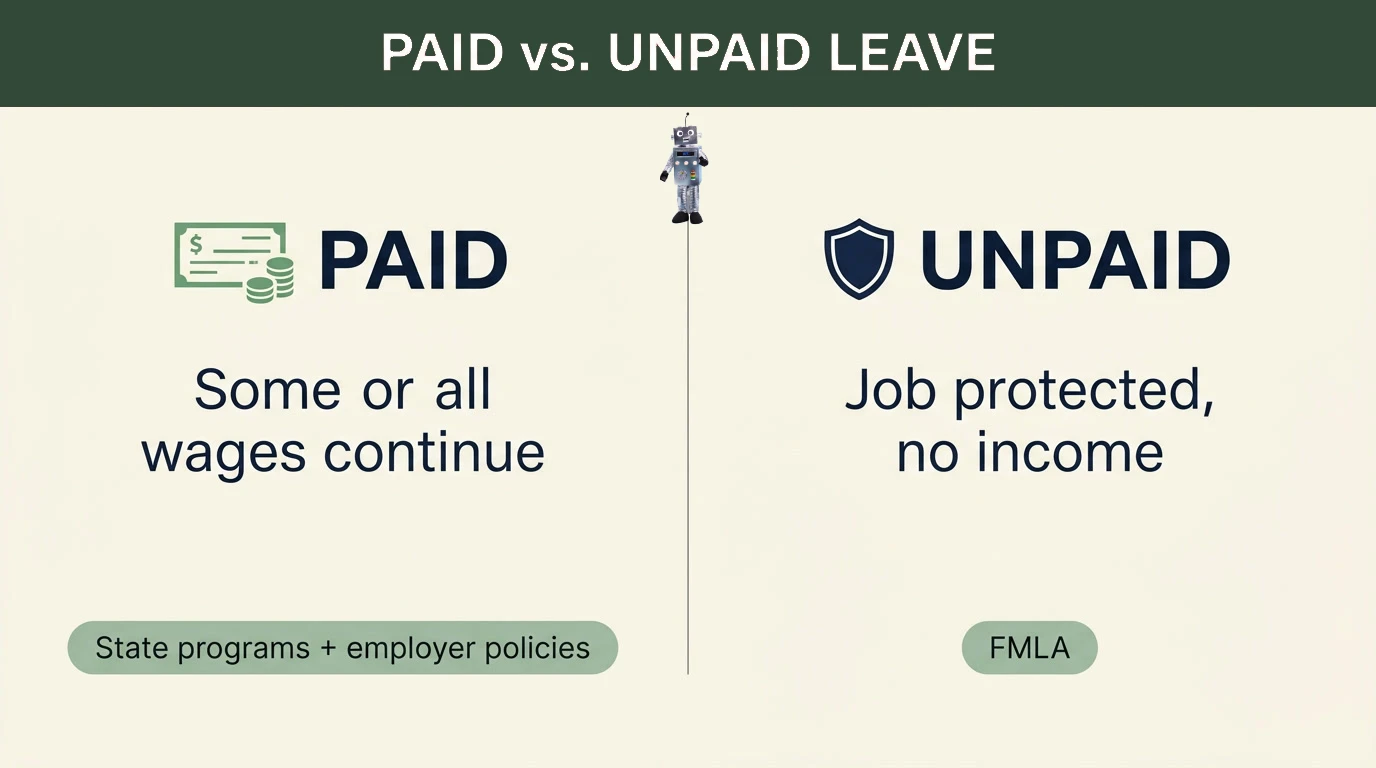
- Paid vs. Unpaid: Paid leave continues some or all of the employee's wages (through the employer, a state program, or insurance); unpaid leave protects the job but provides no income. The FMLA is unpaid; state programs and voluntary employer policies are where pay comes in.
- Job Protection: The right to return to the same or an equivalent job after leave. FMLA and most state programs include it; a casual, informal time-off arrangement may not.
- FMLA: The federal Family and Medical Leave Act, which provides up to 12 weeks of unpaid, job-protected leave at covered employers, the federal floor for parental leave.
- PFML: Paid Family and Medical Leave, the state-run, payroll-funded insurance programs that pay employees a percentage of their wages during qualifying leave, including bonding with a new child.
- Intermittent Leave: Taking leave in separate blocks or on a reduced schedule rather than all at once. Allowed in some situations under FMLA and many state programs, subject to specific rules.
Overview of Related Topics
- Federal vs. State Obligations: When the FMLA applies, when a state paid-leave program applies, and why your headcount and your employees' work locations decide both.
- Paid vs. Unpaid Leave: The single biggest design choice, and the funding options (self-funded, state program, or insurance) that make paid leave affordable.
- Building a Policy: Eligibility, duration, pay, and coordination with disability and state benefits, written down so it's applied consistently.
- The Employee Journey: Notice, approval, the leave itself, and a smooth return to work, the operational side of every leave.
- The Business Case: Why even small employers with no legal mandate increasingly offer parental leave to compete for and keep good people.

Federal & State Law: What Small Businesses Must Know
This is the part that trips small employers up, because the answer to "do I have to offer parental leave?" depends on two separate layers of law, federal and state, and they don't line up. Start with the federal floor, then check your state, which is almost always where the real obligation (and the pay) lives.
The Federal Floor: FMLA (Unpaid)
The FMLA gives eligible employees up to 12 weeks of unpaid, job-protected leave in a 12-month period to bond with a new child, among other reasons. It's job protection, not income; there's no requirement to pay the employee. And it's narrower than people assume. Two conditions both have to be met:
- The employer is covered: the business has 50 or more employees within a 75-mile radius. Below that, the FMLA simply doesn't apply, which is the situation for a large share of small businesses.
- The employee is eligible: they've worked for you for at least 12 months (not necessarily consecutive) and at least 1,250 hours in the 12 months before leave begins.
So a 12-person shop has no FMLA parental-leave duty, and even at a covered employer a brand-new or part-time employee may not yet be eligible. There is no federal law that requires paid parental leave for private-sector workers, a distinction that still puts the U.S. alone among developed economies.
The State Layer: Paid Family Leave (Where the Action Is)
What the federal government doesn't do, a growing number of states now do. Fourteen states and the District of Columbia have enacted mandatory paid family and medical leave (PFML) programs: California, Colorado, Connecticut, Delaware, Maine, Maryland, Massachusetts, Minnesota, New Jersey, New York, Oregon, Rhode Island, Virginia, and Washington, plus the District of Columbia. These programs work like social insurance: small payroll contributions (no more than about 1.3% of wages in any state in 2026, and usually 1% or less) fund a state pool that pays employees a percentage of their wages, commonly 60% to 90%, while they bond with a new child.
| Feature | Federal FMLA | State Paid Family Leave (PFML) |
|---|---|---|
| Pay during leave | None (unpaid) | Partial wage replacement, often 60–90% up to a cap |
| Employer size threshold | 50+ employees within 75 miles | Often applies to small employers, some programs reach down to 1 employee |
| Who funds it | N/A (employer simply holds the job) | Payroll contributions from employees, employers, or both |
| Typical duration | Up to 12 weeks | Roughly 8–12 weeks for bonding (varies by state) |
| Where it applies | Nationwide, at covered employers | Only in states/D.C. that have enacted a program |
Crucially, many of these state programs apply to employers regardless of size: Minnesota's program, which launched January 1, 2026, covers employers of all sizes, and several others reach far below the FMLA's 50-employee line. The newest entrants are still ramping up: Maine's benefits began May 1, 2026, Delaware's began January 1, 2026, and Virginia enacted its program in April 2026 with benefits scheduled for late 2028.
If You're in Texas (and Most of the South and Midwest)
Many states, including Texas, Florida, Georgia, and most of the South and Midwest, have no state paid-leave program. There, a small business below the FMLA threshold has no legal obligation to provide parental leave at all. Some of these states (Texas among them) instead authorize private paid-leave insurance that employers can choose to buy. So in a no-mandate state the question flips from "what must I do?" to "what do I want to offer to stay competitive?", which is exactly where the tax credit in the Statistics & Outlook section becomes interesting.
When Laws Overlap
Where FMLA and a state program both apply, they generally run concurrently: the same 12 weeks count against both, so an employee doesn't stack 12 federal weeks on top of a full state benefit. But the rules differ on eligibility, notice, and pay, and multi-state or remote teams multiply the complexity fast. Applying the right combination for each employee's work location is precisely the moving target an HR or PEO partner is built to manage.

Step-by-Step Guide: Setting Up a Parental Leave Policy
A parental leave policy doesn't have to be elaborate; it has to be clear, legal for your state, and applied the same way every time. Here's the sequence that gets a small business from "we should have something" to a written policy you can actually run.
- Confirm Your Legal Obligations: Check whether the FMLA applies (50+ employees within 75 miles) and whether your state, and each state where employees work, runs a paid family leave program. This determines your floor before you decide anything voluntary.
- Decide Paid or Unpaid: Choose whether you'll provide pay beyond what any state program covers: fully paid weeks, partial top-up, or unpaid with job protection. This is the central decision; everything else flexes around it.
- Set Eligibility: Define who qualifies and when, for example, all full-time employees after six months. Keep it consistent with any FMLA or state eligibility you're subject to, and make the policy gender-neutral so all parents get the same benefit.
- Set the Duration: Decide how many weeks of bonding leave you'll offer and whether it can be taken intermittently or must be continuous. Coordinate this number with FMLA's 12 weeks and your state program so the periods line up rather than stack.
- Coordinate With Other Benefits: Map how parental leave interacts with short-term disability (which often covers a birth mother's recovery), state PFML wage replacement, PTO, and health-insurance continuation, so an employee's total time and pay are clear.
- Put It in Writing: Document the policy in your handbook: eligibility, duration, pay, how to request leave, notice expectations, and the return-to-work process. A written policy is also a requirement to claim the federal Section 45S tax credit.
- Plan for Coverage: Decide in advance how the work gets done while someone is out: cross-training, temporary help, or redistributing duties. This is what makes leave sustainable for a small team rather than a crisis.
- Communicate and Document Each Leave: Tell employees the benefit exists, and when leave is taken, document the request, approval, dates, and pay treatment. Good records protect both the employee and the business, and are essential if you claim the tax credit.

Parental Leave Policy: A Small Business Roadmap
A policy on paper is only half of it. The other half is the journey an actual employee takes, from the day they tell you they're expecting to the day they're fully back up to speed. Walking that path the same way every time is what keeps leave fair, legal, and drama-free.
1. Notice
The employee tells you a child is on the way and roughly when they'll need leave. For planned events, ask for as much advance notice as is reasonable so you can arrange coverage, and respond warmly. How a small business handles this first conversation sets the tone for whether the person comes back.
2. Eligibility & Approval
Confirm what the employee qualifies for under your policy, the FMLA (if you're covered), and any state program. Spell out the duration, the pay (employer, state, disability, or a combination), benefit continuation, and the expected return date, in writing, so there are no surprises later.
3. The Handoff
Before leave starts, transition the employee's work: document in-progress projects, cross-train a colleague or bring in temporary help, and set clear expectations about contact during leave (the default should be "we've got it; focus on your family").
4. The Leave
The employee is out. Process any state-program paperwork, keep benefits running, and respect the boundary; don't pile on "quick questions." If they've chosen intermittent leave, track the blocks carefully against the policy and any FMLA/state limits.
5. Return to Work
Restore the employee to the same or an equivalent role (job protection means the position can't quietly disappear while they're out). Consider a soft landing: a phased schedule, a catch-up on what changed, and accommodation for needs like a private space to pump under the federal PUMP Act.
6. Reintegration
Check in over the first few weeks back. A thoughtful return is where the retention payoff actually happens; employees who feel supported through a major life event are far more likely to stay. This whole roadmap (eligibility, paperwork, benefit continuation, and compliance) is the kind of administrative load an HR or PEO partner can carry for a small business that doesn't have a dedicated HR person.

Parental Leave Compliance Checklist
Use this as a quick self-audit. None of it is complicated on its own. The discipline is doing it consistently and writing it down. An HR or PEO partner can carry the policy, coordination, and recordkeeping pieces if you'd rather not track them yourself.
Policy & Legal
- FMLA coverage checked (50+ employees within 75 miles) and applied if you're covered.
- Every state where employees work checked for a paid family leave program, with required payroll contributions set up.
- A written parental leave policy in the handbook covering eligibility, duration, pay, and the request process.
- Policy written gender-neutrally so birth mothers, fathers, and adoptive and foster parents are treated consistently.
During Leave
- Each leave request documented with dates, approval, and how pay is handled (employer, state program, disability, PTO).
- Group health benefits continued on the same terms during FMLA/qualifying leave.
- FMLA and state leave run concurrently where both apply, rather than stacked, and tracked against their limits.
- Intermittent or reduced-schedule leave, if allowed, tracked block by block.
Return & Records
- Employee restored to the same or an equivalent position on return.
- Pregnancy and nursing accommodations provided as required (Pregnant Workers Fairness Act (PWFA) and PUMP Act).
- Leave records retained per FMLA/state rules, and per the requirements to claim the Section 45S tax credit if you use it.

Topics
Coordinating the Three Buckets of Leave
- Medical / Disability Leave: A birth mother's physical recovery is often covered by short-term disability, separate from bonding time. This is why a mother's total leave can be longer than a non-birth parent's even under a gender-neutral policy.
- Bonding / Parental Leave: Time to care for and bond with the child, available to any parent. This is the "parental leave" most policies are really describing.
- State PFML Wage Replacement: Where it exists, the state program pays a portion of wages during bonding leave, which an employer can choose to top up to full pay.
Related Federal Protections
- Pregnant Workers Fairness Act (PWFA): Requires employers with 15 or more employees to provide reasonable accommodations for pregnancy, childbirth, and related conditions, before and after any leave.
- PUMP Act: Requires most employers to provide reasonable break time and a private, non-bathroom space for nursing employees to express milk.
- Pregnancy Discrimination Act: Prohibits treating employees unfavorably because of pregnancy, childbirth, or related conditions at employers with 15 or more employees.
Who Does What
- Owner / Manager: Sets the policy, approves leave, arranges coverage, and ensures the return to work goes smoothly. In a small business this is usually one person.
- HR / PEO Partner: Handles the specialist work: coordinating FMLA, state PFML, and disability; filing state paperwork; maintaining records; and tracking the rules across each work location, the load a small company can't justify staffing full-time.
- State Agency: Administers the paid family leave program (where one exists), processes claims, and pays benefits to employees.
- Employment Counsel: Advises on close calls, multi-state questions, accommodation disputes, and anything that escalates.
Key Considerations
- Be consistent: Apply the policy the same way for every eligible employee. Inconsistency is where discrimination claims start.
- Check every work location: A remote employee in another state may be covered by that state's program even if your home state has none.
- Don't forget benefit continuation: Health coverage generally must continue during FMLA leave on the same terms as if the employee were working.
- Document everything: For leave compliance, if you can't show it was done, in practice it didn't happen.

Statistics & Outlook
Access by the Numbers
- Only about 1 in 4 private-industry workers (27%) had access to employer-provided paid family leave, according to the most recent Bureau of Labor Statistics data, meaning roughly three-quarters do not.
- By contrast, around 89–90% had access to unpaid family leave, the job protection without the paycheck.
- Access is uneven: it's far more common in higher-wage, professional, and large-employer jobs, and least common at small businesses and in lower-wage roles.
- The United States remains the only OECD member country that does not guarantee paid leave to new mothers in the private sector.
The State-Program Story
The momentum is at the state level. Fourteen states and D.C. now have mandatory paid family leave laws, and the map keeps expanding: Minnesota's program launched in January 2026, Maine's benefits began in May 2026, and Virginia enacted a comprehensive program in April 2026 (benefits arriving in 2028). Several more states have bills pending. For a multi-state employer, this means the compliance picture changes year to year.
A New Federal Incentive
Even without a federal mandate, Washington is nudging employers toward paid leave through the tax code. The Section 45S Employer Credit for Paid Family and Medical Leave, first enacted in 2017 as a temporary measure, was made permanent and expanded in 2026. It now offers a credit of 12.5% to 25% of wages paid during qualifying leave, can be claimed on insurance premiums (not just wages paid), is available to small employers even if they're too small for the FMLA, and lowered its tenure requirement so employees with as little as six months can qualify (if the employer opts in).
What to Watch
- More state programs: New mandatory programs and pending bills mean more small employers will be pulled in automatically through payroll.
- The talent angle: As paid leave spreads, not offering it becomes a competitive disadvantage in hiring, even where it isn't legally required.
- The permanent tax credit: With Section 45S no longer expiring, voluntarily offering paid leave is now a cleaner financial decision than it was when the credit reset every year or two.
Because state programs, contribution rates, and the competitive landscape all move on their own schedules, parental leave rewards an annual review, a good reason to revisit this article each year.

Frequently Asked Questions
Does FMLA apply to my small business?
Only if you have 50 or more employees within a 75-mile radius. Below that threshold, the federal FMLA does not apply, and you have no federal obligation to provide parental leave, paid or unpaid. Even at a covered employer, an individual employee is only eligible after working 12 months and at least 1,250 hours.
But "FMLA doesn't apply" isn't the end of the analysis. Your state may run a paid family leave program that reaches much smaller employers, some down to a single employee, so the real answer depends on where your people work, not just your headcount.
Do I have to pay employees on parental leave?
There is no federal requirement to pay employees during parental leave, the FMLA provides job protection, not income. Whether pay is required depends entirely on your state. In the 14 states and D.C. with paid family leave programs, eligible employees receive partial wage replacement funded through payroll contributions, not directly out of your pocket.
In states without a program, paying for parental leave is voluntary. Many small employers choose to offer some paid leave anyway to compete for talent, and the federal Section 45S tax credit can offset part of the cost when they do.
Can I deny parental leave?
It depends on what's legally required of you. If you're covered by the FMLA or a state paid-leave program and the employee is eligible, you generally cannot deny qualifying leave, and doing so can mean serious legal exposure. If neither applies to your business, parental leave is at your discretion.
Even where you can legally decline, be careful to apply your decision consistently. Denying leave to one parent but not another in a similar situation can create pregnancy or sex discrimination claims, regardless of whether a leave law applies.
How long is parental leave?
It varies. The FMLA caps job-protected leave at 12 weeks. State paid family leave programs typically provide roughly 8 to 12 weeks of bonding leave, and voluntary employer policies range widely. A birth mother's total time may be longer because physical recovery is often covered separately under short-term disability.
Where multiple laws apply, they generally run concurrently rather than stack, so an employee usually doesn't add a full state benefit on top of a separate 12 weeks of FMLA leave. The exact length comes down to your policy and the rules of each state involved.
What's the difference between maternity, paternity, and parental leave?
Maternity leave is taken by a birth mother and often blends physical recovery with bonding time. Paternity leave is taken by a father or non-birth parent and is purely bonding time. Parental (or bonding) leave is the gender-neutral umbrella term that applies to any new parent (birth, adoptive, or foster).
Modern policies increasingly use "parental leave" so all parents receive the same bonding benefit, while still recognizing that a birth mother may have additional medical-recovery leave on top.
Is there a tax credit for offering paid parental leave?
Yes. The federal Section 45S credit rewards employers who provide paid family and medical leave under a written policy. It's worth 12.5% to 25% of wages paid during qualifying leave, and as of 2026 it's permanent and available to small employers even if they aren't covered by the FMLA.
The credit has specific requirements, a written policy, a minimum amount of leave, and an employee-compensation threshold, so it's worth confirming eligibility with a tax advisor. But for a small business weighing whether to offer paid leave, it can meaningfully lower the cost.
Key Takeaways
Parental leave is time off for a parent to bond with and care for a new child after birth, adoption, or foster placement: maternity, paternity, or gender-neutral bonding leave, paid or unpaid. The federal floor, the FMLA, guarantees only unpaid, job-protected leave, and only at employers with 50 or more employees for workers with 12 months and 1,250 hours. A lot of small businesses fall below that line and have no federal obligation at all.
The real variable is the state. Fourteen states and the District of Columbia now run mandatory paid family leave programs funded by small payroll contributions, and many reach employers far smaller than the FMLA does, some down to a single employee. If your people work in one of those states, you're likely in the program whether you planned for it or not. In the many states with no program (Texas, Florida, and most of the South and Midwest among them), offering paid leave is voluntary, and the permanent federal Section 45S tax credit can offset part of the cost when you do.
Whether parental leave is required or optional for you, the work is the same: a clear written policy, consistent eligibility, smart coordination of FMLA, state benefits, and disability; careful records; and a thoughtful return to work. That coordination, across changing state rules and multiple work locations, is exactly where small businesses lose time and make costly mistakes, and exactly the load an HR or PEO partner is built to carry, giving a small business the leave infrastructure of a much larger one without the overhead.