

How to Evaluate Employees
Quick Answer
To evaluate employees, set clear, job-specific performance standards before the review cycle begins, then gather documented evidence of performance across the full period, including output data, self-assessments, and peer input where applicable. Score employees against those pre-established criteria before the appraisal meeting, calibrate your ratings with HR or your manager, and deliver feedback in a structured conversation that covers strengths, gaps, and agreed-upon goals for the next cycle. The completed evaluation form should be signed, filed in the employee's personnel record, and reinforced with scheduled check-ins throughout the year.
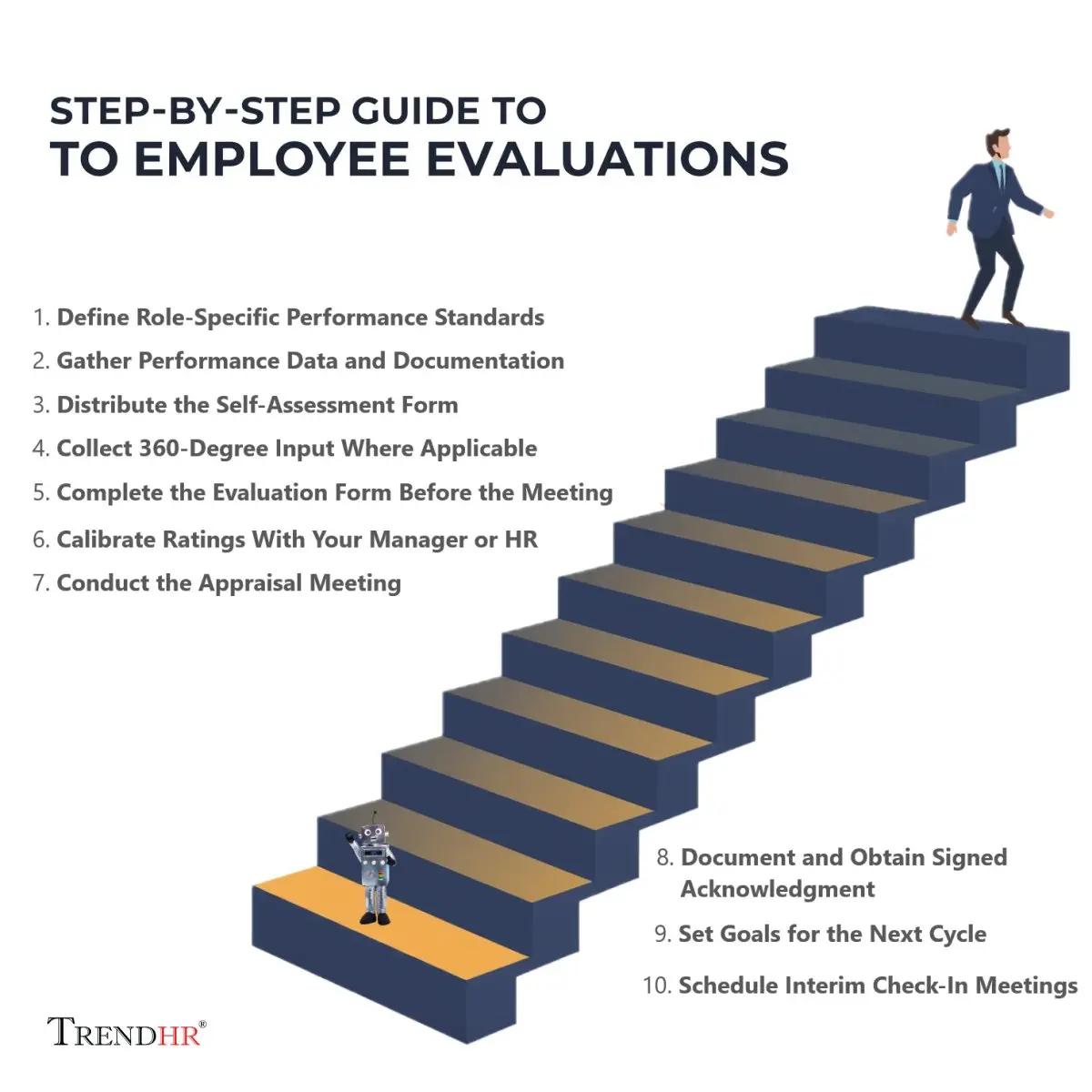
Step-by-Step Guide to Employee Evaluations
- Define Role-Specific Performance Standards: Review the employee's job description and identify 4–6 measurable criteria against which performance will be assessed. Tie each standard directly to job responsibilities, team objectives, or organizational KPIs.
- Gather Performance Data and Documentation: Collect objective evidence from the full review period: completed projects, output metrics, attendance records, customer feedback, and any prior documentation such as PIPs or commendations. Do not rely on memory or recent events; recency bias is a common source of inaccurate ratings.
- Distribute the Self-Assessment Form: Send the employee a structured self-evaluation at least one week before the appraisal meeting. Review their responses before scoring to identify perception gaps between self-reported performance and your observed data.
- Collect 360-Degree Input Where Applicable: If your organization uses multi-source feedback, solicit input from peers, direct reports, or cross-functional partners who have direct visibility into the employee's work. Consolidate this input into themes rather than attributing specific comments to individuals.
- Complete the Evaluation Form Before the Meeting: Assign ratings based on documented evidence and defined criteria before sitting down with the employee. Completing the form in advance prevents the conversation from driving the score rather than informing it.
- Calibrate Ratings with Your Manager or HR: Before delivering feedback, confirm that your ratings are consistent with how peers at the same performance level are being evaluated across the team. Calibration sessions catch outlier scores and protect the organization from claims of disparate treatment.
- Conduct the Appraisal Meeting: Open with the employee's self-assessment, then present your ratings with specific behavioral examples for each. Allow the employee to respond before the meeting concludes; two-directional feedback increases acceptance of the evaluation outcome.
- Document and Obtain Signed Acknowledgment: Finalize the completed evaluation form and obtain the employee's signature confirming receipt, not necessarily agreement. File the signed document in the employee's personnel record in compliance with your organization's retention policy, typically a minimum of one to three years.
- Set Goals for the Next Cycle: Before closing the review period, collaboratively establish 3–5 SMART goals (specific, measurable, achievable, relevant, and time-bound objectives) for the upcoming cycle and document them in your performance management system. Attach any agreed development activities, training commitments, or support resources to the employee's record.
- Schedule Interim Check-In Meetings: Formal evaluations should be reinforced by structured one-on-ones at 30, 60, and 90-day intervals to track progress against stated goals. Mid-cycle check-ins reduce end-of-year surprises, create a documented performance trail, and give managers the opportunity to course-correct before issues become formal matters.

The Evaluation Process, Explained
Evaluating employees effectively means more than completing a form once a year. A defensible, meaningful evaluation is the result of deliberate preparation, consistent documentation, and structured conversation, all anchored to job-relevant standards that were established before the review period began.
Set Standards Before the Cycle Begins
The process starts well before the appraisal meeting. At the opening of each review cycle, managers should define 4–6 measurable performance criteria tied directly to the employee's role and the team's objectives. These standards (covering both quantitative outcomes like output targets or error rates and qualitative competencies like communication and collaboration) give employees a clear picture of what success looks like and give managers an objective framework for scoring performance later.
Document Performance Throughout the Year
Throughout the cycle, documentation is everything. Managers who accumulate specific examples of performance as they occur (commendations, missed deadlines, project outcomes, feedback from stakeholders) enter the evaluation meeting with credible, concrete evidence rather than relying on memory or recent events. Recency bias, the tendency to weight the last few weeks of a review period over the full year, is one of the most common sources of inaccurate and legally vulnerable ratings.
Complete the Evaluation Before the Meeting
When it's time to complete the evaluation, the sequence matters. Distribute a structured self-assessment to the employee at least a week before the appraisal meeting, collect any 360-degree input your organization uses, and finalize your own ratings, with supporting examples, before sitting down together. Completing the form in advance prevents the conversation from driving the score instead of informing it. Before delivering feedback, calibrate your ratings against how peers at a similar performance level are being evaluated across the team; calibration sessions catch outlier scores and protect the organization from claims of inconsistent treatment.
Make the Appraisal Meeting a Two-Way Conversation
The appraisal meeting itself should be a two-way conversation, not a monologue. Open with the employee's own self-assessment, present your ratings with specific behavioral examples, and invite the employee to respond before the meeting concludes. Employees who feel heard during the evaluation process report higher acceptance of their ratings and stronger engagement afterward. Close every evaluation by co-establishing 3–5 SMART goals for the next cycle and documenting any agreed development commitments.
Reinforce With Mid-Cycle Check-Ins
Finally, treat the signed evaluation form as the beginning of the next cycle, not the end of the current one. Schedule structured check-ins at 30, 60, and 90 days to track progress against stated goals. Mid-cycle touchpoints reduce year-end surprises, create an ongoing performance record, and give both managers and employees the opportunity to course-correct before small issues become formal ones.

Employee Evaluations Definition
Employee evaluation is the structured process by which organizations formally assess individual performance, behaviors, and competencies against defined job standards and organizational goals. It encompasses performance appraisals, competency reviews, 360-degree feedback, and development planning conversations. For organizations, it is the foundational mechanism for driving accountability, informing compensation decisions, and aligning individual output with business strategy.
Core Evaluation Components
- Performance Standards: Clearly defined criteria against which employee output, behaviors, and competencies are measured; effective standards are specific, observable, and tied to role requirements.
- Goal Alignment: The process of linking individual objectives to departmental and organizational priorities, typically documented through SMART goals (specific, measurable, achievable, relevant, and time-bound objectives) established at the start of each evaluation cycle.
- Feedback Delivery: Structured communication of performance findings to employees, including recognition of strengths, identification of gaps, and agreed-upon action steps; effective feedback is specific, timely, and two-directional.
- Documentation: The written record of evaluation discussions, ratings, and development commitments; serves as the legal and operational foundation for compensation decisions, promotions, and performance improvement plans.
Overview of Related Topics
- Step-by-Step Guide to Employee Evaluations: A ten-step process covering everything from defining role-specific performance standards through scheduling interim check-in meetings to track progress against stated goals.
- Evaluation Methods & Frameworks: Organizations apply multiple formal models, including management by objectives, behaviorally anchored rating scales, and 360-degree feedback, each offering different advantages in objectivity, employee engagement, and administrative workload.
- Roles & Responsibilities: HR professionals design evaluation systems and ensure compliance; direct managers conduct appraisals and deliver feedback; employees participate in self-assessments and goal setting; senior leadership validates calibration across teams.
- Legal & Documentation Requirements: Evaluations must comply with EEOC guidelines prohibiting discriminatory rating practices; documented reviews protect organizations against wrongful termination and discrimination claims and are essential during PIPs (performance improvement plans) and reductions in force.
- Performance Standards & Metrics: Quantitative KPIs (sales targets, error rates, output volumes) and qualitative competency ratings (communication, leadership, collaboration) together form the measurement framework that determines overall performance ratings.

Topics
Evaluation Methods & Frameworks
- Management by Objectives (MBO): A goal-driven method where managers and employees collaboratively set measurable objectives at the start of a cycle; performance is assessed based on the degree to which those objectives were achieved.
- Behaviorally Anchored Rating Scales (BARS): A structured rating tool that ties specific observable behaviors to numerical scores; reduces rater subjectivity by anchoring evaluations to concrete, job-relevant behavioral examples.
- 360-Degree Feedback: A multi-source appraisal model collecting input from an employee's manager, peers, direct reports, and sometimes external stakeholders; provides a comprehensive view of interpersonal competencies and collaborative effectiveness.
Roles & Responsibilities
- HR Professionals: Design, administer, and audit the evaluation system; train managers on rating accuracy and legal compliance; manage records and use evaluation data to inform workforce planning and succession strategies.
- Direct Managers: Conduct performance conversations, assign ratings, and document outcomes; responsible for ongoing feedback throughout the cycle, not only during formal review periods.
- Employees: Participate in self-evaluation processes, contribute to goal setting discussions, and acknowledge receipt of formal appraisal documentation; active participation increases engagement and development outcomes.
Legal & Documentation Requirements
- EEOC Compliance: Evaluation criteria and rating decisions must not discriminate based on race, sex, age, disability, or other protected characteristics; disparate impact in ratings or outcomes can trigger federal investigations and civil litigation.
- Performance Improvement Plans (PIPs): Formal documents used when performance falls below standard; must include specific deficiencies, measurable expectations, a defined improvement timeline, and available support resources to withstand legal scrutiny.
- Record Retention: Completed evaluations should be retained in personnel files for a minimum of one to three years depending on applicable state and federal requirements; longer retention is advised when litigation is foreseeable.
Performance Standards & Metrics
- Quantitative KPIs: Objective, output-based measures such as revenue generated, units produced, error rates, or response times; provide clear, auditable evidence of performance that minimizes subjective bias in rating decisions.
- Competency Ratings: Assessments of behavioral and interpersonal skills (including communication, leadership, problem-solving, and teamwork), typically rated on a defined scale with behavioral anchors to support cross-rater consistency.
- Performance Rating Scales: Numerical or descriptive scales (e.g., 1–5 ratings or Exceeds / Meets / Below Expectations) used to translate qualitative assessments into standardized scores that support compensation and succession decisions.
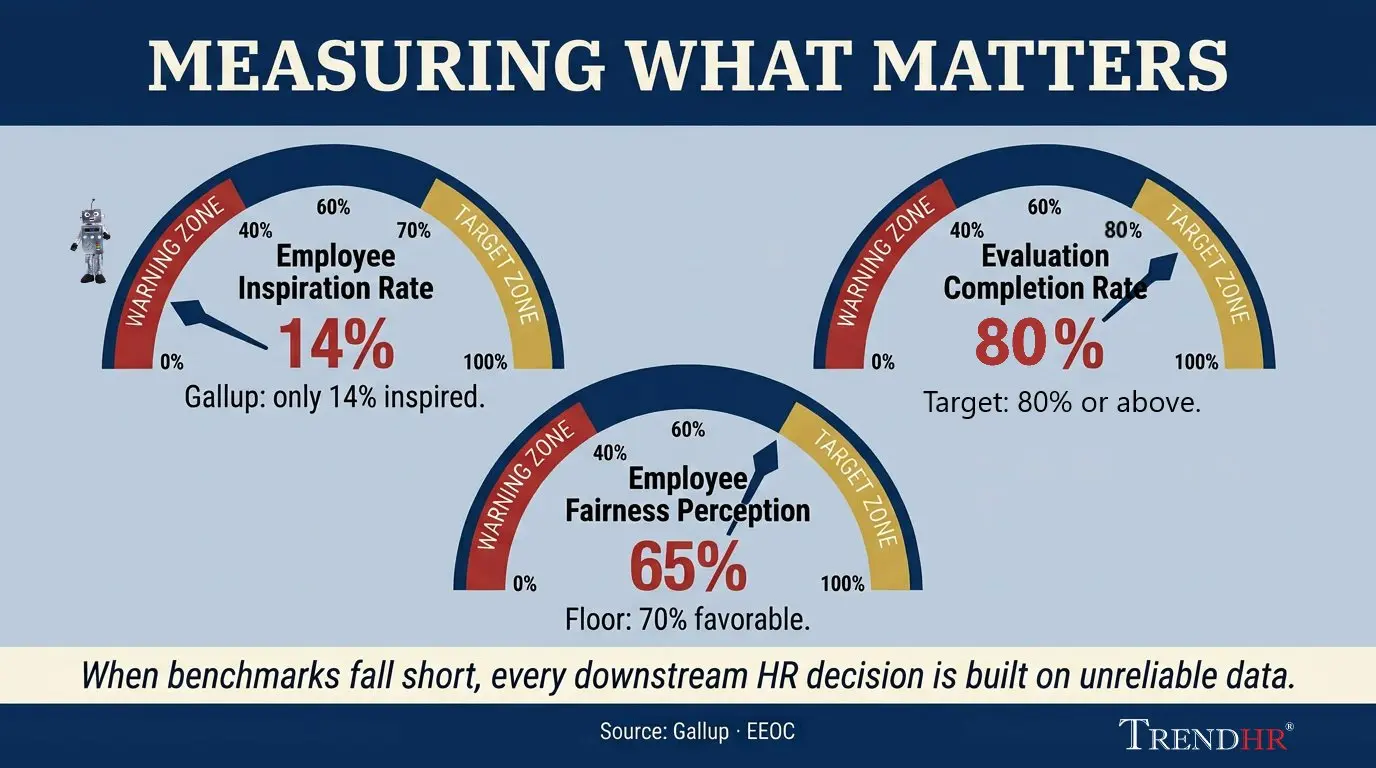
Key Infographic Statistics at a Glance
- 14%: Only 14% of employees strongly agree that annual performance reviews inspire them to improve, exposing the core gap a structured evaluation framework is designed to close (Gallup, 2019)
- 70%: A 70% favorable score is the threshold for employee fairness perception; scores below this indicate systemic manager inconsistency or process credibility problems (Gallup, 2025)
- EEOC Compliance: Federal law requires that evaluation criteria be applied uniformly and without discrimination based on race, sex, age, or disability, making documented review processes a legal obligation, not optional best practice (U.S. Equal Employment Opportunity Commission)

Employee Self-Evaluation
A self-evaluation gives employees the opportunity to reflect on their own performance before the formal appraisal meeting, providing managers with critical context and reducing the likelihood of one-sided reviews. Completed one week before the scheduled evaluation, a structured self-assessment surfaces perception gaps, reinforces employee ownership of development goals, and makes the appraisal conversation more productive for both parties.
- What were your most significant accomplishments during this review period, and how did they contribute to your team's or department's goals?
- Which performance goals or objectives did you fall short of, and what factors (internal or external) contributed to those gaps?
- What specific skills or competencies have you strengthened this cycle, and where do you see the greatest opportunity for growth in the next review period?
- How effectively did you collaborate with colleagues, communicate across teams, or support others in achieving shared objectives?
- What one or two development goals would you like to prioritize in the next cycle, and what support or resources would help you achieve them?

Performance Review Example Phrases
Use the phrases below as a starting point for written evaluations. Each example is designed to be specific and behavioral; adapt them to reflect the employee's actual performance and documented observations from the review cycle.
Quality of Work
- Consistently delivers work that meets defined quality standards with minimal revision required, demonstrating strong attention to detail across all assigned projects.
- Produces accurate, well-organized deliverables on schedule; errors are rare and self-corrected before submission.
- Work quality has improved measurably this cycle; output meets role expectations after coaching.
- Frequently submits work that requires significant revision, indicating a need for closer review of requirements before execution.
- Sets a high standard for the team through the thoroughness and precision of completed work, which has reduced downstream errors in dependent workflows.
Communication
- Communicates project status proactively and clearly, ensuring stakeholders have the information they need before issues escalate.
- Adapts communication style effectively across audiences, equally clear when presenting to senior leadership and when collaborating with frontline team members.
- Written communication is consistently professional, concise, and well-structured; reports and emails require little editing before distribution.
- Has demonstrated growth in delivering difficult messages directly and constructively, with notable improvement in manager feedback conversations this cycle.
- Cross-functional partners have noted delays in receiving updates on shared projects; timelier communication would reduce dependency bottlenecks.
- Listens actively in team discussions and asks clarifying questions that consistently improve group understanding of complex issues.
Initiative & Problem-Solving
- Regularly identifies process gaps and proposes solutions without being asked, demonstrating ownership beyond the boundaries of the defined role.
- Took independent action to resolve a recurring client escalation issue, implementing a workflow change that reduced repeat incidents.
- Approaches obstacles with a solutions-first mindset; rarely presents a problem without also presenting a recommended course of action.
- Has shown growth in taking independent action this cycle; continues to develop confidence in making low-risk decisions without manager approval.
- Waits for direction before acting in situations where independent judgment would be appropriate for this role level; greater initiative is expected in the next cycle.
- Volunteered to lead a cross-departmental process review outside of assigned responsibilities, delivering a final recommendation adopted by senior leadership.
Collaboration & Teamwork
- Is consistently regarded by peers as a reliable, contributing team member who follows through on commitments and supports colleagues during high-demand periods.
- Actively shares knowledge and expertise with less experienced team members, contributing to overall team capability beyond individual output.
- Works constructively across departments, building productive working relationships that accelerate shared project timelines.
- Has shown improvement in incorporating peer feedback during collaborative projects; early-cycle friction with cross-functional partners has not recurred.
- Contributions in team settings are strongest in one-on-one collaboration; participation in group problem-solving discussions is an area for continued development.
Accountability & Dependability
- Meets deadlines consistently and communicates early when timelines are at risk, allowing the team to adjust without disruption.
- Takes clear ownership of outcomes (both successes and shortfalls) and does not deflect responsibility when results fall short of expectations.
- Follows through on commitments made during previous check-in meetings; development goals set in Q1 were completed by the agreed milestones.
- Has missed several project deadlines this cycle without advance notice; a stronger system for tracking and communicating workload capacity is needed.
- Demonstrates reliability under pressure; maintained output quality and delivery commitments during a period of significant team restructuring.
- When errors occur, addresses them directly, communicates impact to affected parties, and implements corrective action without prompting.
Leadership & Development (for managers and senior individual contributors)
- Develops team members: identifies growth opportunities, delegates with appropriate coaching, and tracks individual progress against development goals.
- Creates an environment where direct reports feel comfortable raising concerns and contributing ideas; team engagement scores have improved year over year.
- Provides feedback to direct reports that is specific, timely, and actionable; team members consistently rate their manager's feedback quality above department average.
- Has grown significantly in managing team conflict this cycle, addressing interpersonal issues directly rather than allowing them to affect team performance.
- Demonstrates sound judgment in prioritizing team workload during competing demands, maintaining output quality without driving unsustainable pace.
- Succession readiness has increased this cycle; this employee is actively preparing for expanded scope and would benefit from a stretch assignment in the next review period.

Statistics & Outlook
Employee evaluation, also known as performance appraisal or staff performance review, is the formal organizational process of assessing an individual's job performance against defined standards, goals, and competency expectations. According to Gallup research, only 14 percent of employees strongly agree that their annual performance reviews inspire them to improve, highlighting how wide the gap remains between evaluation systems as they exist and as they should function (Gallup, gallup.com). The U.S. Equal Employment Opportunity Commission requires that performance evaluation criteria be applied uniformly and without regard to race, color, religion, sex, national origin, age, disability, or genetic information, making defensible, documented evaluation processes a federal compliance obligation, not merely a best practice (U.S. EEOC, eeoc.gov). Organizations that develop structured, consistently applied evaluation frameworks reduce their exposure to discrimination-related liability while improving the quality of every downstream decision tied to performance data.
For HR leaders, the return on investment in a well-designed employee evaluation system extends well beyond individual performance outcomes: it strengthens retention, reduces the direct and indirect costs of turnover, and supports organizational agility by ensuring that talent is accurately identified and strategically developed.
Verified Sources
- Gallup: Only 14% of employees strongly agree annual reviews inspire improvement. (gallup.com, 2019)
- U.S. Equal Employment Opportunity Commission: Performance evaluation criteria must be applied uniformly regardless of protected characteristics. (eeoc.gov)

Technology in Employee Evaluation
Core Technology Platforms & Systems
Performance management systems serve as the operational backbone of employee evaluation in most mid-to-large organizations today. These dedicated platforms centralize appraisal cycle administration, goal documentation, continuous feedback capture, and rating workflows within a single interface, replacing paper-based or spreadsheet-driven processes that are prone to inconsistency and record-keeping gaps. Many organizations also integrate employee evaluation functionality within broader human resource information systems, enabling performance data to flow directly into compensation modeling, learning and development records, and succession planning modules. HR professionals interact with these platforms daily to configure review templates, manage cycle timelines, generate compliance reports, and monitor completion rates across departments.
Workflow Automation & Process Optimization
Automation has reduced the administrative burden associated with employee evaluation cycles. Reminder notifications, deadline escalations, self-assessment distribution, and manager sign-off routing are now commonly managed through workflow engines embedded in performance platforms or configured via low-code integration tools. Calibration sessions, where managers collectively review and normalize ratings across a team or department, are increasingly supported by automated data aggregation that surfaces outlier scores and rating distributions in real time. Organizations that have automated these administrative sequences report measurable reductions in cycle completion time and a corresponding increase in manager bandwidth for the substantive feedback conversations that drive actual development outcomes.
Document & Data Management
Evaluation documentation (including completed appraisals, signed acknowledgment forms, performance improvement plans, and goal-setting records) is now predominantly managed within cloud-based document repositories and human resource information systems rather than physical personnel files. Electronic signature platforms enable evaluation acknowledgments to be completed and time-stamped remotely. Compliance considerations are significant: records must be retained according to applicable federal and state requirements, searchable on demand during audits or litigation, and access-controlled to prevent unauthorized disclosure of protected employee information. Well-structured data management practices also enable HR teams to analyze historical performance trends, identify patterns in rating distributions, and generate workforce analytics that support strategic planning.
AI & Emerging Technologies
Artificial intelligence is beginning to reshape how organizations approach employee evaluation at multiple stages of the process. AI tools assist managers in drafting more specific feedback by analyzing prior goal records and flagging vague language. Sentiment analysis can identify early signals of disengagement before they appear in formal ratings. Predictive analytics models, trained on historical performance and retention data, help HR leaders identify flight risks and high-potential employees. In the near term, AI assistants provide managers with real-time guidance during performance conversations, increasing consistency and reducing the impact of unconscious bias in evaluation delivery.
Integration & Interoperability
The value of performance data multiplies when evaluation systems connect seamlessly with adjacent HR platforms. Integration between performance management systems and learning management systems enables development plans created during appraisal cycles to automatically enroll employees in relevant training content. Connections to compensation management platforms allow performance ratings to drive merit increase calculations without manual data transfer. Organizations with disparate, unconnected systems frequently encounter inconsistencies between performance records and payroll, benefits, or talent data.
Skills & Adoption
HR professionals responsible for employee evaluation technology today need competency across system configuration, data reporting, and workflow design, skills that extend well beyond traditional HR generalist training. Common barriers to adoption include time constraints, inconsistent data entry practices, and insufficient training investment at the time of platform implementation. Successful adoption strategies combine structured onboarding, ongoing manager coaching, and executives making the evaluation process a business priority.

Key Performance Indicators (KPIs)
KPIs in employee evaluation connect individual performance data to strategic workforce decisions: compensation calibration, succession planning, high-potential identification, and targeted development investment. Tracking the right metrics enables HR leaders to assess whether the evaluation process itself is functioning effectively, not just whether individual employees are meeting their goals. A measurement-first approach transforms performance management from an annual administrative event into a continuous, results-driven management discipline.
Core Operational KPIs
| KPI | Formula | Target |
|---|---|---|
| Evaluation Completion Rate | Completed reviews ÷ total eligible employees | 95% or above; below 80% signals process failure |
| On-Time Completion Rate | Timely completions ÷ total reviews due | All reviews finalized by established deadline |
| Goal Completion Rate | Fully met goals ÷ total documented goals across workforce | 70–90%; rates above 90% may indicate goals set too conservatively |
| Rating Distribution | Spread of ratings across defined levels (Exceeds / Meets / Below) | Centered on "Meets Expectations"; skewed distributions indicate bias or calibration failure |
| Employee Self-Assessment Participation Rate | Self-evaluations completed ÷ total eligible employees | 85% or above |
Financial & Cost-Efficiency KPIs
| KPI | Formula | Target |
|---|---|---|
| Cost Per Evaluation | Total administrative, technology, and manager time cost ÷ completed evaluations | Year-over-year reduction while maintaining review quality; no universal benchmark, so measure against your own prior cycles |
| Performance-Linked Compensation Accuracy | Correct merit calculations ÷ total merit calculations | Near 100%; errors generate payroll compliance risk |
| Retention Rate of High Performers | Top-tier employees retained year-over-year ÷ total top-tier employees | Year-over-year improvement; decline signals compensation or development gaps |
Quality, Satisfaction & Emerging KPIs
| KPI | Description | Target |
|---|---|---|
| Employee Perception of Fairness | Post-evaluation pulse survey asking whether review was fair, accurate, and constructive | 70% favorable or above |
| Manager Feedback Quality Score | HR audit sampling of completed reviews for specificity, behavioral grounding, and development orientation | Defined quality threshold; low scores drive targeted manager coaching |
| Calibration Consistency Index | Degree of rating alignment across managers evaluating employees with similar roles and responsibilities | Low variance; significant differences indicate calibration sessions are insufficient |
| Continuous Feedback Frequency | Frequency of documented real-time feedback exchanges outside formal review cycles | Tracked as predictor of engagement, development velocity, and rating accuracy |
| Bias Audit Score | Statistical modeling to detect whether ratings correlate with protected characteristics inconsistently with performance data | No statistically significant correlation with gender, race, or age |
Effective KPI reporting for employee evaluation requires a tiered dashboard structure: operational metrics (completion rates, timelines) reviewed monthly by HR operations; quality and fairness metrics reviewed quarterly by HR leadership and senior managers; and strategic workforce metrics (retention of high performers, calibration consistency) reviewed annually by executive leadership. Data should be segmented by department, manager, and demographic group to surface both process execution gaps and potential equity concerns. Review cadences must include structured discussion of out-of-range metrics and documented action plans, transforming data observation into organizational improvement rather than reporting for its own sake.

Frequently Asked Questions
How do you evaluate employee performance effectively?
Effective employee performance evaluation starts with a documented framework of job-specific goals and competency standards established before the review cycle begins, applied consistently through calibrated ratings and continuous feedback. Without these foundational elements, even well-intentioned appraisals produce unreliable results.
The foundation of an effective evaluation is a clear performance framework established before the review cycle begins: documented job-specific goals, measurable KPIs, and defined competency expectations that both the manager and employee understand and agree on. Without this foundation, appraisals become reactive assessments of personality rather than objective reviews of performance.
Effective evaluations are also continuous, not episodic. Managers who hold regular one-on-ones throughout the year, document performance observations in real time, and deliver feedback promptly, rather than stockpiling it for an annual review, produce evaluations that are both more accurate and more credible to the employee receiving them. Research consistently shows that employees who receive ongoing feedback perceive their formal evaluations as fairer than those whose only performance input comes once per year.
Finally, an effective evaluation process must be calibrated. Individual managers have different rating tendencies: some inflate scores, others deflate them. Calibration sessions, where managers collectively review and normalize ratings within a defined peer group, correct for this variation and ensure that a "Meets Expectations" rating in one department means the same thing as it does in another. Without calibration, performance data cannot reliably support compensation, promotion, or succession decisions.
What are the most common methods for evaluating employees?
The four most widely used employee evaluation methods are management by objectives (MBO), graphic rating scales, behaviorally anchored rating scales (BARS), and 360-degree feedback, each with distinct strengths depending on the role, industry, and evaluation purpose.
Management by objectives is the most widely used method in goal-oriented business environments. At the start of each cycle, managers and employees collaboratively set specific, measurable objectives. At review time, performance is assessed based on whether and to what degree those objectives were met. MBO works well when individual output is clearly measurable but can undervalue behavioral competencies that are harder to quantify.
Graphic rating scales ask managers to score employees on defined dimensions (quality of work, communication, reliability) using a numerical or descriptive scale. They are administratively simple but vulnerable to subjective bias, including leniency bias (rating most employees above average) and recency bias (weighting the most recent performance over the full cycle).
Behaviorally anchored rating scales address the subjectivity problem by tying each score on a rating scale to specific, observable behaviors. A score of "4 out of 5" on communication, for example, is anchored to a description such as "Consistently communicates complex information clearly across functions." This method increases consistency and legal defensibility.
360-degree feedback gathers input from multiple stakeholders (peers, direct reports, cross-functional partners, and managers), providing a multi-dimensional view of employee performance, particularly in areas like collaboration and leadership. Many organizations use 360 data for development purposes rather than as a direct input to formal ratings, given the complexity of aggregating feedback from multiple raters with different observational vantage points.
How often should employee evaluations be conducted?
Most organizations conduct formal evaluations annually or semi-annually, but the most effective programs layer those formal reviews with quarterly check-ins and ongoing real-time feedback to ensure employees are never surprised by their appraisal outcome.
Annual reviews remain the most common formal evaluation cadence in U.S. organizations, largely because of their administrative manageability and their natural alignment with annual compensation and budgeting cycles. However, a once-per-year cadence means that performance issues may go unaddressed for months, development opportunities are missed, and employees receive feedback so infrequently that it has limited practical impact on their day-to-day behavior.
Semi-annual or quarterly formal reviews are increasingly common in high-growth industries and organizations with rapidly evolving roles where annual goals become outdated well before the review period closes. These shorter cycles allow managers to reset objectives mid-year, course-correct performance problems earlier, and create more frequent touchpoints that employees consistently report as more motivating and fairer.
The most effective evaluation structures combine a formal annual or semi-annual review, which serves as the calibrated, documented assessment used for compensation and succession decisions, with an ongoing cadence of documented manager-employee check-ins, continuous feedback tools, and mid-cycle goal reviews. This layered approach ensures that the formal evaluation is never the employee's first indication of how they are performing.
What criteria should be used when evaluating an employee?
Employee evaluation criteria should be job-relevant, measurable, and divided into two categories: performance outcomes (the results the employee is expected to produce) and behavioral competencies (the skills and work habits that determine how those results are achieved).
Evaluation criteria typically fall into two categories: performance outcomes and behavioral competencies. Performance outcomes are the measurable results an employee is expected to produce: revenue targets, project delivery milestones, error rates, client satisfaction scores, or output volumes. These criteria provide objective, auditable evidence of performance and should be agreed upon in advance through the goal-setting process.
Behavioral competencies assess how employees achieve results: the skills, attitudes, and work habits that determine long-term effectiveness. Common competency dimensions include communication, collaboration, problem-solving, accountability, initiative, and leadership (for roles with managerial responsibility). Competency ratings require behavioral anchors (concrete descriptions of what each score level looks like in practice) to reduce subjectivity and ensure that different managers assess the same behaviors consistently.
Criteria should also be role-calibrated: a senior manager and an entry-level analyst should not be assessed against identical standards. Role-specific evaluation frameworks, developed in partnership between HR and functional leaders, ensure that assessment criteria reflect actual job requirements rather than generic organizational values that may not translate meaningfully to individual performance.
From a legal standpoint, evaluation criteria must be applied uniformly across all employees in similar roles, regardless of protected characteristics. Inconsistent application of performance standards is one of the most common sources of discrimination claims arising from employee evaluation processes.
How do you give feedback during an employee evaluation?
Effective evaluation feedback is specific, behavioral, and forward-looking, grounded in documented examples accumulated throughout the year and delivered in a problem-solving frame that focuses on observable actions and their impact rather than personality or general impressions.
The most effective feedback in an appraisal conversation begins with preparation. Managers who enter evaluation meetings with specific examples of strong and development-area performance (drawn from documentation accumulated throughout the year, not memory alone) deliver feedback that employees receive as more credible and fairer. Vague feedback such as "you need to communicate better" is less actionable and less legally defensible than "in three instances this quarter, project updates were delivered after the agreed deadline, which required the team to reschedule dependent work."
Tone and framing matter significantly. Development feedback delivered in a problem-solving frame ("Here is what I observed, here is the impact, and here is what I think would help") is more likely to be received constructively than feedback framed as personal criticism. Managers who invite the employee's own perspective before presenting their observations frequently report more productive conversations and stronger post-appraisal employee engagement.
Feedback should also be forward-looking. The most valuable portion of an evaluation conversation is not the review of past performance but the development planning discussion: What skills should the employee build? What goals will frame the next cycle? What support will the manager provide? Ending an evaluation with clear, co-owned commitments, documented in the appraisal record, transforms the review from a report card into a development contract.
Key Takeaways
Knowing how to evaluate employees effectively is a core organizational capability that determines the quality of compensation decisions, development investment, and workforce retention.
The most effective evaluation processes combine a clear performance framework established before the cycle begins, a continuous feedback cadence that eliminates year-end surprises, calibrated ratings that ensure consistency across managers, and structured development conversations that give employees a meaningful path forward.
As workforce expectations continue to evolve, organizations that treat employee evaluation as an ongoing strategic discipline, rather than an annual administrative obligation, are best positioned to build accountable, high-performing teams that drive sustained business results.