

What Is Employee Leasing?
Quick Answer
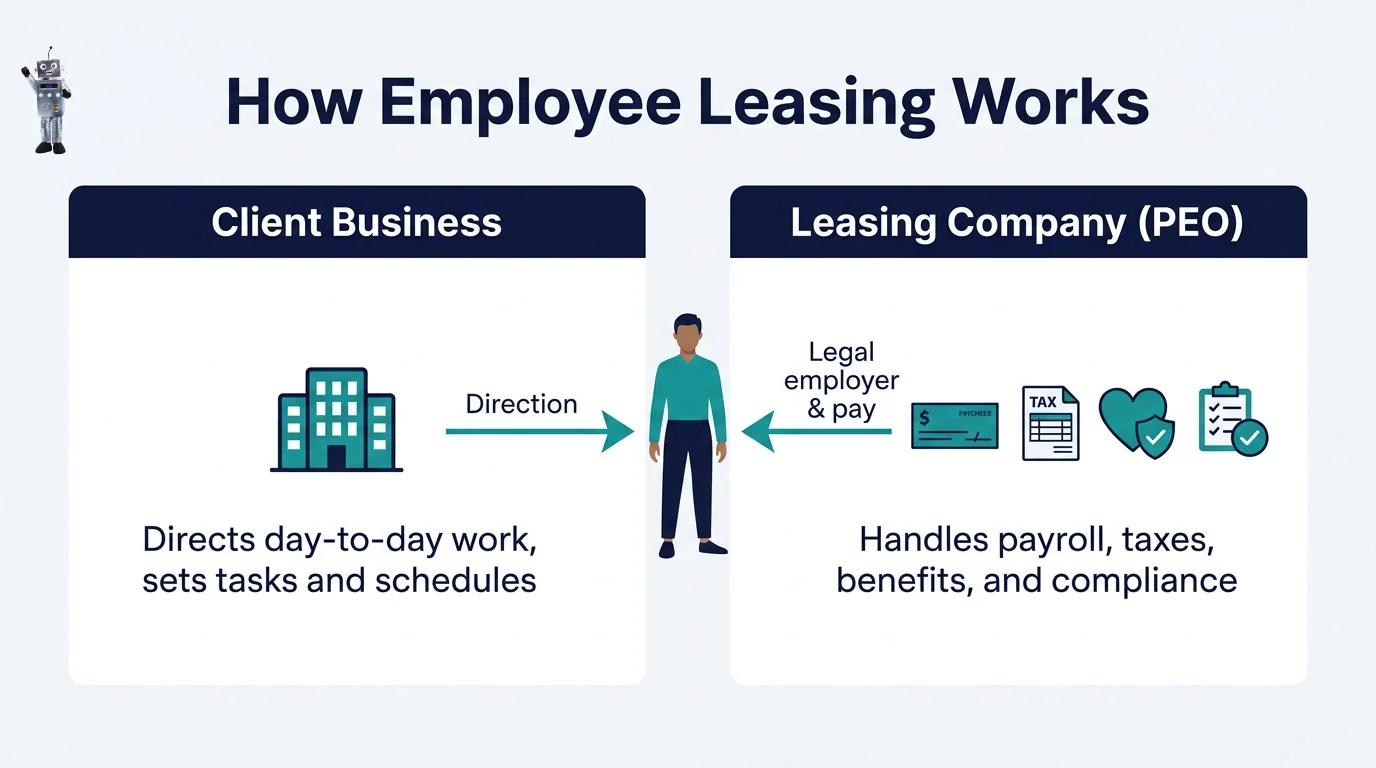
Employee leasing is an arrangement in which a business contracts with an outside firm that becomes the administrative and legal employer of its workers, running payroll and employment-tax administration, employee benefits, workers' compensation, and HR compliance, while the business keeps full day-to-day control of its people. It is the original term for what grew into the modern professional employer organization (PEO) and co-employment model. Today the phrase is used two ways, and the difference matters: it can mean a PEO-style co-employment arrangement that covers your existing staff, or a staffing arrangement in which a leasing firm supplies workers who remain that firm's employees. In the co-employment version, your employees still report to you, are hired and fired by you, and take direction from you; the leasing company handles the paperwork of being an employer, not the running of your business. The arrangement is governed by a written service agreement and is typically priced as a percentage of payroll or a flat fee per employee per month.

Employee Leasing Defined
"Employee leasing" is an umbrella term for an arrangement in which an outside firm takes on the administrative and legal role of employer for some or all of a company's workers, then delivers payroll, taxes, benefits, and HR compliance as a packaged service. In one sentence: employee leasing lets a small company hand the back-office side of employment to a specialist while keeping control of the actual work. The exact division of responsibility, and which party is the employer for which purpose, lives in a written service agreement, which an attorney should review. This is general HR guidance, not legal or tax advice.
A Note on the Term
The phrase carries some history. "Employee leasing" was the original name for the industry that became the modern PEO. As the model matured and the co-employment relationship was better defined in law, most reputable providers moved away from "leasing," which can wrongly imply workers are a rented commodity, toward "professional employer organization." The industry's association was even founded as a staff-leasing group before rebranding. Because of that history, you'll still see "employee leasing" used loosely today, sometimes for a genuine PEO relationship and sometimes for a temporary-staffing arrangement, so it's worth confirming which one a provider actually means.
The Defining Traits
- An outside firm becomes an employer of record: The leasing company or PEO takes on payroll, employment taxes, and benefits administration for the covered workers.
- Delivered as a bundle: Payroll, benefits, workers' comp, and compliance are handled together, not sold as separate one-off products.
- Pooled for scale: Your team is grouped with other clients' employees, which can unlock benefit plans and rates a small employer rarely reaches alone.
- Contractual: The scope, the division of duties, the fees, and the exit terms are all defined in a written service agreement.
- Control depends on the model: In a co-employment (PEO) arrangement you keep hiring, firing, pay, and direction; in a pure staffing-leasing arrangement the workers are the leasing firm's employees placed with you.
Key Terms
- Co-Employment: A contractual split in which two parties share employer responsibilities for the same workers, the basis of the PEO version of leasing.
- Employer of Record: The party responsible for payroll, employment taxes, and benefits administration.
- Worksite Employer: The client business that directs the day-to-day work.
- Service Agreement: The contract that defines the services, who is responsible for what, the fees, and how you exit.
Overview of Related Topics
- How It Works: The mechanics of the arrangement, step by step.
- Co-Employment: How responsibilities are split and what stays with you.
- Cost: How leasing arrangements are priced and what's bundled.
- Comparisons: How leasing differs from PEOs and staffing agencies.
- Getting Started: The practical steps for setting one up.

How Employee Leasing Works
Underneath the label, the mechanics are straightforward. A client business signs a service agreement with a leasing company or PEO. The provider becomes the employer of record for the covered workers, meaning payroll, employment taxes, and benefits run through the provider's accounts, while the client keeps directing the actual work. Here's how the pieces move.
The Basic Flow
- The agreement is signed: The contract defines who is covered, which services are included, how fees work, and how either side can exit.
- Workers are placed on the provider's payroll: For payroll and tax purposes, the covered employees are reported under the leasing company's or PEO's accounts.
- Payroll and taxes are processed: The provider calculates pay, withholds and remits federal, state, and local employment taxes, issues W-2s, and handles new-hire reporting and garnishments.
- Benefits are administered: Because your team is pooled with others, the provider can offer group health, dental, vision, and retirement plans, and manages enrollment and changes.
- Compliance is maintained: The provider supports areas like workers' comp, ACA reporting, and employment-law questions that are easy to get wrong.
- You keep running the business: Day-to-day supervision, scheduling, work assignments, and, in the co-employment model, hiring and firing decisions stay with you.
Two Versions You'll Encounter
The critical distinction is whose employees the workers are. In the co-employment (PEO) version, the workers are your existing staff; you and the provider share the employer role by contract, and you retain hiring, firing, and direction. In the staffing-leasing version, the leasing firm recruits and employs the workers, then places them with you for a period; the workers are the leasing firm's employees, not yours. Both get called "employee leasing," so always clarify which arrangement a provider is describing before you sign.

Understanding Co-Employment and Employer Responsibilities
The most common worry about employee leasing is losing control of your team. In the co-employment version, you don't. Co-employment splits the legal role of "employer" between two parties by contract: the leasing company or PEO handles the administrative and financial side, and you handle the operational side. Knowing exactly where the line falls is the single most important thing to understand before you sign.
What the Leasing Company Typically Handles
- Processing payroll and withholding, filing, and remitting employment taxes.
- Sponsoring and administering employee benefit plans, including enrollment and COBRA.
- Providing or arranging workers' compensation coverage and managing claims.
- Supporting HR compliance, documentation, and employment-law questions.
What Stays With You
- Hiring, disciplining, and, when necessary, terminating your own workers.
- Directing, scheduling, and supervising the day-to-day work.
- Setting pay levels, roles, duties, and business strategy.
- Owning your culture, your customers, and every operational decision.
Why the Split Matters
Because responsibilities are shared, both parties can carry certain employer obligations, and a well-written service agreement is what keeps the line clear. That's also why this isn't a software subscription: it's a real legal and financial relationship. Have an attorney review the agreement so you know precisely which duties, liabilities, and protections sit on each side before you commit.

Employee Leasing for Small Businesses
Large companies have benefits brokers, payroll departments, and full HR teams. A small business has the owner, maybe a part-time bookkeeper, and a stack of compliance deadlines nobody has time to track. Employee leasing exists to close that gap. By pooling your workers with others, a provider can give a small company the benefits, expertise, and infrastructure that normally only large employers can afford, without the headcount or the cost of building it. Here's where that shows up at small scale.
Benefits You Couldn't Buy Alone
On its own, a small employer has little leverage with insurance carriers and often faces steep rates and thin options. Inside a leasing arrangement's pool, your employees can access richer health, dental, vision, and retirement plans at rates a small group rarely gets, which can be the deciding factor when you're recruiting against bigger competitors.
Compliance You Can't Afford to Get Wrong
Payroll taxes, ACA reporting, COBRA, workers' comp, wage-and-hour rules, multi-state registration: the employment-law landscape is dense, and the penalties for missing a step are real. Leasing puts dedicated specialists on this work, lowering the odds that a busy owner makes a costly mistake out of sheer lack of time.
Time Back to Run the Business
Every hour spent reconciling payroll or chasing a benefits question is an hour not spent on customers, product, or growth. Handing the HR back office to a partner returns that time to the people the business most depends on.
What You're Really Weighing
Employee leasing isn't free, and it isn't right for everyone. You're trading a fee and some process standardization for benefits buying power, compliance coverage, and time. For many small and mid-size businesses the math works out clearly in favor of the arrangement, but the decision turns on your specific costs, your growth plans, and how much HR weight is currently falling on people better suited to be doing something else.

The Cost of Employee Leasing
Pricing looks confusing at first because providers quote it two different ways and bundle different things into the number. Once you know the two models, comparing offers gets much easier. This isn't financial advice (your actual cost depends on your size, wages, benefits, and risk profile), but here's how pricing generally works.
The Two Common Models
- Percentage of payroll: The fee is a set percentage of your total gross payroll. Because it scales with wages, this model can get more expensive as salaries rise, so read closely how it's calculated.
- Per employee per month (PEPM): A flat dollar amount per covered employee each month. This is more predictable and easier to compare across providers, since it doesn't move with your payroll dollars.
What's Usually Bundled Into the Fee
The administrative fee typically covers payroll processing, tax administration, HR compliance support, technology, and access to the provider's benefit and workers' comp programs. The cost of the benefits and workers' comp coverage your employees actually use is generally separate; you're paying for the plans on top of the service fee. A clear quote separates the administrative fee from the pass-through cost of benefits and insurance.
What to Watch For
Two providers can look far apart on sticker price yet land close on total cost once you account for what each includes. Ask what's bundled versus added, whether a percentage is charged on gross pay or a capped wage base, and how renewals and benefit-rate changes are handled. The right comparison isn't the lowest fee; it's the total value of the benefits, workers' comp, payroll, compliance, and technology you'd otherwise buy separately or staff for.

Step-by-Step Guide: How to Set Up an Employee Leasing Arrangement
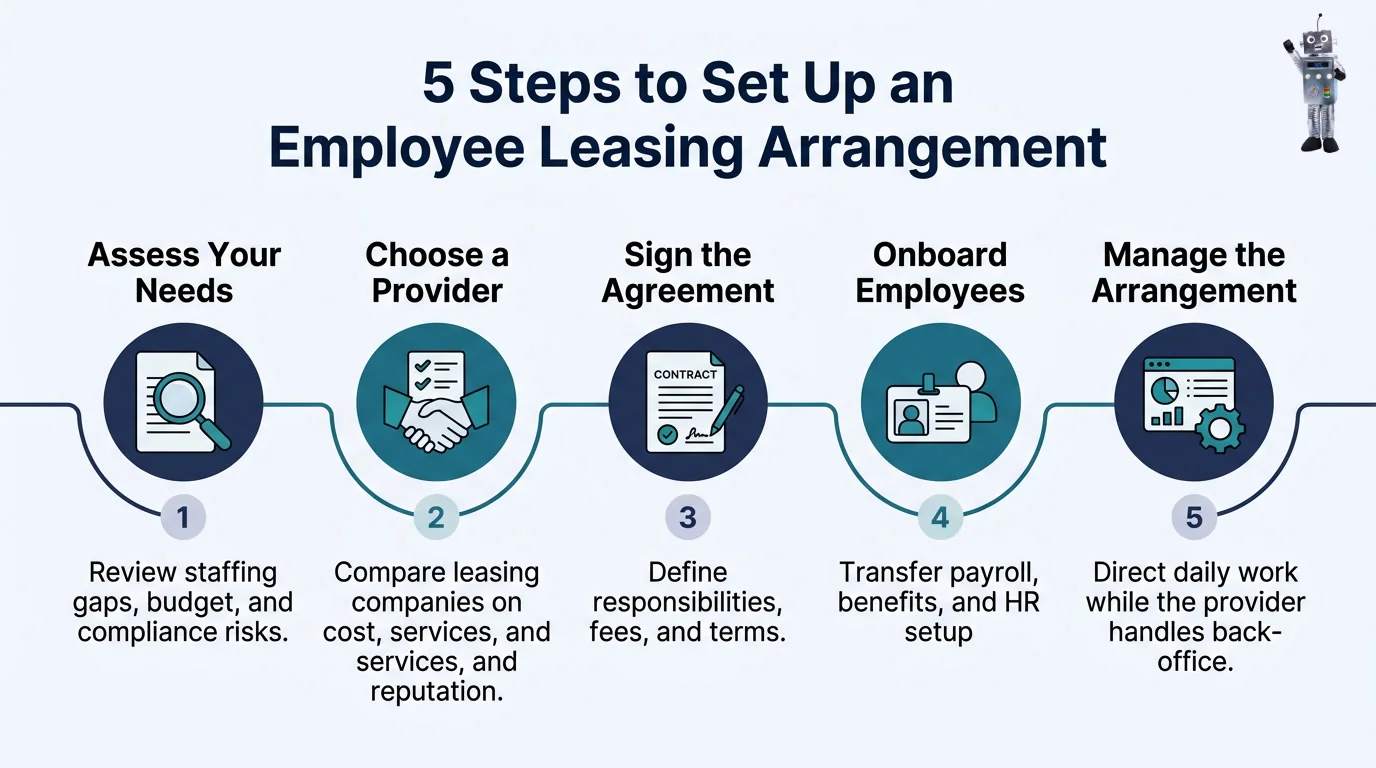
Setting up employee leasing is less about paperwork and more about choosing the right partner and bringing your team along. Here's the sequence that takes you from "we're drowning in HR" to a working arrangement that delivers.
- Assess What You Actually Need: Get specific about the pain: unaffordable health benefits, payroll-tax headaches, compliance you're unsure about, no time for HR, or losing candidates to bigger employers. The clearer your goal, the easier it is to judge each provider against it.
- Gather Your Numbers: Assemble an employee census (head count, locations, roles, salaries), your current benefits and their costs, recent payroll summaries, and your workers' comp and unemployment history. Providers need this to quote you accurately, and having it ready speeds everything up.
- Choose and Compare Providers: Get proposals from a few firms and compare them on the same terms: total cost, exactly which services are included, benefit carriers and plan quality, technology, and service model. Confirm whether each one means co-employment or staffing-style leasing.
- Read the Service Agreement Closely: This contract defines which services you get, who is responsible for what, how fees are structured, and, critically, how you exit. Have an attorney review it; this is a real legal and financial relationship.
- Plan Onboarding and Data Migration: Map how employee records, payroll history, and benefits enrollment will move over, and pick a go-live date that avoids mid-quarter tax complications where you can; the start of a quarter or year is often cleanest.
- Tell Your Team What's Happening and Why: Explain the arrangement plainly so no one fears losing their job or "working for another company." Frame it as an upgrade: better benefits and smoother HR, same job, same boss.
- Go Live, Then Manage the Relationship: Confirm the first few payrolls and benefit deductions are correct, then set a recurring check-in to make sure the arrangement keeps delivering as you grow and your needs change.

Benefits and Drawbacks of Employee Leasing
Employee leasing solves several expensive small-business problems at once, but it isn't a fit for everyone. The honest way to weigh it is to look at both sides.
The Benefits
- Enterprise-grade benefits at small-business scale: Pooling employees gives your team access to health, dental, vision, and retirement plans priced like a large employer's, a durable recruiting and retention advantage.
- Real compliance and risk protection: Specialists handle payroll taxes, ACA reporting, workers' comp, and employment-law questions that are easy to get wrong and costly to miss.
- Hours back every week: Offloading the HR back office returns time to the owner and managers, time that goes to customers and growth instead of administrative upkeep.
- Built-in technology: Most arrangements fold in an HR platform and an employee self-service portal you'd otherwise have to buy and manage yourself.
The Drawbacks
- Less process flexibility: You adopt the provider's systems and some of its standardized procedures, which can feel rigid compared with running HR your own way.
- Shared control and a real contract: Co-employment means shared responsibilities and a binding agreement, with exit terms you need to understand before you sign.
- Cost isn't trivial: The fee only pays off if the bundled value beats what you'd spend piecing the same services together; at very small or very lean setups the math can be closer.
- Provider risk: You're relying on the firm's stability, accreditation, and data practices, so the choice of provider matters as much as the decision itself.

Employee Leasing Compliance Checklist
Employee leasing carries real legal and financial weight, so the provider you choose matters as much as the decision to use one. Use this as a due-diligence pass before you sign. This isn't legal advice (have a qualified attorney review the service agreement), but these are the items that separate a safe, credible partner from a risky one.
Verify Registration and Standing
- The provider is properly registered or licensed in every state where you have employees.
- It carries recognized workers' comp risk-management accreditation where relevant.
- It can provide solid client references, ideally businesses similar to yours in size and industry.
- It is current on its own tax obligations, so its payroll-tax remittances on your behalf are dependable.
Understand the Services and Agreement
- Exactly which services are included is spelled out, and it's clear whether the arrangement is co-employment or staffing-style leasing.
- Fees are transparent and itemized, with the administrative fee separated from the cost of benefits and insurance.
- The benefit carriers, plans, and workers' comp coverage are named and acceptable to you.
- The termination and exit terms are clear, including how your employee and payroll data comes back to you if you leave.
Protect Your Business
- You've obtained a current certificate of insurance for workers' comp and other coverages.
- You understand who owns your employee data and how you retrieve it.
- You know what your HR looks like the day after you exit, so you're never stranded.

Employee Leasing vs. PEOs vs. Staffing Agencies
These terms get lumped together in confusing ways because they overlap, and because "employee leasing" is used for more than one thing. The key differences are whose employees the workers are, whether co-employment is involved, and how long the arrangement is meant to last. Here's how the main options compare.
| Option | Whose Employees? | Co-Employment? | Best For |
|---|---|---|---|
| Employee leasing (PEO-style) | Yours, co-employed | Yes (shared) | Handing your existing team's HR back office to a specialist while you keep control |
| Employee leasing (staffing-style) | The leasing firm's | No | Bringing in workers a firm recruits and employs, then places with you |
| PEO | Yours, co-employed | Yes (shared) | The modern, defined form of the co-employment model: full HR back office and pooled benefits |
| Staffing agency | The agency's | No | Temporary, seasonal, or project-based roles you don't intend to keep on your books |
The Short Version
The PEO is simply the mature, clearly defined version of the original "employee leasing" idea: you keep your people and your control, and a co-employer handles the administrative side under a service agreement. A staffing agency is different in that it employs the workers itself and lends them to you, usually for temporary or project work. The trouble is that "employee leasing" gets applied to both, so the single most useful question you can ask a provider is: are these my employees or yours? The answer tells you which of these lanes you're actually in.

Statistics & Outlook
The numbers help explain why the co-employment model that began as "employee leasing" has grown from a niche offering into a mainstream small-business tool. A few figures worth knowing; these come largely from NAPEO (the PEO industry association) and its commissioned research, and they're updated periodically, so treat them as a snapshot and check NAPEO for the latest figures.
What the Data Shows
- Faster growth. NAPEO-commissioned research has found that businesses using a PEO grow at more than twice the rate of comparable companies that don't.
- Lower turnover. PEO clients show employee turnover meaningfully lower than comparable non-clients, which is significant since turnover is expensive and disruptive for a small team.
- Better survival odds. Businesses that use a PEO have been found substantially less likely to go out of business than those that don't.
- Stronger economics. Industry research points to a positive average return on investment in cost savings alone, though your own numbers depend on your situation.
Industry Benchmarks
- Who uses them: PEOs serve hundreds of thousands of small and mid-size businesses, collectively employing several million people, with the client base skewing toward small employers.
- From leasing to PEO: The industry rebranded from "staff leasing" as the co-employment model was defined in law, which is why "employee leasing" now reads as the older name for it.
- Growth: The industry has expanded substantially over the past decade, a sign of how far the model has moved into the mainstream.
- Pricing models: Providers generally charge either a percentage of total payroll or a flat fee per employee per month; compare total value, not just the headline rate.
The Outlook
The clear trend is toward more outsourcing of HR, not less. As employment regulation grows more complex and small businesses compete for talent against larger employers, the case for pooled benefits and professional compliance keeps strengthening. For a small business, the practical takeaway is that leasing your HR back office, under whatever name a provider uses, is now a well-established, mainstream option, not an exotic one.

Topics
Is "Employee Leasing" the Same as a PEO?
Mostly, yes, with a caveat. "Employee leasing" was the original name for the co-employment model that is now called a PEO, so in that sense they describe the same thing. The caveat is that some providers still use "leasing" to mean a staffing arrangement where the workers are theirs, not yours. If a provider says "employee leasing," confirm whether they mean co-employment of your existing staff or the placement of their own workers.
Do You Keep Control of Your Team?
In the co-employment version, yes. Your employees still report to you, take direction from you, and are hired or let go by you. The provider administers the paperwork of employment (payroll, benefits, compliance) while every operational and business decision stays on your side. This is the single most common worry, and the answer is that control of the business never leaves your hands.
Employee Leasing and Multi-State Employers
If you employ people in more than one state, compliance multiplies fast: registrations, tax accounts, and varying labor laws. A capable provider already operates across states and can absorb much of that complexity, which is one of the more underrated reasons small companies with distributed or remote teams turn to leasing. Confirm the provider actively supports every state where you have workers.

Frequently Asked Questions
What is employee leasing?
Employee leasing is an arrangement in which a business contracts with an outside firm that becomes the administrative and legal employer of its workers, handling payroll, employment taxes, benefits, and HR compliance, while the business keeps day-to-day control of the work.
It is the original term for what grew into the modern PEO and co-employment model. The arrangement is defined by a written service agreement and typically priced as a percentage of payroll or a flat fee per employee per month.
Is employee leasing the same as a PEO?
Largely, yes. "Employee leasing" is the older name for the co-employment model now called a PEO, so they usually describe the same arrangement.
The one caveat is that some providers use "leasing" to mean a staffing arrangement in which the workers are the firm's employees placed with you, rather than co-employment of your existing staff. Always confirm which one a provider means.
Do I lose control of my employees with employee leasing?
In the co-employment version, no. Your employees still work for you, report to you, and are hired or let go by you. The provider covers the administrative and legal side of employment (payroll, taxes, benefits, compliance) while day-to-day management stays entirely yours.
The provider handles the paperwork of being an employer, not the running of your business. Control of operations never leaves your hands.
How much does employee leasing cost?
Providers typically price one of two ways: as a percentage of total payroll or as a flat fee per employee per month. The administrative fee usually covers payroll, tax, compliance, and technology, while the cost of the benefits and workers' comp your team uses is generally separate.
The right comparison isn't the sticker price but the total value of everything bundled in, measured against what you'd otherwise buy or staff for yourself.
Is employee leasing the same as using a staffing agency?
No, in the usual sense. A staffing agency employs the workers itself and lends them to you, typically for temporary, seasonal, or project work. The PEO-style leasing model co-employs your existing staff and keeps them on your team.
Because "employee leasing" is occasionally used for staffing too, the clearest question to ask a provider is whether the workers are your employees or theirs.
Key Takeaways
Employee leasing is an arrangement in which an outside firm becomes the administrative and legal employer of your workers, running payroll, employment taxes, benefits, workers' compensation, and HR compliance, while you keep day-to-day control of the work. It is the original name for what grew into the modern PEO and co-employment model, which is why the two terms usually describe the same thing. The one wrinkle worth remembering is that "employee leasing" is occasionally used for a staffing arrangement in which the workers are the firm's employees, so it always pays to ask whether the workers are yours or theirs.
The value is concrete: pooled buying power unlocks big-company benefits, dedicated specialists handle compliance you can't afford to get wrong, technology comes built in, and the owner gets hours back to run the business. The trade-off is a fee and some process standardization, plus reliance on the provider you choose, so weigh the bundled value against what you'd otherwise spend, and factor in the provider's stability and accreditation.
The decision turns as much on the provider and the contract as on the concept. This is a real legal and financial relationship governed by a service agreement, so compare what's actually included, confirm which model a provider means, and have an attorney review it. Choose well, and a small company gains a full HR department's worth of capability without the overhead of building one.