

What Are SMART Goals?
Quick Answer
SMART goals are objectives written to meet five criteria: Specific, Measurable, Achievable, Relevant, and Time-bound. The framework is a discipline for turning a wish ("grow the business," "improve customer service") into a clear target you can pursue and track. Each letter is a question that exposes a weak goal: Specific asks "what exactly, and who's responsible?" Measurable asks "how will I know it's done?" Achievable asks "is this realistic with the resources I have?" Relevant asks "does this actually matter to the business right now?" and Time-bound asks "by when?" The method was introduced by consultant George T. Doran in 1981 and has become the most widely used goal-setting framework in business. Here's why it matters for a small company: goals are where strategy meets daily work. A goal that's just "sell more" gives a team nothing to aim at, but "add 10 new retainer clients by December 31" tells everyone exactly what success looks like and when. SMART goals need no special software (a sentence and a deadline will do), but they do need to be written down, assigned, and reviewed, which is exactly where they tend to fall apart. For a small business, building SMART goals into annual planning and employee performance reviews is one of the cheapest ways to create accountability, and it's the kind of structure an HR or PEO partner helps put in place and keep running.
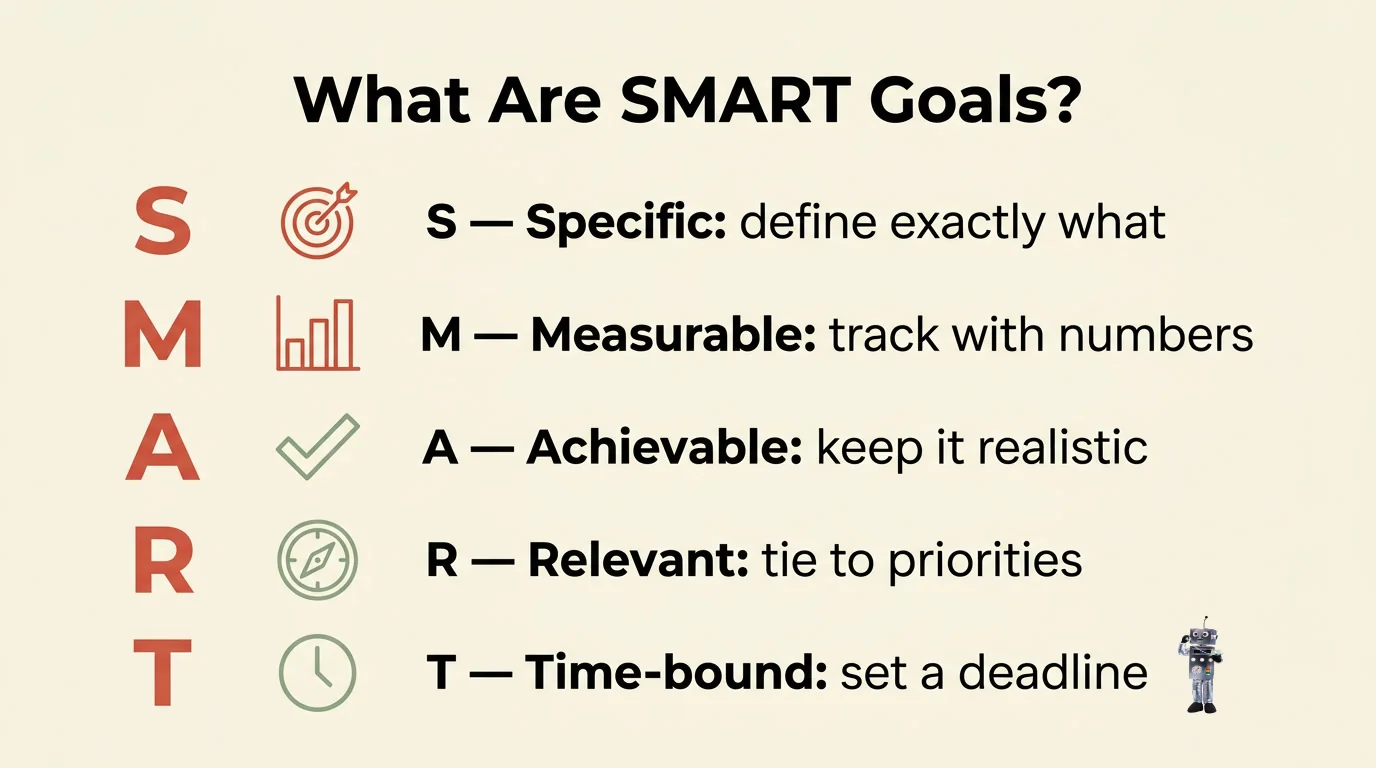

SMART Goals Defined
A SMART goal is an objective deliberately written so that all five of its qualities are present and obvious: it is Specific, Measurable, Achievable, Relevant, and Time-bound. The power isn't in the acronym itself; it's that each letter is a test. Run any goal through the five tests and the weak spots show immediately: the part that's still vague, the part you can't measure, the deadline you never set. A goal that passes all five reads as a single clear sentence that any team member could act on without asking what you meant. This is general guidance on a management framework, not a rigid rulebook, so adapt the wording to your business.
The Five Criteria
- Specific: The goal names exactly what will be accomplished and, ideally, who owns it. "Improve our website" is not specific; "reduce homepage load time to under two seconds" is. Specificity answers the questions of what, who, where, and which.
- Measurable: There's a number or a clear, observable result that tells you whether the goal is met. If you can't point to evidence of "done," the goal isn't measurable. Measurement is what lets you track progress instead of guessing at it.
- Achievable: The goal is realistic given your time, budget, and people. A stretch is healthy; an impossibility just demoralizes. (Some versions of the framework use Attainable for this letter.)
- Relevant: The goal connects to a larger business priority. A goal can be perfectly specific and measurable and still be a distraction if it doesn't move the things that matter. (Some versions use Realistic here instead.)
- Time-bound: The goal has a deadline or a defined review date. A goal without a date is a wish; the time frame is what creates urgency and lets you say whether you succeeded.
Key Terms
- Objective: The broad outcome you want: "grow revenue," "reduce turnover." A SMART goal is an objective sharpened until it's actionable.
- Metric: The specific number you'll watch to measure progress: dollars, percentage, count, days. The "M" in SMART lives here.
- KPI (Key Performance Indicator): An ongoing metric that signals the health of a business area. KPIs and the "Measurable" element overlap, but a KPI is a continuous gauge while a SMART goal is a one-time target with an end date.
- OKR (Objectives and Key Results): A related goal-setting system that pairs an ambitious objective with a few measurable key results. SMART and OKRs solve similar problems in different styles.
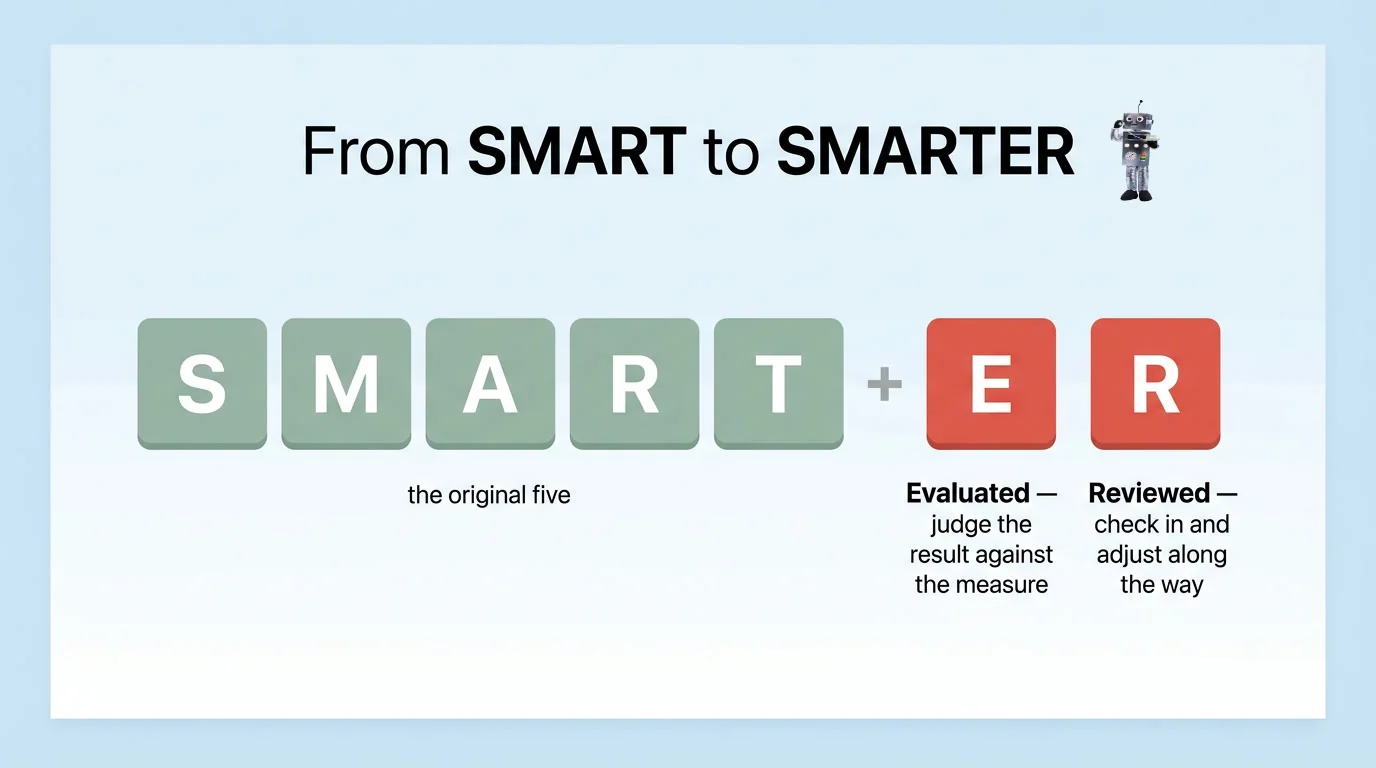
- SMARTER: An extended version that adds Evaluated and Reviewed, a reminder that goals need follow-up, not just a good start.
- Stretch Goal: A deliberately ambitious target meant to push performance beyond the comfortable. Useful, but it must still pass the "Achievable" test to avoid becoming discouraging.
Overview of Related Topics
- Writing a Goal Step by Step: The method for turning a vague aim into a goal that passes all five tests.
- Examples Across the Business: What SMART goals look like for sales, marketing, operations, and individual employees.
- The Goal Lifecycle: Setting a goal is the easy part; tracking, reviewing, and adjusting it is where results come from.
- SMART vs. Other Frameworks: How SMART relates to OKRs, KPIs, and the SMARTER variant.
- Common Mistakes: The handful of errors that quietly turn a SMART goal back into a vague one.

SMART Goals in a Small Business
Big companies have planning departments, dashboards, and a layer of managers whose whole job is keeping goals on track. A small business has none of that, which is exactly why a simple, repeatable goal framework matters more, not less. SMART goals give a small team the discipline of a much larger one without the overhead. Here's where they earn their keep.
Annual and Quarterly Planning
"Have a better year" is not a plan. SMART goals turn the owner's intentions into a short list of concrete targets (a revenue number, a hiring target, a margin improvement), each with a deadline. Breaking the year into quarterly SMART goals keeps the plan alive and gives the team natural checkpoints to course-correct.
Employee Performance Reviews
This is where SMART goals matter most for a small business. Vague reviews ("be more of a team player," "improve your communication") frustrate everyone because no one can tell whether they've succeeded. SMART goals make a review fair and concrete: a goal like "complete the QuickBooks certification by Q3" or "reduce order-entry errors to under 1% by year-end" gives the employee a clear target and gives the manager an objective basis for the next review. Consistent, written, measurable goals also protect the business; they document expectations the same way for everyone.
Accountability Without Micromanaging
In a small shop, the owner can't watch everything, and shouldn't. A clear SMART goal lets you hand someone an outcome rather than a to-do list: agree on the target and the deadline, then get out of the way. That's how small teams scale their effort: by aligning on "what done looks like" instead of supervising every step.
Employee Development and Retention
People stay where they're growing. Tying development goals to the SMART format (a skill to learn, a certification to earn, a project to lead, each by a date) turns "we'd like to invest in you" from a platitude into a plan. Building that into a regular review cycle is the kind of structure a small business often lacks and an HR or PEO partner can set up and run, giving the company a real performance-management system without hiring a full HR department to maintain it.

Step-by-Step Guide: How to Write a SMART Goal
Writing a SMART goal is mostly a matter of taking a rough idea and putting it through the five tests in order, then combining the result into one clear sentence. Here's the sequence that gets you from "we should do something about that" to a goal you can actually run.
- Start With the Objective: Write down what you broadly want, in plain language: "get more repeat customers," "cut shipping costs." Don't worry about precision yet; you just need the raw aim on paper.
- Make It Specific: Sharpen the objective until it names exactly what will happen and who owns it. "Get more repeat customers" becomes "launch a loyalty program that increases repeat purchases." Cut every word that could mean different things to different people.
- Make It Measurable: Attach a number or a clear definition of "done." How much, how many, by what measure? "Increase repeat purchases" becomes "increase repeat purchase rate from 18% to 25%." If you can't measure it, you can't manage it.
- Check That It's Achievable: Be honest about your time, budget, and people. Is a seven-point jump realistic this year, or should it be four? A goal you have no path to hit isn't motivating; it's discouraging. Adjust the target until it's a stretch you believe in.
- Confirm It's Relevant: Ask whether hitting this goal actually moves a priority that matters now. If repeat purchase rate isn't tied to your real bottleneck, the most beautifully written goal is still a distraction. Keep it only if it earns its place.
- Set the Time Frame: Add a deadline, and a review point or two along the way. "By December 31" turns the goal from open-ended to urgent. For longer goals, set interim checkpoints so you're not surprised at the finish line.
- Write It as One Statement: Combine the pieces into a single sentence anyone could act on: "Increase our repeat purchase rate from 18% to 25% by December 31 by launching a customer loyalty program." If it reads clearly and passes all five tests, it's done.
- Schedule the Review: Decide now when you'll check progress, monthly or quarterly, and put it on the calendar. A goal nobody revisits is the single most common reason SMART goals fail. The review is part of the goal, not an afterthought.

SMART Goals Examples
The fastest way to understand the framework is to watch a vague goal become a SMART one. In each pair below, the first line is the kind of goal businesses actually write; the second is the same intention run through the five tests. Notice that the SMART version is always longer; that's the point. The extra words are the specificity, the number, and the deadline that make it real.
Business & Revenue
- Vague: "Grow the business this year."
SMART: "Increase total revenue by 15%, from $1.2M to $1.38M, by December 31, 2026, by adding two new commercial accounts per quarter." - Vague: "Improve our profit margins."
SMART: "Raise gross margin from 38% to 42% by the end of Q3 by renegotiating our two largest supplier contracts and reducing material waste."
Sales
- Vague: "Sell more."
SMART: "Each rep books 20 qualified demos per month through the end of Q2, increasing the team's monthly closed deals from 12 to 18." - Vague: "Follow up with leads faster."
SMART: "Respond to every inbound lead within one business hour, measured weekly, starting next Monday."
Marketing
- Vague: "Get more website traffic."
SMART: "Grow organic search traffic 30% over the next six months by publishing two SEO articles per week." - Vague: "Be more active on social media."
SMART: "Publish three LinkedIn posts per week for the next quarter and grow the company page following from 800 to 1,200."
Employee Performance & Development
- Vague: "Get better at your job."
SMART: "Complete the HubSpot inbound certification by the end of Q3 and apply it by building two automated email sequences." - Vague: "Make fewer mistakes."
SMART: "Reduce order-entry error rate from 3% to under 1% by year-end through a new two-step verification checklist."
HR & Operations
- Vague: "Hire some help."
SMART: "Fill two open warehouse positions with fully onboarded employees by August 15." - Vague: "Reduce turnover."
SMART: "Lower voluntary employee turnover from 22% to 15% over the next 12 months by launching quarterly stay interviews and a structured review cycle."

The Goal-Setting Process: A SMART Goals Roadmap
Writing the goal is the beginning, not the end. A SMART goal that's filed away and never touched is no better than a vague one; the results come from the lifecycle that follows. Walking every goal through the same path keeps it alive and turns a good sentence into an actual outcome.
1. Set the Goal
Run the objective through the five tests and write it as one clear statement, with an owner attached. The owner matters: a goal that belongs to "the team" in the abstract belongs to no one. This is the step the rest of the framework is built on.
2. Break It Into Actions
Translate the goal into the handful of concrete steps that will actually move it: the loyalty program to build, the contracts to renegotiate, the calls to make. A goal without a short action list is a destination with no route.
3. Track Progress
Watch the number you chose to measure. This can be as simple as a shared spreadsheet or a line on a whiteboard updated weekly. The act of tracking is what keeps the goal in view; what gets measured gets attention.
4. Review & Adjust
At the checkpoints you scheduled, look honestly at where things stand. Behind? Decide whether the plan needs to change or the target was unrealistic. Ahead? Consider whether to raise the bar. Reviewing isn't admitting failure; it's how a goal stays useful as conditions change.
5. Evaluate the Outcome
When the deadline arrives, judge the result against the measure plainly: hit, missed, or partial. Resist the urge to move the goalposts after the fact. A clear yes-or-no is what makes the next round of goals more accurate.
6. Reset for the Next Cycle
Feed what you learned into the next goal: a more realistic target, a better metric, a tighter timeline. Goal-setting is a loop, not a one-time event. For a small business, building that loop into a regular review rhythm is the part most likely to slip, and exactly the recurring discipline an HR or PEO partner can help install and keep running.

The SMART Goals Checklist
Use this as a quick self-audit before you commit to a goal. If you can't answer "yes" to every question in the first group, the goal isn't SMART yet, so keep sharpening it until you can. None of this is complicated; the discipline is doing it every time.
The Five Tests
- Specific: Could a new employee read this goal and know exactly what to do, without asking what you meant?
- Measurable: Is there a number or a clear, observable result that tells you whether it's done?
- Achievable: Do you have a realistic path to hit it with the time, budget, and people you actually have?
- Relevant: Does hitting this goal move a priority that matters to the business right now?
- Time-bound: Is there a deadline, and at least one review point before it?
Before You Commit
- The goal is written down, not just discussed.
- One named person owns it.
- It's broken into a short list of concrete actions.
- You're not committing to too many goals at once; a small team can usually carry three to five, not fifteen.
While It's Running
- Progress is tracked somewhere visible and updated on a set rhythm.
- Review checkpoints are on the calendar, not left to chance.
- The goal is adjusted when circumstances genuinely change, and only then.
- The final result is evaluated plainly against the original measure.

Topics
SMART Goals vs. OKRs
OKRs (Objectives and Key Results) are the other framework you'll hear about, popularized at Intel and Google. They're cousins, not competitors. An OKR pairs one ambitious objective with a few measurable key results, and those key results usually look a lot like SMART goals. The practical difference is tone and scale: SMART goals are designed to be realistic and achievable, while OKRs deliberately aim high and expect you to fall a little short. Many small businesses use SMART goals for individual and operational targets and reserve OKRs (if at all) for company-wide ambition.
| Feature | SMART Goals | OKRs |
|---|---|---|
| Best for | Individual, team, and operational targets | Company-wide alignment and ambition |
| Difficulty | Realistic and achievable by design | Deliberately ambitious; ~70% is "success" |
| Structure | One goal meeting five criteria | One objective + 3-5 key results |
| Time frame | Whatever deadline you set | Usually quarterly, with annual objectives |
| Feel | Concrete and grounded | Aspirational and stretch-oriented |
The SMARTER Variant
Some practitioners extend the acronym to SMARTER, adding Evaluated and Reviewed. It's less a new framework than a built-in reminder of the most-skipped step: that a goal needs follow-up. If your team reliably reviews and evaluates its goals already, the extra letters are redundant, but for businesses that tend to set goals and forget them, SMARTER bakes the cure into the name.
How KPIs Relate to "Measurable"
KPIs (Key Performance Indicators) and SMART goals are often confused because both involve numbers. The clean distinction: a KPI is an ongoing gauge of business health (monthly revenue, customer churn, on-time delivery rate) that you watch continuously. A SMART goal is a one-time target with a finish line. They work together: a KPI often supplies the metric for a goal's "Measurable" element ("raise on-time delivery from 91% to 97% by Q4"), and hitting that goal shifts the KPI you keep watching afterward.
Cascading Goals Across a Team
In a well-run business, goals connect top to bottom. A company goal ("grow revenue 15%") cascades into department goals (sales, marketing), which cascade into individual goals, each one SMART, each one supporting the level above it. Cascading is what keeps everyone's effort pointed the same direction and keeps the "Relevant" test honest, because every goal can trace a line up to a company priority.
Who Does What
- Owner / Manager: Sets the top-level goals, ensures each one is genuinely SMART, and protects the review rhythm so goals don't drift.
- Employee: Owns their individual goals, tracks their own progress, and raises a flag early when a target is slipping.
- HR / PEO Partner: Builds goal-setting into the performance-review cycle, supplies templates and documentation, and keeps the process consistent across the whole team, the structure a small business rarely has time to maintain itself.

Common Mistakes to Avoid
Most failed goals aren't failures of ambition; they're failures of one of the five tests, or of follow-through. These are the errors that quietly turn a SMART goal back into a vague one.
Vague Metrics
"Improve customer satisfaction" sounds measurable but isn't, because there's no actual measure attached. The fix is to name the number and the source: "raise our average review rating from 4.1 to 4.5 stars," "cut support response time to under four hours." If you can't say what you'll look at, the goal isn't measurable yet.
No Deadline
A goal without a date is the most common mistake of all. "Eventually" never arrives, and without a finish line there's no urgency and no way to call the goal a success or a miss. Every goal needs a real date, and most need an interim checkpoint too.
Unrealistic Targets
Setting a goal you have no path to hit feels motivating for about a week, then becomes a source of discouragement everyone quietly stops believing in. Ambition is good; fantasy isn't. The "Achievable" test exists precisely to catch this: stretch the target until it's hard and credible.
Too Many Goals at Once
A team that's chasing fifteen priorities is really chasing none. Focus is a feature of good goal-setting, not a limitation of it. For a small business, three to five active goals is usually the ceiling before attention fragments and nothing gets the push it needs.
Set and Forget
The goal looks great in January and is never mentioned again. This is why the SMARTER variant exists. Without a review rhythm, even a perfectly written goal drifts out of sight. Put the checkpoints on the calendar the day you set the goal.
Goals Disconnected From Strategy
A goal can pass four of the five tests and still fail "Relevant": it's specific, measurable, achievable, and timed, but it doesn't move anything that matters. Before committing, trace each goal up to a real business priority. If you can't, it's busywork dressed up as a target.

Frequently Asked Questions
What does SMART stand for?
SMART stands for Specific, Measurable, Achievable, Relevant, and Time-bound. Each letter is a test a goal should pass: it names exactly what will happen, attaches a number you can measure, stays realistic, ties to a real priority, and has a deadline.
Some versions swap in close substitutes (Attainable for Achievable, or Realistic for Relevant), but the five tests are essentially the same. The wording matters less than running every goal through all five.
Who created SMART goals?
The framework was introduced by consultant George T. Doran in a 1981 article in Management Review titled "There's a S.M.A.R.T. Way to Write Management's Goals and Objectives." It built on earlier management-by-objectives thinking and has since become the most widely used goal-setting method in business.
Because it's been adapted so many times over the decades, you'll see slightly different words behind some letters; that variation is normal and doesn't change how the framework is used.
What's the difference between SMART goals and OKRs?
Both are goal-setting frameworks, but they differ in ambition and structure. SMART goals are designed to be realistic and achievable, written as a single goal meeting five criteria. OKRs pair one ambitious objective with a few measurable key results and deliberately aim high; hitting around 70% is often considered success.
Many small businesses use SMART goals for individual and operational targets and reserve OKRs, if they use them at all, for company-wide stretch ambitions. The two can coexist; an OKR's key results are often written as SMART goals.
How many SMART goals should I set at once?
For most small teams, three to five active goals at a time is the practical ceiling. Beyond that, attention fragments and nothing gets the focus it needs. Goal-setting is as much about deciding what not to chase as what to pursue.
It's usually better to fully achieve a few meaningful goals than to half-finish a dozen. If your list is longer, rank it and stage the goals across quarters rather than running them all at once.
Are SMART goals good for employee performance reviews?
Yes. They're one of the most useful tools a small business has for reviews. Vague feedback like "improve your communication" frustrates everyone because no one can tell whether it was achieved. A SMART goal gives the employee a clear, measurable target and gives the manager an objective basis for the next review.
Written, measurable goals applied consistently also help document expectations fairly across the whole team, which is exactly the kind of structure an HR or PEO partner can help build into a regular review cycle.
Can you give a simple SMART goal example?
A vague goal like "get more customers" becomes SMART when it reads: "Increase our repeat purchase rate from 18% to 25% by December 31 by launching a customer loyalty program." It names the exact outcome, attaches numbers you can measure, stays realistic, ties to revenue, and sets a deadline.
The SMART version is always longer than the vague one; the extra words are the specificity, the metric, and the date that make the goal real and trackable.
Key Takeaways
SMART goals are objectives written to be Specific, Measurable, Achievable, Relevant, and Time-bound. The framework, introduced by George T. Doran in 1981, works because each letter is a test that exposes a fuzzy goal: what exactly, how will I measure it, is it realistic, does it matter, and by when. Run any goal through all five and the weak spots show immediately.
For a small business, the value is concrete: SMART goals turn annual planning into a short list of real targets, make employee performance reviews fair and measurable, and create accountability without micromanaging. They need no special software (a clear sentence and a deadline will do), but they do need to be written down, assigned to one owner, and reviewed on a rhythm. The most common ways they fail are vague metrics, no deadline, unrealistic targets, chasing too many at once, and setting them and never looking again.
The hardest part isn't writing a good goal; it's keeping the whole loop running: tracking progress, reviewing at the checkpoints, and feeding what you learn into the next cycle. That recurring discipline, built into a consistent performance-review process across the whole team, is exactly the structure a small business tends to let slip and an HR or PEO partner is built to install and maintain, giving a small company the goal-setting infrastructure of a much larger one without the overhead.