
Employee Onboarding
What Is Onboarding?
Onboarding is the steps through which new employees are integrated into an organization following hire. It typically encompasses required government paperwork, orientation sessions, role-specific training, systems access setup, policy review, and introductions to team members and culture. For organizations, effective onboarding accelerates time-to-productivity, strengthens early engagement, and directly reduces first-year attrition.
Core Components
- Government-Required Paperwork: Ensures completion of legally mandated employment forms — including the I-9 (Employment Eligibility Verification), W-4 (Federal Tax Withholding), and applicable state withholding and new hire reporting forms — before or on the employee's first day. These forms carry strict legal deadlines and employer penalties for non-compliance, making them the highest-priority administrative step in any onboarding program.
- Orientation: Introduces new hires to company policies, organizational structure, and workplace culture, typically completed within the first one to three days.
- Role-Specific Training: Equips employees with the technical skills, tools, and workflows required to perform job functions independently.
- Systems & Access Setup: Covers provisioning of IT credentials, software licenses, and equipment necessary for day-one productivity.
- Policy & Compliance Review: Ensures completion of required documentation including NDAs, benefits enrollment, acknowledgment of the employee handbook, and any mandatory compliance training.
- Cultural & Social Integration: Connects new hires to team norms, internal communication channels, and key stakeholders to accelerate engagement and belonging.
Overview of Related Topics
- Key Roles & Ownership: HR designs the program and manages compliance; direct managers own role clarity and 30/60/90-day goal setting; IT and Facilities handle systems provisioning before the start date.
- Delivery Models: Onboarding runs in-person, remotely, or in combination with deadlines spanning a single day to structured 90-day programs. Larger organizations use HRIS platforms and LMS tools to automate delivery and track completion.
- Measurement & Effectiveness: Primary KPIs are time-to-productivity, 90-day retention rate, and new hire satisfaction scores collected via surveys at 30 and 90 days.

Key Roles, Delivery Models & Measurement
Key Roles & Ownership
- HR/People Operations: Designs program structure, manages compliance documentation (including government-required employment forms), coordinates benefits enrollment, and maintains audit-ready records.
- Direct Manager: Sets role expectations, owns the 30/60/90-day milestone framework, and drives daily integration into team workflows.
- IT & Facilities: Responsible for equipment readiness, system access provisioning, and workspace setup completed prior to the hire's first day.
Delivery Models
- In-Person Onboarding: Conducted on-site, enabling direct introductions, hands-on systems training, and immediate access to workplace resources. In-person onboarding also simplifies the physical document inspection required for I-9 verification.
- Remote Onboarding: Delivered via video conferencing, HRIS portals, and LMS platforms; requires structured virtual touchpoints to maintain engagement and clarity. Remote programs must account for authorized I-9 representatives when employees are not physically present at a company location.
- Structured Timeline Programs: 30/60/90-day frameworks stage milestones, set measurable expectations, and create defined checkpoints for early performance evaluation.
Measurement & Effectiveness
- Time-to-Productivity: Tracks the duration from start date to independent performance; benchmarks vary by role complexity and seniority level.
- 90-Day Retention Rate: Measures whether new hires remain past the highest-risk attrition window; directly correlates with program quality and manager involvement.
- New Hire Satisfaction Scores: Pulse surveys administered at 30 and 90 days assess program clarity, perceived support, and early cultural fit.

A Closer Look
Onboarding is the process through which organizations integrate new employees from their first day through their early weeks and months of employment. A well-designed employee onboarding process begins with completing legally required government paperwork and proceeds through orientation, role-specific training, systems access, compliance documentation, benefits enrollment, and introduction to company culture and structure. It exists because organizations that leave new hires to navigate their roles without structure pay a measurable cost — in slower productivity, lower engagement, and higher first-year turnover. Understanding what onboarding is, and doing it well, reflects an organization's commitment to setting every person up to contribute with clarity and confidence.
The new employee onboarding experience is owned collaboratively across functions. HR designs the program, manages compliance requirements — including the timely collection of government-mandated employment forms — and coordinates administrative components that must be completed before and during the first week. Direct managers take responsibility for role clarity, goal-setting, and day-to-day integration. IT and Facilities ensure systems and workspaces are ready before the hire's start date. New hires depend on this structure to become productive contributors as quickly as possible. Organizations that invest seriously in onboarding have higher retention rates, faster time-to-productivity, and stronger early engagement scores — outcomes that directly affect workforce stability and the return on recruiting investment.
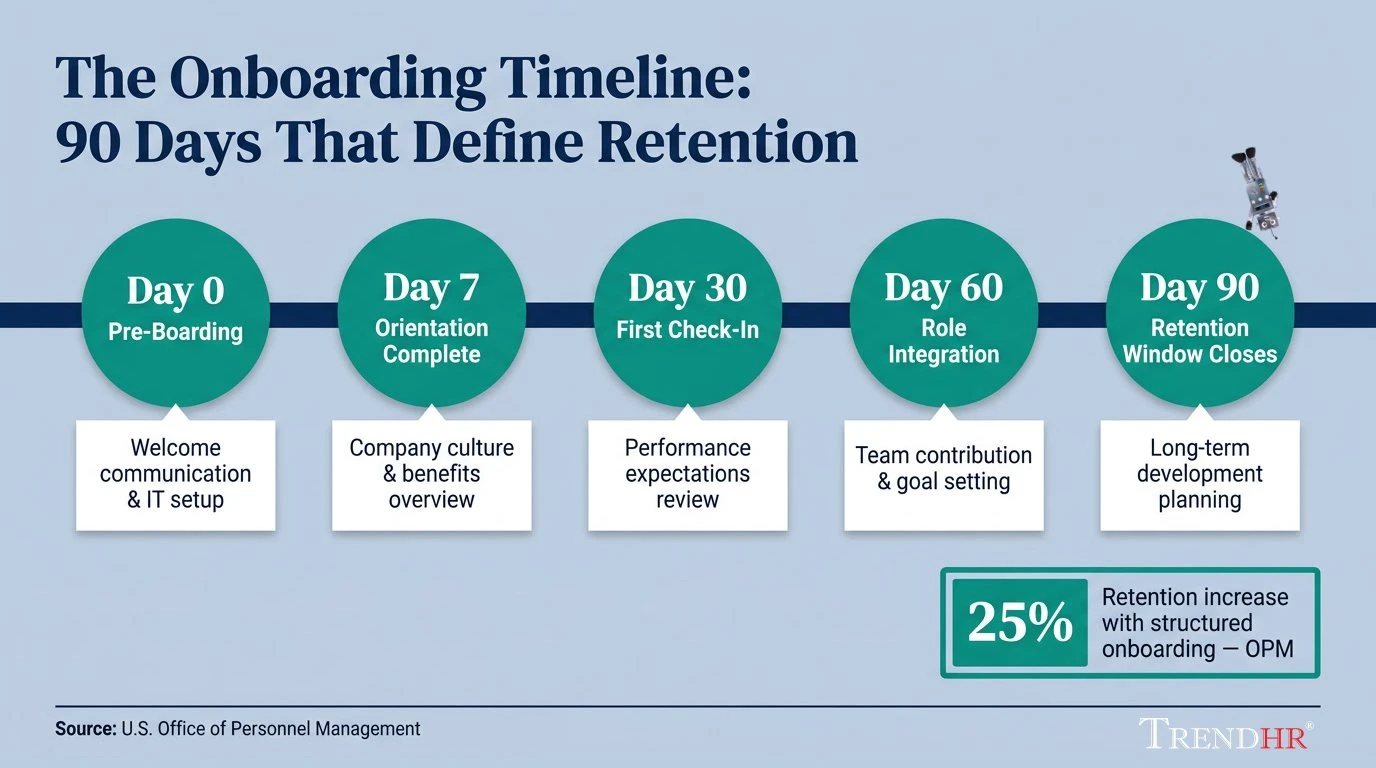
Key Infographic Statistic at a Glance
- 25% retention — increase with structured onboarding (U.S. Office of Personnel Management (OPM) Training and Development Policy),

Statistics & Outlook
Onboarding is the structured process of integrating new employees from job offer acceptance through their first year of employment, encompassing required government paperwork, orientation, role-specific training, systems provisioning, compliance documentation, and cultural assimilation. The U.S. Office of Personnel Management (OPM) defines onboarding to include "new employee socialization, orientation, and training" — distinguishing it from the narrower, administrative function of orientation alone. Despite its importance, only 12 percent of employees report that their company does a great job with onboarding, and only 29 percent of new hires feel prepared and supported to excel in their new role according to Gallup.
The business case for investing in a formalized new hire onboarding program is well-documented. Research cited by OPM's Training and Development Policy framework found that successfully onboarding employees during their first year of service increases engagement, raises retention by as much as 25 percent, improves performance, and hastens the time to full productivity. Organizations that approach onboarding as a strategic, year-long process — rather than a single-day orientation event — see measurable returns in workforce stability, faster time-to-productivity, and stronger early engagement scores. Building a consistent, structured onboarding program is one of the highest-leverage investments businesses can make in HR.

Technology in Onboarding
Core Technology Platforms & Systems
Onboarding today is supported by several interconnected platform categories. Human resource information systems (HRIS) serve as the central record-keeping backbone, housing employee data from offer acceptance through active employment. Dedicated onboarding modules — either built into an HRIS or deployed as standalone new hire experience platforms — coordinate task assignment, document collection, and progress tracking, including the routing and storage of government-required forms such as the I-9 and W-4. Learning management systems (LMS) deliver and record completion of mandatory training, compliance certifications, and role-specific content. Identity and access management systems handle credential provisioning, ensuring new hires have system access on day one.
Workflow Automation & Process Optimization
Automation has substantially reduced the manual burden of onboarding administration. Workflow builders and integration engines now automate task sequencing — triggering IT provisioning requests upon an offer's acceptance, routing benefits enrollment forms to the appropriate administrators, delivering W-4 and state withholding forms for electronic completion before day one, and sending timed check-in reminders to hiring managers. Automation handles repetitive data entry across systems.
Document & Data Management
Onboarding generates significant documentation: offer letters, government-required employment forms, tax withholding elections, benefits enrollments, policy acknowledgments, and compliance certifications. Electronic signature platforms have replaced paper-based execution, reducing processing time from days to minutes — and many now support compliant I-9 remote verification workflows. Cloud-based document management repositories store completed forms with access controls and audit trails, supporting compliance with recordkeeping requirements. In regulated industries, records management systems enforce retention schedules aligned with federal and state documentation standards, including the specific retention rules governing I-9 forms.
AI & Emerging Technologies
Artificial intelligence is reshaping onboarding at multiple touchpoints. Intelligent document processing tools extract and validate data from submitted forms automatically. Personalization engines are increasingly used to tailor onboarding content sequences by role, location, and seniority level.
Integration & Interoperability
Onboarding touches HR, IT, Finance, Legal, and Operations simultaneously, making integration a persistent challenge. Application programming interfaces (APIs) connect otherwise siloed systems — ensuring that a new hire's data entered once in the applicant tracking system flows accurately into the HRIS, payroll, benefits, and access management systems without re-entry. Organizations with unified technology ecosystems report fewer data errors, faster provisioning, and a more consistent new hire experience.
Skills & Adoption
HR professionals managing onboarding programs increasingly need fluency in workflow configuration, data reporting, and system administration — not just process design. Common adoption barriers include resistance from hiring managers unfamiliar with digital task platforms and inconsistent usage across departments. Successful implementations pair technology rollouts with structured training, clear ownership of each workflow step, and ongoing measurement of completion rates and new hire satisfaction to drive continuous improvement.

Key Performance Indicators (KPIs)
Tracking KPIs connects program design to business outcomes — enabling HR leaders to identify where new hires disengage, where process gaps create delays, and where investment produces measurable returns. Organizations that treat onboarding as a measured function rather than a one-time event make faster, evidence-based decisions about program design, resource allocation, and manager enablement.
Core Operational KPIs
| KPI | Formula | Target |
|---|---|---|
| Time-to-Productivity | Days from start date to independent performance at role benchmarks, assessed by manager | 60–90 days for professional roles; varies by complexity |
| 90-Day Retention Rate | (New hires retained past day 90 ÷ total new hires) × 100 | >85%; below 75% signals program or hiring quality issues |
| Onboarding Task Completion Rate | Completed tasks by deadline ÷ total assigned tasks × 100 | >95% for compliance-critical items |
| Government Form Completion Rate | Forms completed within legal timeframe ÷ total required × 100 | 100%; any miss represents direct legal exposure |
| Time-to-Fill vs. Time-to-Contribute | Recruitment velocity compared against days to meaningful output | Alignment between hiring speed and program readiness |
| Manager Readiness Score | Pre-boarding steps completed by manager before start date ÷ total steps × 100 | 100% of pre-boarding steps completed before day one |
Financial & Cost-Efficiency KPIs
| KPI | Formula | Target |
|---|---|---|
| Cost-per-Onboard | Total onboarding program costs ÷ number of new hires processed in period | Benchmarks vary by industry and role level |
| First-Year Turnover Cost | Recruiting + training + lost productivity costs for a departing employee | Minimize; commonly 50–200% of annual salary by role seniority |
| Benefits Enrollment Error Rate | Administrative errors requiring correction ÷ total enrollments × 100 | <1%; each error carries direct cost and compliance exposure |
Quality & Satisfaction KPIs
| KPI | Description | Target |
|---|---|---|
| New Hire Satisfaction Score (NHSS) | Surveys at 30 and 90 days measuring perceived support, role clarity, and cultural fit | >70%; scores below 70% are a leading indicator of early attrition |
| Hiring Manager Satisfaction Score | Survey of managers on program quality and new hire preparedness | Identifies gaps between HR-designed content and actual role requirements |
| Compliance Training Completion Rate | Audited completion of mandatory certifications by regulatory deadlines | 100%; non-compliance carries direct legal and financial risk |
| Onboarding Experience Index (OEI) | Composite score combining task completion, NHSS, and manager engagement data | Trending upward quarter-over-quarter; benchmark to industry cohorts |
| Digital Adoption Rate | Speed and depth of new hire engagement with core technology platforms during onboarding | Correlates early system fluency with long-term productivity |
Onboarding KPIs should be reviewed at a monthly cadence at the operational level and quarterly at the strategic level. Dashboards need to distinguish leading indicators — task completion rates, manager readiness scores — from lagging indicators like 90-day retention and first-year turnover cost. Assigning metric ownership across HR, IT, and hiring managers creates cross-functional accountability.

Frequently Asked Questions
What Is Onboarding?
Onboarding is the structured process through which organizations integrate new employees from the moment an offer is accepted through their first year of employment. It begins with completing legally required government paperwork and extends through orientation, role-specific training, compliance documentation, systems access, and cultural assimilation — and when done well, it is one of the highest-impact investments an organization can make in its workforce.
Understanding what onboarding is, why it matters, and how to execute it effectively is a strategic priority for HR leaders and business executives alike.
What government forms are required during onboarding?
Every new hire in the United States requires completion of a core set of government-mandated forms before they can legally begin work or receive their first paycheck. Federal Forms: Form I-9 (Employment Eligibility Verification) is required for every employee hired in the United States — the employee must complete Section 1 on or before their first day of work, and the employer must complete Section 2 within three business days of the start date. Form W-4 (Employee's Withholding Certificate) determines federal income tax withholding and should be completed before the first paycheck is processed. State Forms: Most states require a state income tax withholding form, new hire reporting to the state's designated agency within 20 days of hire, and state-specific labor law notices. For many smaller organizations, completing these government forms constitutes the entirety of their onboarding process — but regardless of how robust or minimal the broader program is, these forms must always be completed accurately and on time.
What is the purpose of employee onboarding?
The purpose of employee onboarding is to accelerate a new hire's transition from candidate to fully contributing team member by providing the structure, information, and support they need to succeed. A well-designed new hire onboarding program addresses four core needs simultaneously: compliance (completing required government documentation and mandatory training), clarification (establishing role expectations and performance goals), connection (building relationships with colleagues and leadership), and culture (helping new hires internalize organizational values and ways of working).
The business case is well-supported by data. Research cited by the U.S. Office of Personnel Management found that effective onboarding raises retention by as much as 25 percent and accelerates time to full productivity. Onboarding also signals organizational credibility — a new hire's early experience shapes their long-term perception of the employer, making the quality of the onboarding process a direct reflection of company culture.
What is the difference between onboarding and orientation?
Orientation is a single event; onboarding is a sustained process — and confusing the two is a common mistake organizations make in their new hire programs. Orientation refers to the formal, often first-day or first-week activity in which new hires complete paperwork, receive introductions, and review company policies. Onboarding, by contrast, is the broader, longer-arc program that encompasses orientation but extends far beyond it — HR and staffing professionals consistently recommend that structured onboarding span a minimum of 90 days, with best-in-class programs running a full 12 months. A practical way to distinguish the two: orientation answers "What do I need to know to start?" while onboarding answers the larger question "What do I need to become effective and stay?" Organizations that conflate the two typically see the consequences in their metrics: lower new hire satisfaction scores, slower time-to-productivity, and higher first-year attrition rates.
How long should the onboarding process take?
The onboarding process should last a minimum of 90 days, with the most effective programs extending to 12 months for full role and cultural integration. The widespread assumption that onboarding ends after the first week is one of the primary contributors to preventable early attrition. The 90-day retention rate is the most-watched early-tenure metric in workforce analytics because it defines the highest-risk window for new hire departure. Employees who exit within this period represent a near-total loss of recruiting and onboarding investment. The appropriate length of onboarding also varies by role complexity and seniority — an entry-level hire may reach independent performance within 60 days, while a senior leader or technical specialist may require a full year. Program design should account for these differences rather than applying a single timeline uniformly across all positions.
What does effective onboarding include?
Effective onboarding includes six core components: government-required paperwork, pre-boarding, formal orientation, role-specific training, cultural integration, and structured performance check-ins across the first 90 days. Government-required paperwork — the I-9, W-4, and applicable state forms — is the foundational first step and carries direct legal consequences if mishandled. Pre-boarding begins between offer acceptance and the first day, delivering benefits information, completing administrative paperwork digitally, and ensuring IT credentials and workspace setup are completed before arrival. Formal orientation covers organizational structure, policy review, and compliance training, and is best delivered over several days to avoid information overload. Role-specific training equips the new hire with tools and workflows specific to their position; cultural integration connects new hires to team norms and organizational values. Finally, structured check-ins at 30, 60, and 90 days provide a feedback loop that helps managers correct course before disengagement becomes departure.
Why does onboarding matter for employee retention?
Onboarding matters for employee retention because the first 90 days of employment represent the highest-risk period for voluntary departure — and the quality of that experience is one of the most significant predictors of whether a new hire stays. Research consistently shows that structured onboarding programs reduce first-year attrition and improve long-term engagement. Employees who go through a structured new employee onboarding experience are significantly more likely to remain with the organization at the three-year mark according to Gallup. The retention link is driven by three mechanisms: effective onboarding establishes role clarity, builds early social connection, and demonstrates employer credibility. Gallup estimates that new hire turnover can cost six to nine months of an employee's salary to onboard a replacement — making onboarding one of the clearest examples of a people investment with a quantifiable return on retention, productivity, and workforce stability.
Key Takeaways
Onboarding is not a single event but a structured, sustained process that directly shapes whether new employees become productive, engaged, and retained contributors. It begins with a non-negotiable foundation: the completion of legally required government forms — the I-9, W-4, and applicable state forms — that every employer must collect accurately and on time regardless of how minimal or sophisticated the broader program is. From there, when designed with intentionality — spanning pre-boarding through the 90-day mark and beyond — onboarding delivers measurable returns in retention rates, time-to-productivity, and new hire satisfaction.
As workforce expectations continue to evolve and competition for talent remains intense, the quality of an organization's onboarding program has become a meaningful differentiator in both the candidate experience and the employee lifecycle. HR leaders who treat onboarding as a strategic function — measured, iterated, and resourced accordingly — position their organizations to realize the full value of every hire from day one.