

Equal Employment Opportunity Commission (EEOC)
Quick Answer
The Equal Employment Opportunity Commission is the federal agency that enforces the laws banning workplace discrimination — Title VII, the Americans with Disabilities Act, the Age Discrimination in Employment Act, the Equal Pay Act, the Genetic Information Nondiscrimination Act, and the Pregnant Workers Fairness Act — and it's the agency that investigates when an employee files a charge of discrimination. Most of these laws apply once you have 15 employees (20 for age, and essentially every employer for equal pay), and the employer duties come down to a short list of habits: make job decisions on ability rather than a protected trait, apply your policies consistently, train your managers, take internal complaints seriously, and never punish someone for raising a concern or filing a charge. Retaliation is the single most-cited basis in EEOC charges, and it's often easier to prove than the discrimination claim underneath it. If a charge does land, the real danger usually isn't the decision you made — it's ignoring the notice, blowing the position-statement deadline, destroying records, or reacting against the employee. You don't need an in-house legal department to handle this — you need consistent practices, a calm response, and good documentation, all of which an HR or PEO partner can help you put in place if you don't have it already.
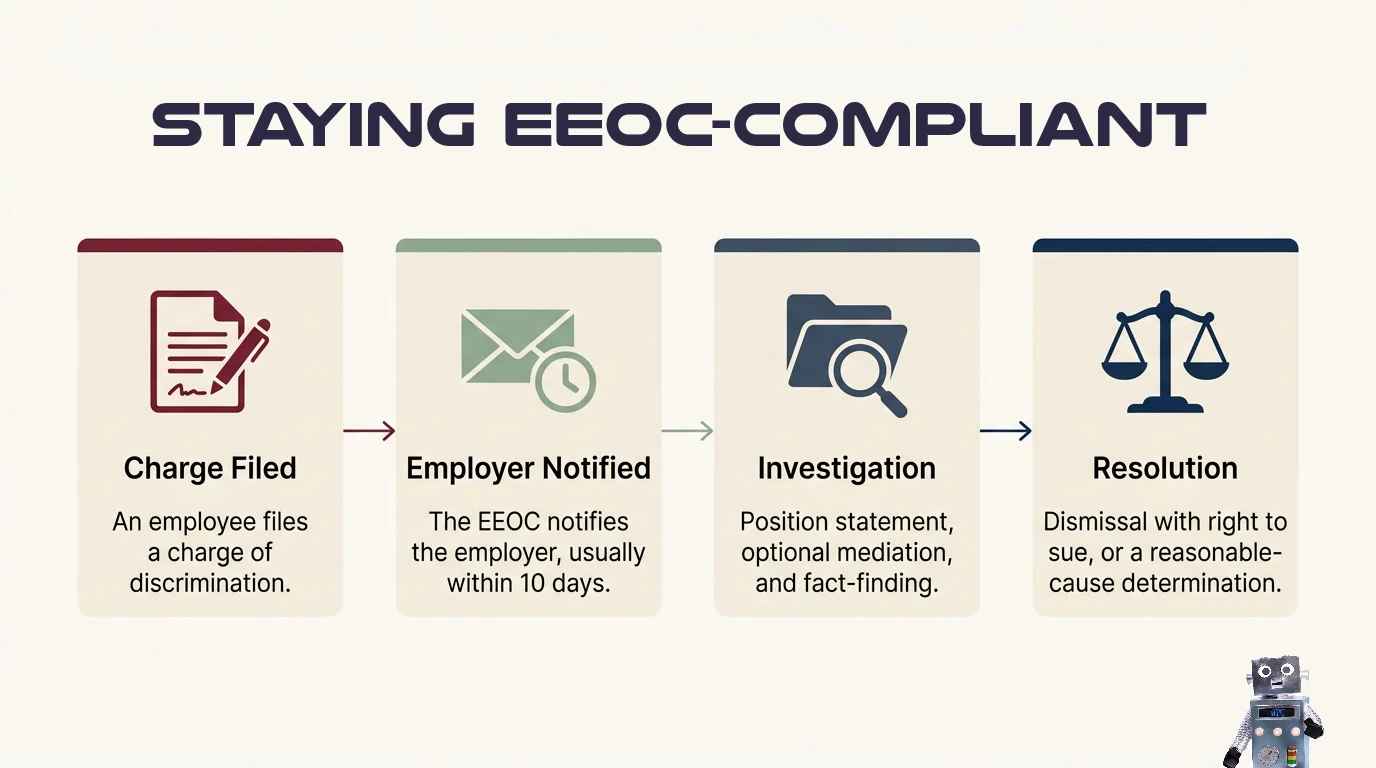
Step-by-Step Guide to Staying EEOC-Compliant
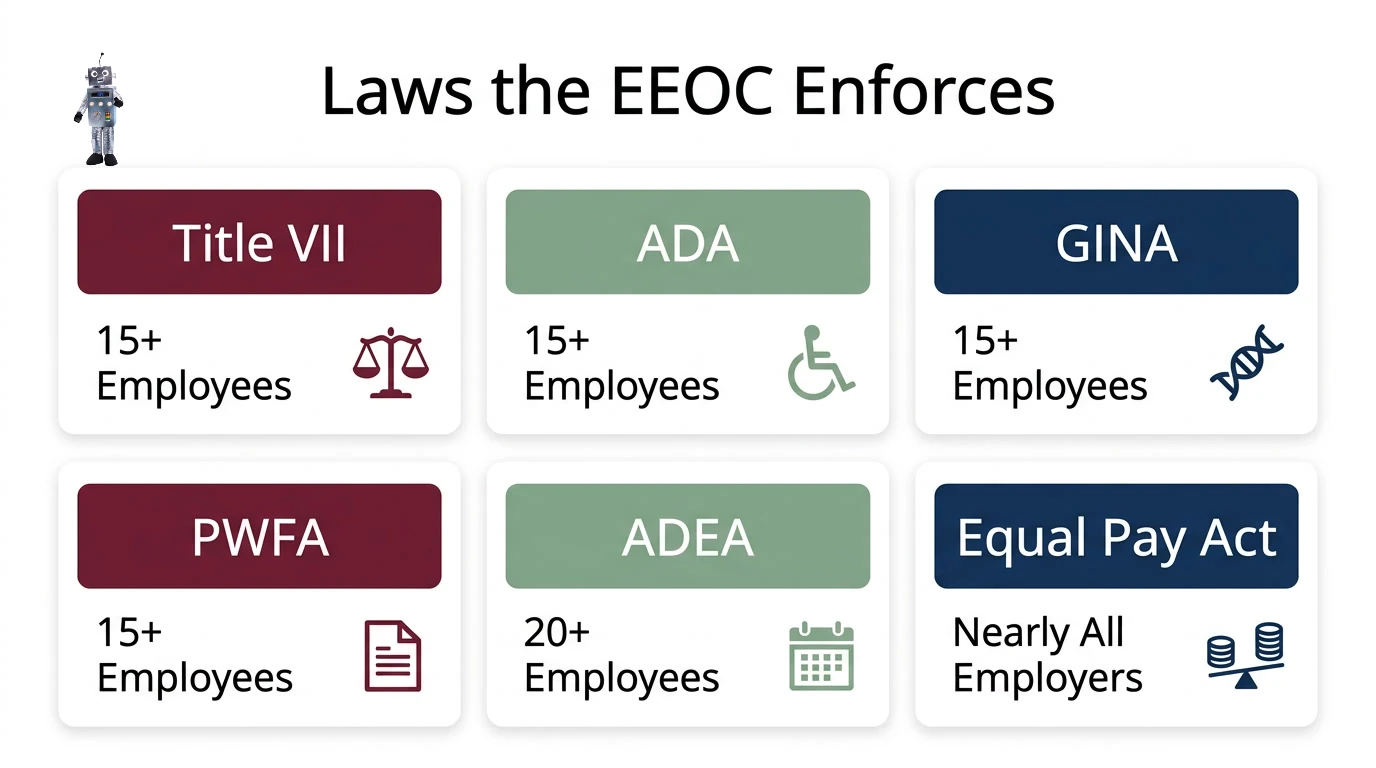
- Know Whether the EEOC's Laws Apply to You: Most of the laws the EEOC enforces — Title VII, the ADA, GINA, and the Pregnant Workers Fairness Act — cover employers with 15 or more employees; the age-discrimination law (ADEA) kicks in at 20; and the Equal Pay Act applies to virtually every employer regardless of size. Headcount is measured across the weeks of the year, not by full-time-equivalents, and many states have their own fair-employment agencies that reach far smaller employers. If you're at or near 15, treat the rules as live.
- Build Fair, Job-Related Employment Practices: The surest way to stay clear of the EEOC is to make every employment decision — hiring, pay, promotion, discipline, termination — on job-related criteria you can explain, and to apply your policies the same way to everyone. Write down the reason for significant decisions when you make them. Consistency is both the right thing and your strongest defense if a decision is ever questioned.
- Post Required Notices and Keep Your Records: Covered employers must display the EEOC's "Know Your Rights" poster where employees can see it (a printable version is on eeoc.gov). Keep personnel and employment records for the required periods, and if you have 100 or more employees — or are a federal contractor at the applicable size — confirm whether you must file the annual EEO-1 workforce report.
- Train Managers on What the Law Prohibits: Most problems start with a front-line decision. Make sure anyone who hires, disciplines, or supervises understands the protected categories, what they can and can't ask in an interview, how to recognize and stop harassment, and — above all — that punishing someone for complaining is itself illegal. Their training is usually the weakest link and the cheapest to fix.
- Take Every Internal Complaint Seriously: A complaint to a manager or HR is your chance to fix a problem before it becomes a charge. Have a simple way for employees to raise concerns, investigate promptly and fairly, document what you did, and follow up. An employer who handled a complaint well is in a far stronger position than one who ignored it.
- Never Retaliate: Once someone complains, asks for an accommodation, files a charge, or takes part in an investigation, they're protected. Cutting their hours, cooling toward them, a sudden bad review, or a termination soon after invites a retaliation claim — the most common charge the EEOC sees, and one that can stick even when the original complaint doesn't. Keep treating the person normally and document any independent business reason for later decisions.
- Respond Properly If a Charge Arrives: Don't ignore it and don't react against the employee. The EEOC notifies you, usually within 10 days, through its online Respondent Portal, and asks for a written position statement and documents, generally within about 30 days. Calendar the deadline, preserve all related records, and respond factually. This is the moment a contested situation is most often won or lost.
- Document Everything and Fix Root Causes: Whatever the outcome of a complaint or charge, write down what happened and what you did, and address the underlying issue — retraining a manager, clarifying a policy, correcting a pay gap. A documented, good-faith response and a real fix are what keep one incident from becoming a pattern.
- Get Help for Complex or Systemic Issues: A single tricky termination, a pay-equity question, a charge that could become a class or "systemic" matter, or anything tangled up with an accommodation or leave is worth an HR professional or employment attorney's time before you act. It's far cheaper than untangling it after a determination.

The EEOC in a Small Business
For a small business, the EEOC rarely arrives as a dramatic accusation. It arrives as an envelope or a portal notice weeks or months after an ordinary moment that didn't seem like much at the time — a termination, a passed-over promotion, a complaint a manager waved off, a comment that should have been stopped. What you did in that moment, and whether you wrote anything down, decides whether the charge is a routine matter you can answer or a real problem. You don't have an HR department to catch these or a lawyer down the hall to call, so the outcome depends on whether an owner or manager made the decision for a reason they can explain, handled any complaint seriously, and never reacted against the person for speaking up.
Most Risk Is in the Response, Not the Original Decision
It's a common misread to think a charge means you've already lost. It doesn't. Many charges end with no finding of wrongdoing, and most are resolved without a lawsuit. What turns a defensible situation into a costly one is usually the handling: ignoring the notice, missing the deadline to respond, throwing away records once you know there's a dispute, or — most damaging of all — punishing the employee for filing. Employers get into trouble far more often for how they reacted than for the underlying decision. A calm, documented response is a strong position; silence, destruction, or retaliation is a weak one.
Retaliation Is the Trap, Not the Complaint
The instinct to distance yourself from an employee who has complained or filed is natural and dangerous. Retaliation — any materially adverse action taken because someone engaged in protected activity — is the most frequently cited basis in EEOC charges, and it's frequently easier to prove than the discrimination it followed, because the timing tells the story. The safe move is to keep treating the person exactly as you would have, make any later decision for a documented, independent reason, and make sure your managers understand that "getting back" at a complainer is the one thing most likely to create liability where none existed.
An Ounce of Prevention Is Cheap
Almost everything the EEOC's laws ask of a small employer is inexpensive to do well: fair and consistent decisions, a posted notice, trained managers, a way to receive complaints, and a no-retaliation rule everyone understands. The expense comes from skipping these and then scrambling after a charge. This is exactly the kind of routine compliance an HR or PEO partner can carry — policies, manager training, the required postings, recordkeeping, and a calm hand if a charge ever comes in — giving a small business the protection of a much larger one without the overhead.
Documentation Is What Protects You
"We treated everyone fairly" tells an investigator nothing; a dated record tells them everything. The reason for the decision, the complaint and what you did about it, the consistent application of a policy — that file is the difference between a charge you can answer in a paragraph and one you have to reconstruct from memory. In a small business this is the piece most likely to be skipped, and the easiest to hand to an HR or PEO partner whose job is to keep it clean and current.

Equal Employment Opportunity Commission Definition
The U.S. Equal Employment Opportunity Commission (EEOC) is the federal agency that enforces the nation's laws against employment discrimination. Created by Title VII of the Civil Rights Act of 1964 and operating since 1965, it is the sole federal agency authorized to investigate and bring lawsuits against private-sector employers for violating these laws. The EEOC investigates charges of discrimination, attempts to settle them, issues guidance, collects workforce data, and litigates in the public interest. It is led by a bipartisan, five-member Commission appointed by the President and confirmed by the Senate, with no more than three members from the same political party; the Commission's enforcement priorities shift with each administration, but the underlying statutes do not. For a small business, the EEOC isn't an abstraction — it's the agency behind the rules that govern how you hire, pay, manage, and part with employees, and the body that will contact you if a worker files a charge. This is general information, not legal advice, and some rules vary by state, so confirm the specifics for yours.
Who and What the EEOC Covers
- Covered Employer: Coverage depends on the law: 15 or more employees for Title VII, the ADA, GINA, and the Pregnant Workers Fairness Act; 20 or more for the Age Discrimination in Employment Act; and essentially all employers for the Equal Pay Act. The count includes full- and part-time workers across the weeks of the year. State fair-employment laws often reach much smaller employers, so being under 15 doesn't always mean you're outside the rules.
- Protected Characteristics: The EEOC's laws prohibit discrimination based on race, color, religion, sex (including pregnancy, and — under the Supreme Court's 2020 Bostock decision — sexual orientation and gender identity), national origin, age (40 and over), disability, and genetic information. They also forbid retaliation against anyone who asserts these rights.
- Charge of Discrimination: The formal, signed complaint an employee or applicant files with the EEOC alleging unlawful discrimination. With one exception (the Equal Pay Act), filing a charge is a required first step before an individual can sue under these laws.
- Charging Party & Respondent: The "charging party" is the person who files the charge; the "respondent" is the employer responding to it. Much of the process runs through the EEOC's online portals for each side.
Key Terms
- Position Statement: The employer's written response to a charge, setting out the facts and any legal or factual defenses. It's the centerpiece of your response and is shared with the charging party, who may reply.
- Mediation: A voluntary, confidential settlement process the EEOC offers early on. If both sides agree, a neutral mediator helps them try to resolve the charge — often faster and cheaper than a full investigation.
- Reasonable Cause & Determination: After investigating, the EEOC issues a finding. If it can't conclude the law was violated, it issues a dismissal; if it finds reasonable cause to believe discrimination occurred, it issues a Letter of Determination and invites the parties to resolve it.
- Conciliation: The informal settlement effort that follows a reasonable-cause finding. If conciliation fails, the EEOC may sue or issue the charging party a notice allowing them to sue.
- Notice of Right to Sue: The document that lets the charging party file a lawsuit in court. Once issued, they generally have 90 days to file.
- Retaliation: A materially adverse action taken against someone because they engaged in protected activity — complaining, requesting an accommodation, filing a charge, or assisting an investigation. It's separately illegal under every EEOC-enforced law.
Overview of Related Topics
- Step-by-Step Guide to EEOC Compliance: A practical process — from knowing whether you're covered, through fair practices, posting, training, and complaint handling, to responding correctly if a charge arrives — sized for a team without an HR department.
- Laws the EEOC Enforces: The specific statutes behind the agency's authority — Title VII, the ADA, the ADEA, the Equal Pay Act, GINA, and the PWFA — and what each one requires.
- Who Does What: EEOC compliance in a small business is carried by a few people — the owner or manager who decides, the supervisor who fields complaints, an HR or PEO partner who supplies process and training, and an employment attorney for the hard cases.
- Compliance Considerations: Coverage thresholds, filing deadlines, the charge process, required postings and recordkeeping, EEO-1 reporting, state fair-employment agencies, and the central role of anti-retaliation.
- Measuring Effectiveness: A few simple signals — were complaints logged and resolved, were managers trained, were decisions documented, were charges avoided — that tell you whether your approach is working.

Topics
Laws the EEOC Enforces
- Title VII of the Civil Rights Act (1964): The foundational law, banning discrimination based on race, color, religion, sex (including pregnancy, sexual orientation, and gender identity), and national origin. It covers hiring, firing, pay, promotion, harassment, and every other term of employment, and applies at 15 or more employees.
- Americans with Disabilities Act (ADA), Titles I & V: Prohibits disability discrimination and requires reasonable accommodation for qualified individuals unless it's an undue hardship; Title V bars retaliation. Applies at 15 or more employees.
- Age Discrimination in Employment Act (ADEA): Protects workers and applicants 40 and over from age-based discrimination. Applies to private employers with 20 or more employees.
- Equal Pay Act (EPA): Requires that men and women be paid equally for substantially equal work in the same establishment. It applies to virtually all employers, and an employee can sue under it without first filing a charge.
- Genetic Information Nondiscrimination Act (GINA): Bars employers from using genetic information — including family medical history — in employment decisions, and restricts how such information may be acquired. Applies at 15 or more employees.
- Pregnant Workers Fairness Act (PWFA): Requires covered employers to provide reasonable accommodations for known limitations related to pregnancy, childbirth, or related medical conditions, through an interactive process much like the ADA's. Applies at 15 or more employees.
Who Does What
- Owner / Manager: Makes the employment decisions, ensures they're job-related and consistent, and owns the response if a charge arrives. In a small business this one person carries what a large company spreads across managers, HR business partners, and a legal team.
- Direct Supervisor: Usually the first to hear a complaint and the one whose day-to-day conduct creates or prevents most exposure. They have to recognize a complaint, respond without retaliating, and route it correctly — which is why their training is the highest-value, easiest fix.
- HR / PEO Partner: Supplies the compliance layer — anti-discrimination and anti-harassment policies, manager training, required postings, complaint-intake and investigation procedures, recordkeeping, EEO-1 reporting, and hands-on help drafting a position statement if a charge comes in — the specialist knowledge a small company can't justify hiring full-time.
- Employment Attorney: Brought in for the harder cases — a contested termination, a potential class or systemic charge, a reasonable-cause determination, or anything likely to end in litigation. Cheaper before the decision or response than after a finding.
- EEOC Investigator: The neutral agency staffer who handles the charge — notifying the employer, reviewing the position statement and evidence, offering mediation, and recommending a finding. They are fact-finders, not advocates for either side.
Regulatory & Compliance Considerations
- Coverage Thresholds: 15 employees for Title VII, the ADA, GINA, and the PWFA; 20 for the ADEA; and essentially all employers for the Equal Pay Act. Counting is by headcount across the calendar weeks of the year. State laws frequently reach smaller employers.
- Filing Deadlines: An employee generally has 180 days from the alleged discrimination to file a charge, extended to 300 days where a state or local agency enforces a comparable law (most states). The Equal Pay Act is the exception — an employee may sue directly within two years (three for willful violations). Federal-sector complaints follow a separate 45-day process.
- The Charge Process: The EEOC notifies the employer within about 10 days, requests a position statement and documents (generally within 30 days), may offer mediation, and investigates — a process that often takes around ten months and ends in a dismissal or a reasonable-cause determination.
- Postings & Recordkeeping: Covered employers must display the "Know Your Rights" poster and retain personnel and employment records for the periods set by the EEOC's regulations and the ADEA. Larger employers (generally 100+, or federal contractors at the applicable threshold) must file the annual EEO-1 demographic report.
- State & Local Agencies (FEPAs): Most states have a Fair Employment Practices Agency that enforces a parallel law, often covering smaller employers and offering additional protected categories. The EEOC and these agencies share charges through work-sharing agreements, so a single complaint can implicate both.
- Retaliation & Interference: Every law the EEOC enforces independently prohibits retaliation against someone for asserting their rights or participating in the process — and retaliation is the single most-cited charge basis, frequently easier to prove than the underlying claim.
Measuring Effectiveness
- Were Complaints Logged & Resolved: Every internal complaint — however informally raised — should be captured, investigated, and closed out, not lost in a hallway conversation.
- Were Managers Trained: Supervisors current on protected categories, lawful interviewing, harassment, and the absolute rule against retaliation. Manager conduct drives most exposure.
- Were Decisions Documented: Significant employment decisions tied to a recorded, job-related reason and applied consistently — the simplest defense there is.
- Were Charges & Findings Avoided: EEOC charges, reasonable-cause findings, and retaliation complaints tracked over time; a clean or improving record is the clearest sign the process is working.

What to Do When an EEOC Charge Arrives: A Response Roadmap
Receiving a charge of discrimination is the EEOC moment small businesses are least prepared for and most likely to mishandle — and it's the part where a calm, correct response matters most. A charge is not a finding; it's a notice that someone has complained and the agency is looking into it. What you do in the next few weeks shapes the outcome far more than the original decision did. The roadmap below lays out that response step by step so you can follow it the moment a notice lands, rather than improvising under pressure or, worse, reacting against the employee. It takes the guesswork out of the highest-stakes EEOC situation a small business faces and leaves you with a record you can stand behind.
The charge arrives — don't ignore it, don't react
You'll typically get notice within about 10 days of filing, through the EEOC's Respondent Portal. Read it carefully, note the deadline, and resist two opposite urges: doing nothing, and doing something to the employee. Both make things worse.
Preserve records and freeze any adverse action
Put a litigation hold on everything related to the charge — emails, personnel files, notes, schedules — and stop any pending discipline or termination of the charging party until you've taken advice. Destroying records or retaliating now is the fastest way to turn a weak charge into a strong one.
Calendar the deadline and decide who handles it
The EEOC generally asks for a position statement and documents within about 30 days. Diarize it, and decide early whether you'll handle it yourself or loop in an HR/PEO partner or employment attorney — sooner is cheaper than later.
Decide whether to mediate
The EEOC often offers voluntary mediation up front. It's confidential, faster, and not an admission of anything — a good option for resolving a misunderstanding or a low-exposure dispute early.
Investigate internally and write the position statement
Get the real story: talk to the people involved, pull the documents, and lay out the legitimate, non-discriminatory reasons for what happened. Respond to the specific allegations, attach supporting records, and keep it factual — it will be shared with the charging party.
Cooperate with the investigation
Answer the EEOC's follow-up requests for information, witnesses, or documents promptly and completely. Cooperation shortens the process and signals good faith; stonewalling invites subpoenas and inferences against you.
The determination — and what comes next
The agency closes the charge one of two ways. Either outcome may still allow the employee to sue, so a clean record matters regardless.
Document the resolution and fix the root cause
However it ends, keep the complete file and address what allowed the dispute to arise — retrain a manager, clarify a policy, correct a pay gap. The point isn't just to close this charge; it's to prevent the next one.
Where the Roadmap Saves a Small Business
The value of following these steps is the value of any checklist for a rare, high-stakes event: it forces the right moves in the right order before stress or hurt feelings take over. It also tells you where to spend money — a routine charge with a clear, documented reason is often answerable in-house with a solid position statement, while a reasonable-cause determination, a possible systemic or class charge, or anything bound up with a termination is worth an employment attorney's time before you respond. Keep the completed file; it's both your compliance and your defense.

EEOC Compliance Checklist
Use this checklist as the backbone of EEOC compliance — for setting up your basics, for handling complaints as they come, and for responding if a charge is ever filed. Adapt it to your business and your state's rules, but keep every item something you can mark done or not done. None of it requires a big system; consistent practices, a few documents, and trained managers will do, and an HR or PEO partner can handle the policies, postings, training, and recordkeeping if you'd rather not.
Policies & Setup
- Written anti-discrimination, anti-harassment, and anti-retaliation policies employees can see and acknowledge.
- The EEOC "Know Your Rights" poster displayed where employees and applicants can see it.
- Job-related, consistent criteria for hiring, pay, promotion, and discipline that you can explain.
- Interviewers and managers trained on protected categories, lawful questions, and harassment.
- A simple, known way for employees to raise a complaint — and someone responsible for acting on it.
- Personnel and employment records retained for the required periods; EEO-1 filed if you're at the threshold.
When a Complaint or Charge Comes In
- The complaint acknowledged and investigated promptly and fairly, with the steps documented.
- No adverse action taken against the person for complaining, requesting accommodation, or filing.
- For a charge: the deadline calendared, records preserved (litigation hold), and a factual position statement prepared.
- Mediation considered where it could resolve the matter early.
- EEOC information requests answered completely and on time.
Ongoing
- Significant employment decisions documented with a job-related reason at the time they're made.
- Managers refreshed periodically on lawful practices and the rule against retaliation.
- Pay and promotion patterns reviewed occasionally for unexplained disparities.
- Policies and postings checked against current federal, state, and local requirements.
- Root causes of any complaint or charge addressed so the same issue doesn't recur.

Statistics & Outlook
Employment discrimination is one of the busiest corners of federal law, and the numbers make the case for handling it deliberately. The U.S. Equal Employment Opportunity Commission reported recovering roughly $660 million for about 17,680 workers in fiscal year 2025 — its third-highest annual total — and the striking part is where it came from: about $528 million was secured before any lawsuit, through mediation, conciliation, and settlements, the highest pre-litigation recovery in the agency's 60-year history. The EEOC fields roughly 270,000 inquiries a year, which turn into around 90,000 new charges, and resolves them largely through that administrative process rather than the courtroom. For a small employer the lesson is plain: most of the action — and most of the money — happens before litigation, in the response to a charge.
The other constant is retaliation. It remains the most frequently cited basis in EEOC charges, alleged in a large share of them, and it's often easier to prove than the underlying discrimination because the timing speaks for itself. That points straight at the cheapest, highest-value thing a small business can do: train managers never to react against someone who complains or files. The encouraging counterpoint is that nearly everything the EEOC's laws ask of a small employer — fair and consistent decisions, a posted notice, trained supervisors, a complaint channel, a no-retaliation rule, and good documentation — costs little to put in place, while the failures that generate charges are inexpensive to avoid. EEOC risk for a small business is concentrated and manageable, and an HR or PEO partner can supply the process, training, and charge-response support if you don't have it in-house.
Verified Sources
- U.S. Equal Employment Opportunity Commission — Overview & Laws Enforced — The EEOC enforces Title VII, the ADEA, the Equal Pay Act, the ADA, GINA, and the PWFA, prohibiting discrimination and retaliation in employment. (eeoc.gov)
- EEOC — FY 2025 Performance Results — The agency recovered nearly $660 million for about 17,680 workers in FY 2025, including a record $528 million through pre-litigation enforcement. (eeoc.gov)
- EEOC — What You Can Expect After a Charge Is Filed — The EEOC notifies the employer within 10 days, requests a position statement, may offer mediation, investigates, and issues either a dismissal or a reasonable-cause determination. (eeoc.gov)
- EEOC — Time Limits for Filing a Charge — A charge generally must be filed within 180 days, extended to 300 days where a state or local agency enforces a comparable law. (eeoc.gov)
- EEOC — Small Business Information & Coverage — Coverage thresholds of 15 employees (Title VII, ADA, GINA, PWFA) and 20 (ADEA), with the Equal Pay Act applying to virtually all employers. (eeoc.gov)

Technology & Tools for EEOC Compliance
You Don't Need an Enterprise HR Platform
Large companies run EEO compliance through applicant-tracking systems, case-management tools, and analytics wired into legal. A small business doesn't need to buy or run any of that. What you need is a way to make and document consistent decisions, a place to receive and track complaints, current policies and postings, and organized records — and you can get all four without enterprise software. The most common path for a small business is a simple set of templates plus a compliance and recordkeeping platform provided through an HR or PEO partner, pre-loaded with the right policies, postings, and state-specific rules.
Simple Tools That Do the Job
For most of this, the tools you already have are enough. A consistent hiring and discipline workflow — even a checklist — keeps decisions defensible. A complaint log makes sure nothing gets lost. A shared, access-controlled folder keeps personnel records and decision notes organized. And the EEOC's own website (eeoc.gov/employers/small-business) offers free, plain-language guidance and the required "Know Your Rights" poster — often the single most useful resource a small employer can reach for.
Keep Records Audit-Ready
EEOC situations turn on paperwork precisely when they're challenged: the reason for a decision, the complaint and what you did about it, the consistent application of a policy, and — if a charge is filed — the position statement and supporting documents. For a small business the danger isn't the wrong system; it's letting these slip until a charge makes them urgent. Date-stamped electronic records and a sensible retention practice solve most of it, and an HR or PEO partner's platform typically handles retention and access controls automatically — much of the value for a company without an HR staffer to chase it.
Where AI Can Help a Small Team
AI tools have made it inexpensive to do work that used to need a specialist. You can use them to draft job-related interview questions, turn rough notes into a clean complaint-investigation summary, review a job posting for language that could screen out protected groups, or produce a first-draft position statement to a charge. That lets a busy owner generate the kind of written record that used to require an outside consultant — just keep a human who knows the situation and the law reviewing anything AI produces, and never feed confidential personnel or medical details into a tool that doesn't protect them.
What to Prioritize
If you only fix a few things, fix these: consistent, documented decisions so nothing looks arbitrary; trained managers who know the protected categories and the rule against retaliation; a working complaint channel; and the required postings. Skip the temptation to buy a complex HR suite you won't fully use. A small business is far better served by good habits, consistent records, the EEOC's free small-business resources, and an HR partner for the compliance heavy lifting than by an enterprise platform no one has time to administer.

Key Performance Indicators (KPIs)
If you make employment decisions but never check whether you're making them consistently, you're guessing — and EEO compliance is one area where guessing is expensive. The good news for a small business is that you don't need a dashboard or an analyst; you need a short list of honest signals you can glance at a few times a year. The handful below connects everyday practice to what you care about: staying compliant, treating people fairly, and avoiding charges. Track these and you'll know what's working without drowning in metrics.
A Few Metrics Worth Tracking
| What to Track | How to Read It | Target |
|---|---|---|
| Complaints Logged & Resolved | Internal complaints captured, investigated, and closed out | 100% logged; each one investigated and documented |
| Time to Respond | Days from a complaint (or charge) to the first substantive response | As short as practical; days, not weeks |
| Manager Training Current | Share of supervisors trained on EEO basics and anti-retaliation | 100% — manager conduct drives most exposure |
| Decisions Documented | Significant decisions tied to a recorded, job-related reason | Most or all; consistency is the defense |
| Retaliation Incidents | Adverse actions after protected activity, flagged and reviewed | Zero — the most-cited and most preventable charge |
| Charges & Findings | EEOC charges and reasonable-cause findings over time | Zero, or a downward trend as practices mature |
Look at these a few times a year — more often for the response-time and complaint items, less often for the rest. You don't need to model anything; for a small business a quick review is enough to tell you whether decisions are being handled consistently. If pulling even these together feels like one more thing you don't have time for, it's exactly the kind of tracking an HR or PEO partner's platform handles in the background.

Frequently Asked Questions
What does the EEOC do?
The EEOC is the federal agency that enforces the laws prohibiting employment discrimination. It investigates charges of discrimination, tries to settle them through mediation and conciliation, issues guidance, collects workforce data, and can sue employers in the public interest.
In practice, the EEOC is the body an employee turns to when they believe they were discriminated against or retaliated against at work. For most of these laws, filing a charge with the EEOC is a required first step before the person can take the employer to court — which means the agency is usually the first point of contact an employer has with a dispute, not the last.
For a small business, the EEOC matters in two ways: the everyday standards its laws set for hiring, pay, and management, and the process it runs if a charge is filed. Getting the everyday part right — consistent, documented, non-retaliatory decisions — is what keeps the process part from ever becoming a problem, and it's exactly where an HR or PEO partner earns its keep.
How many employees do you need before the EEOC's laws apply?
It depends on the law: 15 or more employees for Title VII, the ADA, GINA, and the Pregnant Workers Fairness Act; 20 or more for the age-discrimination law (ADEA); and essentially all employers for the Equal Pay Act. Many states have their own agencies that reach far smaller employers.
The 15-employee threshold is the most common federal trigger, and it's measured by headcount across the calendar weeks of the year, not by full-time-equivalents. If you're hovering near that line as you grow, the safe approach is to assume the rules apply and build the basic practices now rather than scramble later.
State and local law is the bigger catch. Many states extend discrimination protections to employers with far fewer than 15 employees — some to just one — and often add protected categories beyond the federal list. So a business under the federal threshold may still be fully obligated under its own state's law, which makes confirming your state's rule the one step that keeps "we're too small for the EEOC" from becoming a costly assumption.
What should I do if I receive an EEOC charge of discrimination?
Don't ignore it and don't react against the employee. Note the deadline, preserve all related records, prepare a factual position statement responding to the allegations, consider the EEOC's offer of mediation, and cooperate with the investigation. Getting HR or an attorney involved early is cheaper than later.
A charge is a notice that someone has complained, not a finding that you did anything wrong — many charges end with no finding, and most resolve without a lawsuit. The EEOC will notify you, usually within about 10 days, and ask for a position statement and documents, generally within roughly 30 days. Calendar that deadline immediately and put a hold on destroying any related records.
The two mistakes that turn a manageable charge into a serious one are missing the deadline or destroying records, and retaliating against the employee for filing. Keep treating the person normally, respond factually and on time, and fix whatever underlying issue allowed the dispute. If the charge is contested, tangled up with a termination, or could become a systemic matter, get help before you respond.
What is retaliation, and why is it such a big deal?
Retaliation is any materially adverse action taken against someone because they engaged in protected activity — complaining about discrimination, requesting an accommodation, filing a charge, or assisting an investigation. It's separately illegal under every EEOC-enforced law and is the most frequently cited basis in charges.
Retaliation is dangerous because it's often easier to prove than the underlying complaint. If an employee complains and then sees their hours cut, gets a sudden bad review, or is fired soon after, the timing alone can carry the claim — even if the original complaint goes nowhere. In effect, mishandling the aftermath can create liability where none existed.
The defense is straightforward: keep treating the person exactly as you would have, make any later employment decision for a documented, independent business reason, and train your managers that "getting back" at someone who complained is the single most likely way to create a problem. This is the cheapest and highest-value piece of EEO compliance there is.
How do you reduce the risk of an EEOC charge?
Make employment decisions on job-related criteria and apply your policies consistently, post the required notice, train your managers, take internal complaints seriously, never retaliate — and document the whole thing. Most charges trace back to a decision that wasn't documented or a complaint that wasn't handled.
Most EEOC exposure isn't created by a single hard decision; it's created by inconsistency and by mishandling complaints. An employee who feels heard and treated like everyone else rarely files; one who feels ignored or singled out does. So the everyday prevention is fairness you can show: a recorded, job-related reason for significant decisions, and a real, prompt response to any concern raised.
For anything contested — a possible wrongful-termination claim, a pay-equity question, or a charge that could spread beyond one person — get HR or an employment attorney involved before you act, not after a finding. The cost of an hour of review is trivial next to the cost of defending a decision you rushed, and a consistent, documented process is what keeps a lawful decision from looking like an unlawful one.
Key Takeaways
EEOC compliance is within reach of any small business — it takes consistent, documented decisions and a habit of taking complaints seriously, not an HR department. Most of the agency's laws apply once you have 15 employees (20 for age, essentially all employers for equal pay), and the same duties fall on a team of 15 as on one of 1,500. Many states extend these protections to even smaller employers, so don't assume you're exempt.
Keep it simple and deliberate: decide on ability rather than protected traits, apply policies consistently, post the required notice, train your managers, handle internal complaints promptly, and — above all — never retaliate, since retaliation is the most-cited charge and often the easiest to prove. If a charge does arrive, the response is what matters: meet the deadline, preserve records, answer factually, consider mediation, and fix the root cause. Most charges resolve before litigation.
You don't have to build the infrastructure yourself. An HR or PEO partner can supply anti-discrimination and anti-harassment policies, manager training, the required postings, complaint and recordkeeping systems, and hands-on help if a charge is filed — giving a small business the protection and consistency of a much larger one without the overhead of staffing for it. And the EEOC's own small-business resources are free.