
Employee Vacations
Management of Employee Vacations
Employee Vacation Time Management is the structured process by which organizations track, approve, and administer employee paid time off (PTO) in alignment with company policy and labor requirements. It encompasses accrual tracking, request and approval workflows, blackout periods, carryover rules, and compliance with applicable leave laws. Effective management reduces operational disruption, ensures equitable access, and supports workforce planning and retention.
Core Components of Vacation Time Management
- Accrual Tracking: Employees earn vacation time based on hours worked, tenure, or a front-loaded annual grant — all of which is recorded in an HRIS or time-tracking system.
- Request and Approval Workflow: Employees submit time-off requests through a defined process — typically via HR software — and managers approve or deny based on coverage needs and policy rules.
- Carryover and Forfeiture Rules: Policies specify how much unused vacation rolls into the next year, with some organizations imposing a cap or enforcing "use-it-or-lose-it" provisions where permitted by law.
- Blackout Periods: Organizations may restrict vacation during peak operational periods — such as fiscal year-end or high-volume retail seasons — and must communicate these windows clearly in writing.
Overview of Related Topics
- Roles and Responsibilities: HR sets policy and maintains records; direct managers handle day-to-day approvals and coverage planning; employees are responsible for submitting requests within required notice periods.
- Policy Design and Accrual Models: Accrual structures vary — hourly accrual, lump-sum grants, and tenure-based tiers are the most common — and each carry different administrative burdens and employee experience tradeoffs.
- Compliance and Legal Requirements: Federal law (FLSA) does not mandate vacation, but state laws in California, Colorado, and others treat accrued vacation as earned wages, prohibiting forfeiture and requiring payout at separation.
- Tracking and Measurement: Vacation liability, utilization rates, and average balances are the primary metrics HR uses to manage payroll exposure.

Roles, Policy Design, Compliance & Tracking
Roles and Responsibilities
- HR Department: Owns policy documentation, system configuration, compliance monitoring, and serves as the escalation point for disputes or policy exceptions.
- Direct Managers: Approve or deny requests, balance team coverage, and flag excessive unused balances that create financial liability or burnout risk.
- Employees: Responsible for submitting requests within the notice window specified by policy and monitoring their own balances through HR tools.
Policy Design and Accrual Models
- Hourly Accrual: Employees earn a set number of hours per pay period, providing a straightforward audit trail and proportional benefit for part-time staff.
- Front-Loaded (Lump-Sum) Grant: The full annual allotment is available on a fixed date — typically January 1 or the employee's hire anniversary — simplifying administration but increasing early-year liability.
- Tenure-Based Tiers: Vacation allotments increase at defined service milestones (e.g., 10 days at hire, 15 days at three years), functioning as a retention incentive baked into policy structure.
Compliance and Legal Requirements
- State Wage Laws: California, Colorado, and Illinois classify accrued vacation as earned wages — forfeiture policies and "use-it-or-lose-it" rules are unlawful in these states without careful structuring.
- Payout at Separation: Several states require full payout of unused accrued vacation upon termination; organizations with multi-state workforces must maintain state-specific policy variants.
- Recordkeeping Requirements: Accurate vacation balance records support wage-and-hour compliance and must be retained in accordance with applicable state statutes, typically three to four years minimum. dol.gov
Tracking and Measurement
- Vacation Liability: Accrued but unused vacation represents a balance sheet liability; HR and Finance monitor aggregate balances to manage payroll exposure, particularly before fiscal year-end.
- Utilization Rate: Measures the percentage of allotted vacation taken; low utilization signals potential burnout risk and signals the need for manager intervention or policy adjustment.
- Average Balance Reporting: Regular reporting on employee balances allows HR to identify individuals carrying excess time and proactively manage both legal liability and workforce wellbeing.

A Closer Look at Vacation Time Management
Knowing how to manage employee vacation time is one of the most practical and consequential responsibilities in HR operations. It covers the full lifecycle of paid time off — from policy design and accrual tracking to request approvals, carryover rules, and legal compliance. Organizations invest in structured vacation management because unmanaged PTO creates payroll liability, operational gaps, and employee dissatisfaction. A well-built employee PTO management system ensures that every worker's earned time is accurately recorded, fairly administered, and applied consistently across the workforce. When done right, it protects both the organization and the people it employs.
Understanding how to manage employee vacation time is a shared responsibility across HR professionals, payroll teams, and direct managers. HR sets the policy framework and ensures compliance with state and federal leave laws; managers handle day-to-day approvals and workforce coverage; employees rely on the system to access earned time equitably. Effective vacation time tracking gives organizations real-time visibility into accrued liability, utilization trends, and potential burnout signals before they escalate. For HR professionals who own this function, the work is detailed and high-stakes — accurate records, clear policy, and consistent enforcement are the foundation of a workforce that feels valued and a payroll operation that stays compliant.
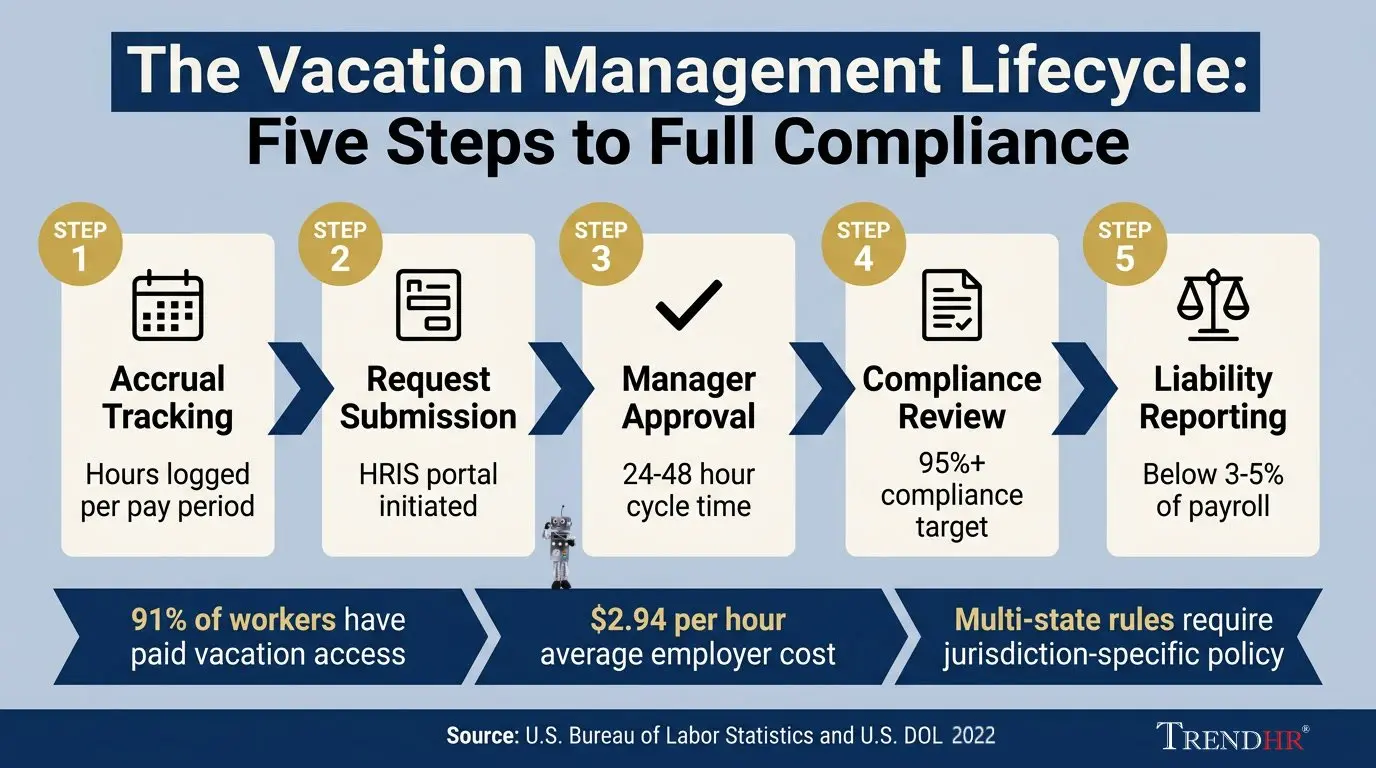
Key Infographic Statistic at a Glance
- $2.94 per hour cost Vacation Management Lifecycle (U.S. Bureau of Labor Statistics 2022),

Statistics & Outlook
Managing employee vacation time is a structured administrative and compliance function that governs how organizations award, track, approve, and account for paid time off across the workforce. The U.S. Department of Labor's Wage and Hour Division clarifies that the Fair Labor Standards Act does not require payment for time not worked, such as vacations — these benefits are a matter of agreement between an employer and an employee. Because vacation is a voluntary but near-universal employer offering, the stakes of managing it well are significant: paid leave benefits cost private employers an average of $2.94 per hour worked as of September 2022, representing 7.4 percent of total compensation costs (U.S. Bureau of Labor Statistics). Effective vacation time management — encompassing accrual tracking, request workflows, carryover policies, and recordkeeping — directly controls that liability while ensuring employees receive the benefit they have earned.
The scale of vacation administration is considerable. In 2025, 31 percent of private industry workers received 10 to 14 days of paid vacation after one year of service, with access to paid vacation leave available to 91 percent of workers in the largest establishments (U.S. Bureau of Labor Statistics). HR professionals, payroll teams, and direct managers share responsibility for implementing policy consistently — and with multi-state workforces, that means maintaining jurisdiction-specific rules, since several states treat accrued vacation as earned wages subject to payout at separation. Organizations that invest in clear paid time off policies, reliable accrual systems, and manager training reduce payroll exposure, support legal compliance, and build the kind of workforce trust that drives measurable retention outcomes.
Verified Sources
- U.S. Bureau of Labor Statistics – Who Receives Paid Vacations? — 31% of private industry workers receive 10–14 days of paid vacation after one year of service; paid vacation access available to 91% of workers in establishments with 500 or more employees; access varies significantly by industry and establishment size. (bls.gov)
- U.S. Bureau of Labor Statistics – Paid Time Off: Measuring the Cost of Paid Leave Benefits — Paid leave benefits cost private employers an average of $2.94 per hour worked as of September 2022, representing 7.4% of total compensation; vacation leave alone accounted for 3.8% of total compensation for nonunion workers. (bls.gov)
- U.S. Department of Labor – FLSA Frequently Asked Questions — The Fair Labor Standards Act does not require employers to provide vacation, sick leave, or holiday pay; these benefits are entirely a matter of agreement between employer and employee; no federal mandate governs vacation accrual, carryover, or payout at separation. (dol.gov)

Technology for Managing Employee Vacation Time
Core Technology Platforms & Systems
The foundation of modern vacation time management is the human resource information system (HRIS), a centralized platform that stores employee records, tracks accrual balances, and enforces policy rules automatically. Larger organizations often manage vacation within a broader human capital management (HCM) suite that integrates payroll, benefits, and scheduling into a single system of record. Time and attendance platforms serve as the operational layer where employees clock leave requests and managers monitor coverage in real time. For organizations without enterprise-level infrastructure, standalone paid time off (PTO) tracking applications provide accrual calculation, balance visibility, and approval routing at lower implementation cost.
Workflow Automation & Process Optimization
Automation has eliminated much of the manual overhead traditionally associated with vacation administration. Approval chains that once required email threads and spreadsheet updates now route automatically through low-code workflow builders — triggering manager notifications, updating accrual ledgers, and issuing confirmation messages without human intervention. Automated accrual engines calculate balances each pay period based on policy rules, reducing payroll errors and audit risk. Calendar synchronization tools push approved absences directly into team scheduling systems, giving managers real-time visibility into coverage gaps before they become operational problems.
Document & Data Management
Vacation policy documentation, accrual schedules, and audit trails are maintained within cloud-based document management repositories that support version control and access permissions. Electronic acknowledgment tools allow HR to confirm that employees have reviewed updated PTO policies, creating a timestamped compliance record. In multi-state organizations, records management databases store jurisdiction-specific policy variants and support retention schedules aligned with applicable state wage recordkeeping requirements — typically three to four years minimum. dol.gov
AI & Emerging Technologies
Artificial intelligence is beginning to reshape vacation management in meaningful ways. Predictive analytics tools analyze historical leave patterns to forecast high-absence periods, enabling proactive staffing adjustments. AI-driven scheduling assistants can recommend optimal approval decisions based on team coverage thresholds and workload data.
Integration
Application programming interfaces (APIs) connect HRIS platforms to payroll engines, ensuring that approved leave automatically flows into compensation calculations without manual reconciliation. Integration with project management and workforce planning tools gives operations leaders a unified view of availability across teams.
Skills & Adoption
HR professionals managing vacation time today need functional fluency in HRIS configuration, reporting, and data auditing. Common adoption barriers include resistance from managers accustomed to informal approval processes and employees unfamiliar with self-service portals. Successful implementation strategies prioritize role-specific training, clear communication of policy changes, and phased rollouts that build user confidence before full deployment. Organizations that invest in ongoing system training consistently report higher utilization of self-service features and lower HR administrative burden over time.

Key Performance Indicators (KPIs)
Without measurable data, vacation management defaults to reactive administration. KPIs convert leave activity into actionable intelligence — enabling HR leaders to identify policy gaps, control payroll liability, flag burnout risk, and demonstrate the operational value of structured PTO programs to executive leadership. Organizations that track vacation metrics consistently make faster, better-informed decisions about staffing, policy design, and workforce wellbeing.
Core Operational KPIs
| KPI | Formula | Target |
|---|---|---|
| Vacation Utilization Rate | (Vacation days used ÷ vacation days available) × 100 | 70–85%; below 60% warrants investigation |
| Average Accrued Balance per Employee | Total unused vacation days ÷ total employees | Below 10 days per employee |
| Request-to-Approval Cycle Time | Average days between request submission and manager approval | 24–48 hours; delays beyond 5 business days indicate bottleneck |
| Blackout Period Violation Rate | Approved leave overlapping restricted periods ÷ total approvals | 0%; any violation warrants policy communication review |
Financial & Cost-Efficiency KPIs
| KPI | Formula | Target |
|---|---|---|
| Vacation Liability as % of Payroll | Accrued unused vacation value ÷ total payroll × 100 | Below 3–5% of total payroll; values above trigger Finance & HR review |
| Cost of Vacation Payout at Separation | Total dollar value of unused vacation paid out to departing employees | Monitor quarterly; minimize via effective carryover cap policy |
Quality, Satisfaction & Emerging KPIs
| KPI | Description | Target |
|---|---|---|
| Policy Compliance Rate | Percentage of vacation requests processed per documented policy rules, tracked via HRIS audit logs | Above 95% |
| Employee Satisfaction with PTO Policy | Collected via pulse surveys or annual engagement instruments; low scores correlate with elevated turnover risk | High scores; treat low scores as a leading retention indicator |
| Burnout Risk Index | Composite of low vacation utilization, extended tenure without time off, and overtime hours; surfaces high-risk employees proactively | Flag & intervene before performance or attendance issues emerge |
| Self-Service Adoption Rate | Percentage of vacation transactions completed via employee self-service portals vs. HR-assisted processes | Increasing trend over time; proxy for digital transformation progress |
Vacation KPIs should be reviewed monthly at the operational level and quarterly at the strategic level. Annual policy reviews should be directly informed by full-year KPI trends, ensuring that carryover rules, accrual rates, and blackout periods remain calibrated to both organizational needs and workforce realities.

Frequently Asked Questions
How Do You Track Employee Vacation Time Effectively?
Tracking employee vacation time effectively requires a centralized system that records accruals, approvals, and balances in real time. Without structured tracking, organizations face payroll errors, compliance exposure, and employee disputes over available leave.
Human resource information systems (HRIS) and dedicated time-off tracking platforms are the most reliable solutions for most organizations. These tools automate accrual calculations, route approval requests to managers, and give employees self-service access to their own balances — eliminating the spreadsheet-based tracking that creates version control problems and audit risk. For smaller organizations not yet using an HRIS, a consistently maintained shared leave ledger with a documented approval process provides a functional baseline. Regardless of the tool, every employee's accrual rate, current balance, and approved absences must be recorded accurately and updated in real time. According to the U.S. Bureau of Labor Statistics, paid vacation leave is available to 91% of workers at the largest private establishments — meaning the administrative expectation is widespread and the standard for accurate tracking is high. Managers should receive regular balance reports — at minimum monthly — so they can identify employees carrying excess accruals before those balances create financial liability or indicate underlying burnout risk.
What Is a Vacation Accrual Policy and How Does It Work?
A vacation accrual policy is the documented rule that governs how and when employees earn paid time off based on hours worked, pay periods elapsed, or tenure with the organization. It determines the rate at which leave accumulates, when it becomes available to use, and what happens to unused balances at year-end. The three most common accrual structures are hourly accrual (employees earn a fixed number of hours per pay period), front-loaded grants (the full annual allotment is available on a set date), and tenure-based tiers (the annual allotment increases at defined service milestones such as three or five years). Each model carries different administrative requirements and employee experience tradeoffs. Carryover and forfeiture rules are a critical component of any accrual policy. Some organizations permit employees to roll unused vacation into the following year up to a defined cap; others enforce "use-it-or-lose-it" provisions. Employers with employees in California, Colorado, or Illinois must be aware that those states prohibit forfeiture of accrued vacation, treating it as earned wages under state law. A well-designed accrual policy balances operational flexibility with fairness — and should be reviewed annually against both workforce utilization data and any applicable state law updates.
Are Employers Required by Law to Provide Paid Vacation?
No federal law requires private employers to provide paid vacation. The U.S. Department of Labor states that the Fair Labor Standards Act does not mandate vacation, sick leave, or holiday pay — these benefits are entirely a matter of agreement between employer and employee. However, once an employer establishes a vacation policy, legal obligations attach — particularly at the state level. Several states, including California, Colorado, and Illinois, treat accrued vacation as earned wages. In those jurisdictions, employers cannot implement "use-it-or-lose-it" policies without careful legal structuring, and they are required to pay out unused accrued vacation upon an employee's separation from the organization. This distinction between federal permissiveness and state-level obligation is where many multi-state employers run into compliance problems. A policy designed for a Texas workforce may be unlawful when applied to employees working in California. Organizations with employees in multiple states must maintain jurisdiction-specific policy variants and ensure their HRIS is configured to apply the correct rules by work location — not the company's headquarters state. The practical takeaway: while offering vacation is voluntary, managing it lawfully is not — and the legal floor rises considerably depending on where your employees work.
How Do You Handle Vacation Requests Fairly as a Manager?
Fair vacation request management requires a written policy, a consistent approval process, and clear communication of any scheduling constraints before conflicts arise. Managers who handle requests informally — or approve them inconsistently — create legal exposure and erode team trust. A defensible process starts with documented criteria for approval decisions. Common factors include submission date (first-come, first-served), minimum coverage requirements, and pre-designated blackout periods tied to operational peaks. These criteria should be communicated to all employees at onboarding and reviewed annually. When two employees request the same dates, organizations should apply the established criteria consistently and document the decision. Seniority-based tiebreaking is common in unionized environments; in non-union settings, submission order is the most legally defensible standard. Managers should also proactively monitor their team's accrual balances. Employees carrying high unused balances are both a financial liability and a potential burnout signal. Encouraging — and in some cases scheduling — regular time off is a management responsibility, not a courtesy. Research consistently links vacation utilization to employee engagement and retention, making this a direct business performance issue.
What Happens to Unused Vacation Time When an Employee Leaves?
What happens to unused vacation at separation depends entirely on state law and the employer's written policy. There is no federal requirement to pay out accrued vacation upon termination. In states that classify accrued vacation as earned wages — including California, Colorado, and Illinois — employers must pay out all unused accrued vacation in the employee's final paycheck, regardless of the reason for separation. Failing to do so exposes the organization to wage claims, penalties, and interest. In states without such protections, employers may enforce a written forfeiture policy — meaning unused vacation is simply lost at separation. However, this policy must be clearly stated in writing and consistently applied. An employer who routinely pays out vacation informally, then denies a payout to a specific departing employee, risks a discrimination or retaliation claim even in a state that would otherwise permit forfeiture. Best practice for multi-state employers is to maintain a state-by-state policy matrix, reviewed annually by employment counsel, and to configure payroll and HRIS systems to trigger the correct separation payout calculation based on the employee's work location — not the company's headquarters state.
Key Takeaways
Managing employee vacation time is a compliance-driven, financially significant HR function that requires clear policy, reliable systems, and consistent enforcement. Federal law sets a permissive baseline — vacation is voluntary — but state-level wage laws in multiple jurisdictions impose firm obligations around accrual treatment and separation payouts.
Organizations that invest in structured accrual tracking, documented approval processes, and jurisdiction-aware policy design reduce payroll liability, avoid legal exposure, and build the employee trust that supports long-term retention. As workforce expectations around paid time off continue to rise, the organizations best positioned to compete for talent will be those that treat vacation management not as an administrative afterthought, but as a deliberate component of their total compensation and workforce health strategy.