
Employee Training
How to Train Employees
Employee training is the structured organizational process of developing the knowledge, skills, and competencies workers need to perform their roles effectively. It typically encompasses onboarding, technical instruction, compliance education, leadership development, and ongoing professional skills programs. Organizations prioritize training to improve performance, reduce errors, and build a workforce capable of meeting current and future business demands.
Core Training Methods
- Instructor-Led Training (ILT): Live instruction delivered in person or via virtual classroom; best suited for complex topics requiring facilitated discussion, role-play, or real-time feedback from a qualified facilitator.
- On-the-Job Training (OJT): Employees learn by performing actual work tasks under the direct supervision of an experienced colleague or manager; the dominant method for procedural, technical, and trade-based roles.
- eLearning & Self-Paced Modules: Digital courses completed independently through a learning management system (LMS); used when consistent delivery at scale, scheduling flexibility, or geographic distribution is a priority.
- Blended Learning: A structured combination of in-person instruction and digital content; consistently outperforms single-method approaches by addressing both conceptual understanding and practical application.
Overview of Related Topics
- Training Delivery Models: Organizations structure training delivery through centralized L&D teams, business-unit embedded subject matter experts, or outsourced third-party providers — each model carries different tradeoffs in consistency, expertise, and cost.
- Key Roles & Responsibilities: Three roles carry primary accountability for employee training outcomes — the Learning & Development (L&D) specialist who designs and manages programs, the subject matter expert (SME) who validates content, and the direct manager who reinforces learning through post-training coaching and performance conversations.
- Regulatory & Compliance Considerations: Federal law mandates documented training in workplace safety (OSHA), anti-discrimination and anti-harassment conduct (EEOC), and industry-specific licensing; several states impose additional requirements specifying minimum frequency, content scope, and delivery format by employer size.
- Measurement & Effectiveness: Training outcomes are evaluated using the Kirkpatrick Model's four levels — reaction, learning, behavior, and results — supported by operational metrics including completion rate, assessment pass rate, and post-training performance data compared against pre-training baselines.

Topics
Training Delivery Models
- Centralized L&D Function: A dedicated Learning & Development team designs and manages training programs enterprise-wide, ensuring consistency in content standards, branding, and compliance tracking.
- Business-Unit Embedded Training: Subject matter experts within a department deliver role-specific training; effective for highly technical functions where centralized staff lack domain expertise.
- Outsourced Training Providers: Third-party vendors deliver off-the-shelf or customized programs; commonly used for compliance topics, leadership development, and specialized technical certifications.
Key Roles & Responsibilities
- Learning & Development Specialist: Designs curriculum, selects delivery formats, and manages the learning management system; owns the instructional quality of training programs.
- Subject Matter Expert (SME): Provides technical content and validates accuracy; collaborates with L&D to translate expertise into instructional materials.
- Direct Manager: Reinforces training through coaching, real-world application opportunities, and post-training performance conversations; critical for transfer of learning to the job.
- HR Business Partner: Aligns training priorities with organizational goals, workforce planning data, and compliance requirements.
Regulatory & Compliance Considerations
- OSHA Safety Training: OSHA mandates industry-specific safety training for roles involving hazardous materials, machinery, or high-risk environments; records of completion must be retained.
- Anti-Harassment & Discrimination Training: EEOC guidance and numerous state laws require anti-harassment training; several states specify minimum frequency, content, and delivery format by employer size.
- Documentation & Recordkeeping: Employers must maintain training completion records for audits, litigation defense, and regulatory inspections; a learning management system (LMS) is the standard tool for this.
Measurement & Effectiveness
- Kirkpatrick Model: The four-level evaluation framework — reaction, learning, behavior, results — provides a structured methodology for assessing whether training achieves intended outcomes at each stage.
- Completion Rate: Tracks the percentage of assigned employees who finish required training; a baseline compliance metric that signals program accessibility and workforce accountability.
- Knowledge Retention Assessments: Pre- and post-training tests measure learning gain; assessment scores above 80% are a common benchmark for compliance and certification programs.
- Post-Training Performance Metrics: Compares key performance indicators before and after training completion to quantify behavioral and operational impact.

A Closer Look at Employee Training
Knowing how to train employees is one of the most foundational capabilities an organization can develop. Employee training covers the full range of structured activities designed to build job-relevant knowledge and skills — from new hire onboarding that sets early expectations to compliance programs that protect the business and technical upskilling that keeps teams competitive. The need for training exists because even highly qualified employees require guidance on how a specific organization operates, what its standards are, and how to apply their skills within its particular context. When companies invest consistently in employee training, they reduce error rates, strengthen compliance, and build the internal capability needed to grow.
Training is delivered by a combination of HR professionals, dedicated Learning & Development teams, internal subject matter experts, and direct managers who reinforce learning on the floor. Every level of the workforce depends on it: new hires rely on it for orientation, mid-career employees rely on it for advancement, and senior staff rely on it to stay current with regulatory changes and emerging tools. Organizations that approach how to train employees strategically — aligning programs to business objectives and measuring outcomes rigorously — consistently outperform those that treat training as an administrative obligation. The professional discipline of employee training is a measurable driver of retention, productivity, and organizational resilience.
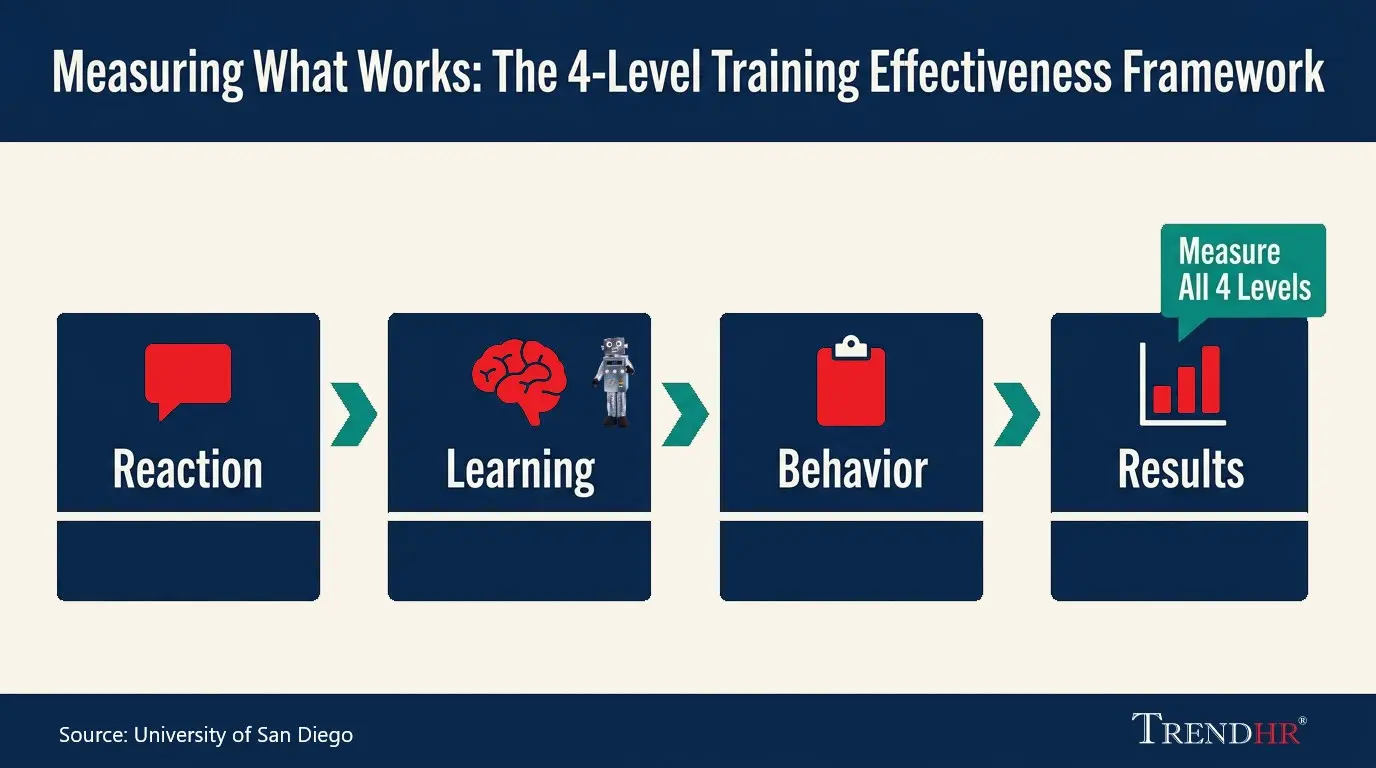
Key Infographic Statistics at a Glance
- The Four Levels of the Kirkpatrick Model — Level 1: Reaction, Level 2: Learning, Level 3: Behavior, Level 4: Results. (University of San Diego)
Statistics & Outlook
Understanding how to train employees is not optional for modern organizations — it is a legal requirement in many contexts and a proven driver of business performance. The U.S. Department of Labor emphasizes that systematic workforce training improves both individual productivity and organizational output, and federal law mandates documented training in areas including workplace safety, anti-discrimination practices, and industry-specific operations (U.S. Department of Labor, dol.gov). According to the U.S. Bureau of Labor Statistics, employers spent an average of 70.6 hours per employee on training annually in recent survey periods, reflecting the scale of investment organizations commit to workforce development (Bureau of Labor Statistics, bls.gov/news.release/ebs2). The Occupational Safety and Health Administration further requires that safety training be conducted in a language and vocabulary workers can understand — a compliance standard with direct implications for how training content is designed and delivered (OSHA, osha.gov/workers/file-a-complaint).
The business case for investing in structured employee training programs is well-supported in academic and institutional research. Cornell University's ILR School has documented that organizations with formal training programs report higher levels of employee engagement and lower voluntary turnover compared to those without structured learning initiatives (Cornell ILR, ilr.cornell.edu). From a financial perspective, the cost of replacing a single employee — estimated at anywhere from 50% to 200% of that employee's annual salary — far exceeds the investment required to train and retain existing talent. Organizations that build rigorous, measurable approaches to employee training position themselves for reduced compliance risk, stronger workforce capability, and sustainable competitive performance.
Verified Sources
- U.S. Department of Labor — Systematic workforce training improves individual productivity and organizational output; federal law mandates documented training in safety, anti-discrimination, and industry-specific operations. (dol.gov)
- U.S. Bureau of Labor Statistics — Employers spent an average of 70.6 hours per employee on training annually in recent survey periods. (bls.gov)
- Occupational Safety and Health Administration (OSHA) — Safety training must be conducted in a language and vocabulary workers can understand. (osha.gov)
- Cornell University ILR School — Organizations with formal training programs report higher employee engagement and lower voluntary turnover than those without structured learning initiatives. (ilr.cornell.edu)
Technology in Employee Training
Core Technology Platforms & Systems
The primary technology infrastructure for employee training today centers on the Learning Management System (LMS) — a cloud-hosted platform that houses course content, assigns training by role or department, tracks completion, and stores compliance records. LMS platforms serve as the operational hub for training administration across organizations of all sizes. Larger enterprises may also use Learning Experience Platforms (LXPs), which layer personalized content recommendations, social learning features, and skills-gap analytics on top of core LMS functionality. HR Information Systems (HRIS) often integrate directly with training platforms so that onboarding workflows, role changes, and performance reviews trigger relevant training assignments automatically.
Workflow Automation & Process Optimization
Automation has significantly reduced the manual overhead associated with employee training administration. Onboarding sequences — including welcome communications, document acknowledgments, policy reviews, and introductory course assignments — can now be triggered automatically upon an employee's hire date without HR intervention. Approval chains for training requests, certification renewals, and manager sign-offs are handled by low-code workflow builders that route tasks based on organizational hierarchy. Automated reminder sequences for expiring compliance certifications eliminate reliance on manual tracking, and AI-driven scheduling tools can coordinate training sessions across time zones and team calendars without human scheduling effort.
Document & Data Management
Training functions generate substantial documentation: completion records, assessment scores, certification files, acknowledgment signatures, and version-controlled course content. Cloud-based document management systems and integrated LMS reporting modules ensure these records are organized, searchable, and accessible during audits. Electronic signature platforms allow employees to acknowledge policies and complete required attestations digitally, with timestamps stored for regulatory purposes. Data governance practices — including retention schedules aligned to federal and state requirements — are increasingly formalized within training operations teams.
AI & Emerging Technologies
Artificial intelligence is reshaping how employee training content is created and delivered. AI-powered authoring tools can generate draft course scripts, quiz questions, and scenario-based exercises from source documents, significantly accelerating content development timelines. Intelligent document processing extracts policy and procedural information to keep training content current with minimal manual effort. Conversational AI tools serve as on-demand job aids, allowing employees to query training content in natural language rather than searching static documentation. Predictive analytics identify employees at risk of skill gaps or compliance lapses before they become performance issues, enabling proactive intervention.
Integration & Interoperability
Effective training technology ecosystems require tight integration between the LMS, HRIS, performance management systems, and payroll platforms. Without integration, data silos emerge — training completions go unrecorded in employee files, role changes fail to trigger required retraining, and compliance reports require manual reconciliation. Application programming interfaces (APIs) and integration middleware platforms enable real-time data exchange across these systems, ensuring that training records are accurate, current, and available wherever HR professionals need them.
Skills & Adoption
Training professionals today are expected to be comfortable with LMS administration, data reporting, and basic content authoring in digital formats. Common adoption barriers include low manager engagement, resistance to self-paced formats among certain workforce populations, and LMS configurations too complex for end-users to navigate intuitively. Successful implementation strategies combine executive sponsorship, streamlined user interfaces, role-based onboarding for the platforms themselves, and regular feedback loops that surface usability issues before they affect completion rates.
Key Performance Indicators (KPIs)
Organizations that invest in employee training without measuring outcomes cannot determine whether that investment is working. KPIs in employee training connect learning activities to tangible business results — compliance risk reduction, performance improvement, and retention — and provide leadership with the evidence needed to defend and grow the training budget. Without structured measurement, training functions operate on assumption rather than data.
Core Operational KPIs
| KPI | Formula | Target |
|---|---|---|
| Training Completion Rate | (Completions ÷ Assignments) × 100 | 90–95% for required programs |
| Time to Competency | Elapsed time from training start to verified full performance | Minimize; shorter indicates better alignment to job requirements |
| Assessment Pass Rate | % of learners achieving a passing score on post-training knowledge tests | ≥75%; below 75% may indicate content or design issues |
| Training Hours Per Employee | Total training hours delivered ÷ headcount | Benchmark against industry standards; identify underserved populations |
| Voluntary Participation Rate | % of eligible employees who elect to participate in non-mandatory programs | Proxy for perceived training value and L&D engagement |
Financial & Cost-Efficiency KPIs
| KPI | Formula | Target |
|---|---|---|
| Cost Per Learner | Total program costs (design, delivery, technology, facilitator time) ÷ employees trained | Minimize; compare modalities (ILT vs. eLearning) to identify optimization opportunities |
| Training ROI | ((Benefits − Costs) ÷ Costs) × 100 | Positive ROI tied to measurable outcomes such as error reduction or turnover decrease |
| Rework & Error Rate Post-Training | Track reduction in defects or compliance violations in targeted job functions after training | Measurable reduction directly validates training ROI |
Quality, Satisfaction & Emerging KPIs
| KPI | Description | Target |
|---|---|---|
| Learner Satisfaction Score | Post-training survey rating (1–5 scale or Net Promoter Score) reflecting perceived training quality and relevance | High scores; low scores correlate with disengagement and reduced content retention |
| Manager Satisfaction with Trainee Readiness | Survey of direct managers 30–60 days post-training to assess whether employees demonstrated covered skills on the job | Confirms transfer of learning from classroom to actual job performance |
| Compliance Audit Pass Rate | % of audit findings related to training documentation resolved without corrective action | 100% target; direct measure of program integrity and recordkeeping quality |
| Skills Gap Closure Rate | % of identified skill gaps — surfaced through assessments, reviews, or workforce planning tools — that training has addressed within a cycle | Track progress toward skills-based talent model goals |
| AI Tool Adoption Post-Training | Rate at which employees actively use new AI-assisted tools following AI literacy programs | Forward-looking indicator of digital transformation progress |
Training KPI dashboards should be reviewed on a monthly cadence for operational metrics (completion rates, assessment scores) and quarterly for outcome metrics (ROI, time to competency, manager readiness ratings). Data should be segmented by department, role, and delivery format to surface actionable patterns rather than organization-wide averages that obscure performance gaps. Training leaders who connect their KPI dashboards directly to business unit performance data — not just learning data — earn the strategic credibility needed to influence workforce planning decisions.
Frequently Asked Questions
What is the best way to train new employees?
The best way to train new employees combines structured onboarding, role-specific instruction, and early on-the-job practice supported by a designated mentor or manager.
No single method works for every organization or role, but research and practitioner experience consistently point to a blended approach as the most effective model. Structured onboarding in the first week establishes cultural context, company policies, and systems access. Role-specific technical training — delivered through a combination of instructor-led sessions and self-paced eLearning — builds the job knowledge employees need to perform independently. On-the-job training, where new hires work alongside experienced colleagues on real tasks, accelerates skill application and reduces the performance gap between classroom learning and actual work.
Equally important is post-training reinforcement. Managers who check in regularly during an employee's first 30, 60, and 90 days — asking questions, providing feedback, and coaching on observed gaps — dramatically improve the transfer of training to actual job performance. Organizations that build this manager touchpoint into the formal onboarding process consistently report higher new hire retention and shorter time to full productivity. The best training programs treat learning as a process, not a one-time event.
How long should employee training take?
The length of employee training depends on the role's complexity, the employee's prior experience, and the organization's performance standards — but most onboarding programs span 30 to 90 days, with role proficiency often taking three to six months.
There is no universal answer, and organizations that impose arbitrary time limits on training often pay for it through early turnover and performance gaps. Entry-level roles with well-defined procedures can often achieve competency with focused two-to-four week programs. Complex technical, professional, or client-facing roles typically require structured learning over several months, with formal milestones built in to assess readiness at each stage.
Compliance training timelines are often dictated externally: OSHA safety certifications, anti-harassment programs, and industry-specific licensing each carry their own completion requirements, which HR teams must track against regulatory deadlines. For ongoing training — professional development, leadership programs, and annual compliance refreshers — most organizations build a minimum annual training hours target into their workforce planning. The key principle is that training should last as long as it takes for an employee to demonstrate the competencies required to perform safely and effectively, not just as long as is convenient.
What are the most effective employee training methods?
The most effective employee training methods are those matched to the complexity of the content, the learning preferences of the audience, and the conditions under which skills will be applied on the job.
Instructor-led training remains effective for topics requiring real-time discussion, nuanced judgment, or interpersonal practice — leadership development, conflict resolution, and complex compliance topics are well-served by live facilitation. eLearning and self-paced modules excel when content is procedural, when employees are geographically dispersed, or when consistent delivery at scale is a priority.
On-the-job training is among the highest-impact methods available because it places employees in authentic work conditions where learning is directly tied to real outcomes. Simulations and scenario-based learning — increasingly delivered through digital platforms — provide a middle ground: employees practice applying judgment and skills in realistic situations without the risk of real-world errors. The research on blended learning consistently shows it outperforms single-method approaches because it addresses multiple dimensions of skill development. The worst training programs select a method based on convenience or cost alone; the best ones ask what employees need to be able to do and work backward to the format that best builds that capability.
How do you measure the effectiveness of employee training?
Employee training effectiveness is measured using the Kirkpatrick Model's four levels: reaction, learning, behavior, and results — each capturing a different dimension of whether training is working.
Level 1 (Reaction) captures learner satisfaction through post-training surveys. It is easy to collect but tells you relatively little on its own — a well-liked course is not necessarily an effective one. Level 2 (Learning) uses pre- and post-assessments to measure knowledge and skill gain. A meaningful improvement in assessment scores confirms that content was absorbed.
Level 3 (Behavior) is where most training programs fall short: it requires observing or measuring whether employees are actually applying new skills on the job, typically through manager observations, performance data, or 360-degree feedback 30 to 90 days post-training. Level 4 (Results) connects training to business outcomes — reduced error rates, improved sales performance, lower accident frequency, or decreased voluntary turnover. This is the most compelling metric for executive audiences and the most difficult to attribute cleanly to training alone. Organizations that build measurement checkpoints into training design — rather than adding them as an afterthought — are far more likely to produce data that informs meaningful program improvement.
Why is employee training important for business success?
Employee training is important to business success because it directly improves performance, reduces compliance risk, and increases employee retention — three outcomes with measurable financial impact.
Untrained or undertrained employees make more errors, take longer to complete tasks, and are less equipped to navigate complex customer or operational situations. The cost of those errors — in rework, customer loss, safety incidents, or regulatory fines — typically exceeds the cost of the training that would have prevented them. Training also plays a significant role in talent retention: employees who feel their employer is investing in their development are substantially more likely to remain with the organization, reducing the high costs of turnover and rehiring.
From a compliance standpoint, employee training is not optional. Federal law and state regulations require documented training in safety, anti-discrimination, and industry-specific practices — organizations that cannot demonstrate training completion face legal exposure. Beyond compliance, organizations that train proactively build workforce capability ahead of business needs rather than scrambling to address skill gaps reactively. In a labor market where specialized skills are in high demand, how to train employees well is a strategic differentiator, not just an HR function.
Key Takeaways
Understanding how to train employees effectively is a core organizational capability that spans compliance, performance, and culture.
The most successful training programs combine the right delivery methods with structured measurement, strong manager involvement, and content directly tied to job requirements.
Technology continues to expand what's possible — from AI-powered content creation to automated compliance tracking — but the fundamentals remain the same: training must be relevant, accessible, and reinforced on the job to produce lasting results.
Organizations that approach employee training as a strategic investment rather than an administrative requirement consistently see returns in productivity, retention, and risk reduction.
As workforce demands continue to evolve, the ability to train employees quickly and effectively will remain one of the most valuable capabilities any organization can build.