
Employee Handbook
Why Should I Update My Handbook?
Updating your employee handbook ensures policies remain legally compliant, operationally accurate, and aligned with current organizational standards. It encompasses revisions to reflect new legislation, regulatory changes, updated benefits, revised workplace policies, and cultural shifts. Organizations that maintain current handbooks reduce legal liability, reinforce consistent policy enforcement, and demonstrate a professional, well-governed workplace to employees and auditors alike.
Key Reasons for Handbook Updates
- Legal Compliance: Federal and state employment laws change regularly — including FMLA, ADA, FLSA, and state-specific leave statutes — and outdated handbooks create direct legal exposure.
- Policy Accuracy: Operational policies covering remote work, PTO accrual, disciplinary procedures, and benefits need to reflect current practice, not past intent.
- Cultural Alignment: As organizations evolve their work environments, code of conduct standards, and workplace expectations, handbooks need to mirror those shifts to remain credible.
- At-Will and Disclaimer Language: Courts have held that poorly worded or outdated disclaimers can inadvertently create implied contracts, making periodic review essential.
Overview of Related Topics
- Regulatory Triggers: New or amended legislation — such as changes to state paid leave laws, salary transparency requirements, or federal contractor obligations — are common mandatory drivers of handbook updates.
- Roles and Accountability: HR leads the revision process and department heads validate that operational policies reflect actual practice.
- Update Frequency and Process: Most organizations conduct a formal annual review, with off-cycle updates triggered by legislation changes, M&A activity, or significant policy shifts.
- Employee Acknowledgment: Updated handbooks require re-acknowledgment signatures to establish that employees received and reviewed the revised policies — a critical legal step.

Topics
Regulatory Triggers
- Federal Law Changes: Updates to Title VII interpretations, EEOC guidance, or DOL rule changes on overtime thresholds require handbook review and revision.
- State and Local Mandates: State-specific laws on harassment training, pay equity, lactation accommodation, and predictive scheduling can outpace federal requirements and vary by jurisdiction.
- Litigation and Audit Findings: Internal investigations, EEOC charges, or wage-and-hour audits can expose handbook gaps that require corrective language.
Roles and Accountability
- HR Department: Owns the revision cycle, coordinates input from department heads, tracks regulatory changes, and manages version control across handbook editions.
- Senior Leadership: Approves policy changes that affect organizational culture, compensation structure, or employee relations strategy before publication.
Update Frequency and Process
- Annual Review Cycle: A structured yearly audit — typically tied to the start of a fiscal or calendar year — ensures all policies are evaluated against current law and operational reality.
- Off-Cycle Triggers: Mergers, acquisitions, workforce expansions into new states, or major policy overhauls necessitate updates outside the standard annual schedule.
Employee Acknowledgment
- Signed Acknowledgment Forms: Every handbook revision needs to be accompanied by a dated employee signature confirming receipt — paper or electronic.
- Distribution and Accessibility: Updated handbooks should be published on the company intranet or HRIS platform upon approval, with notification to all active employees.

A Closer Look
Asking why I should update my handbook is one of the most practical questions an HR professional or business owner can raise. A current employee handbook documents the organization's policies on everything from leave and benefits to conduct standards, anti-harassment protections, and at-will employment. It exists because employees deserve accurate, accessible information about their rights and responsibilities — and because organizations need documented standards to manage consistently and defend legally. Updating the handbook means reviewing policies against current federal and state law, aligning language with actual practice, and ensuring disclaimers remain legally sound. Regular employee handbook updates are not administrative busy work; they are foundational governance.
The work of handbook revision is led by HR professionals — often in partnership with employment counsel and department managers — but its value extends to every level of the organization. Employees rely on a current handbook to understand their rights, responsibilities, and available protections. Managers depend on consistent policy language to apply standards fairly and avoid decisions that create legal exposure. For senior leadership, a well-maintained handbook reduces liability, supports defensible employment decisions, and reflects the organization's commitment to compliance. The question of why I should update my handbook is answered directly by outcomes: organizations with current handbooks experience fewer policy disputes, stronger audit results, and more consistent employee relations practices.

Statistics & Outlook
Keeping your handbook current is a compliance obligation, not a discretionary best practice. The U.S. Department of Labor's Employment Law Guide explicitly states that covered employers with written handbooks are required to include FMLA leave policy notice within those documents — and that if an employer handbook describes leave provisions, it must reflect current FMLA rights and responsibilities. Failure to maintain compliant handbook language carries direct enforcement consequences: an employer that willfully fails to post required FMLA notice may be assessed a civil monetary penalty under federal regulations. Beyond leave law, the EEOC defines harassment as a form of employment discrimination that violates Title VII of the Civil Rights Act of 1964, the Age Discrimination in Employment Act of 1967, and the Americans with Disabilities Act of 1990 — statutes that require employers to establish and communicate anti-harassment policies to employees.
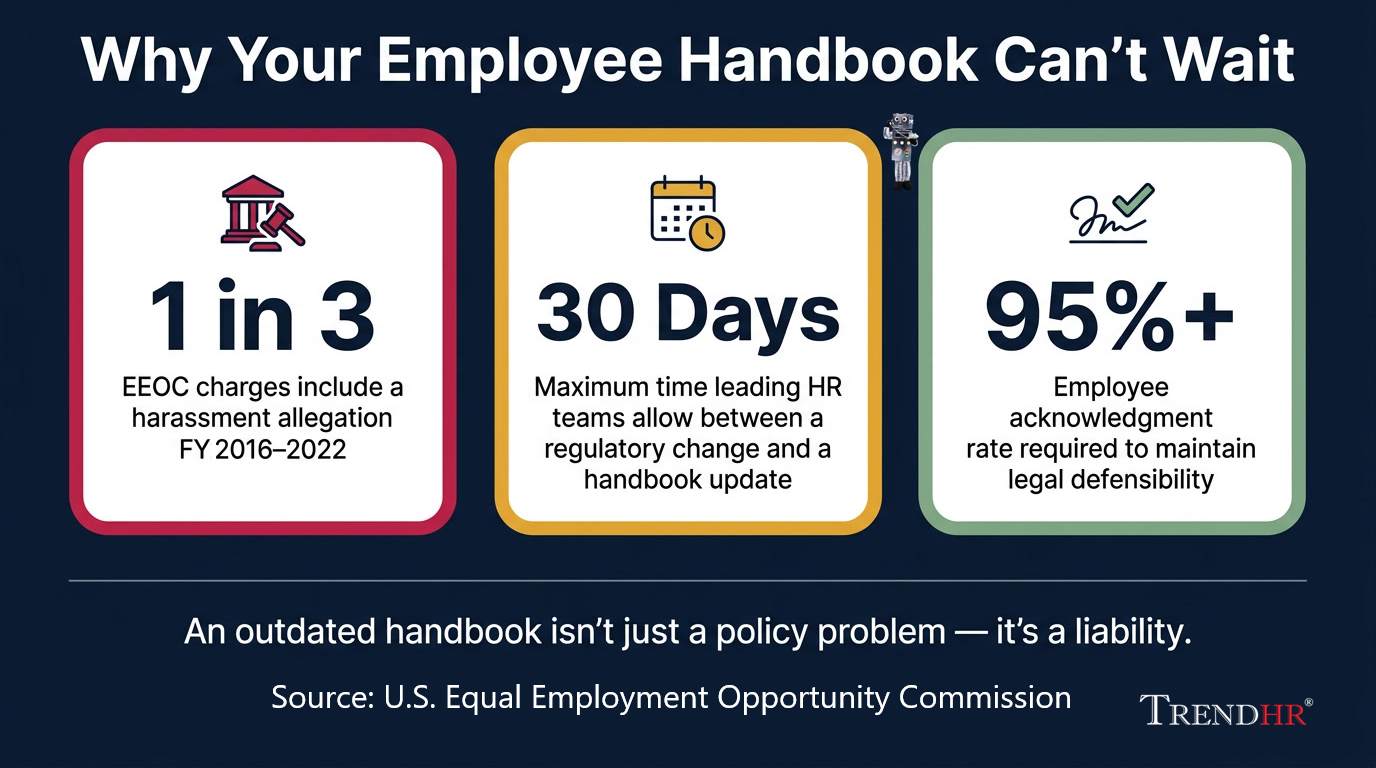
The volume of workplace claims alone underscores why regular employee handbook updates and policy review are essential to risk management. Between fiscal years 2016 and 2022, more than one-third of all charges received by the EEOC included an allegation of harassment — a figure that reflects the ongoing prevalence of conduct-related disputes that documented policies are designed to prevent and address. Organizations that conduct annual handbook reviews, align policy language with current federal and state law, and obtain updated employee acknowledgments position themselves to demonstrate documented compliance — reducing legal exposure and supporting consistent, defensible employment decisions across the organization.

Technology for Handbooks
The process of updating an employee handbook is supported by several categories of enterprise technology. Human resource information systems serve as the central repository for policy documents, connecting handbook content directly to employee records, onboarding workflows, and compliance tracking.
Workflow Automation & Process Optimization
Automation has reduced the manual burden of the handbook update cycle. Once a handbook is finalized, distribution workflows push updated documents to all active employees simultaneously and trigger re-acknowledgment requests — a process that once required weeks of manual coordination and is now completed in hours.
Document & Data Management
Handbook governance requires disciplined document management. Version control systems maintain a complete audit trail of every revision, including who approved each change and when — critical evidence in employment disputes or regulatory audits. Electronic signatures capture employee acknowledgments with legally defensible timestamps. Cloud storage repositories with role-based access controls ensure that only authorized personnel can edit source documents, while all employees retain read access to the current published version. Records management protocols govern how long prior handbook versions must be retained, often informed by applicable state recordkeeping requirements.
AI & Emerging Technologies
Artificial intelligence is beginning to reshape how organizations identify when handbook updates are needed. Natural language processing tools can scan regulatory databases and flag newly enacted state or federal employment laws that may conflict with existing policy language — a task that previously required manual legal monitoring. AI-assisted drafting tools can generate initial policy revision language based on detected regulatory changes, which HR and legal teams then review and refine.
Integration & Interoperability
Handbook technology does not operate in isolation. Application programming interfaces allow acknowledgment data captured in one system to populate compliance records in another, eliminating manual data entry and reducing the risk of incomplete records. Organizations that operate without these integrations frequently encounter data silos where an updated handbook exists in one system but acknowledgment tracking lags in another.
Skills & Adoption
HR professionals managing the handbook update process benefit from proficiency in cloud-based collaboration tools, document version control, and workflow automation configuration. Common adoption barriers include resistance from teams accustomed to offline review processes and decentralized ownership of policy content across departments. Successful implementation strategies prioritize cross-functional training, clearly defined ownership of each policy section, and scheduled automation audits to ensure that regulatory monitoring tools remain calibrated to applicable jurisdictions.

Key Performance Indicators (KPIs)
KPIs connects the operational work of reviewing, revising, and distributing policy documents to measurable compliance outcomes and organizational risk posture. Organizations that track handbook-related metrics can demonstrate regulatory readiness, identify gaps before they become liabilities, and make data-driven decisions about review frequency and resource allocation. KPIs should be reviewed quarterly at minimum, with acknowledgment rates and time-to-update metrics monitored continuously.
Core Operational KPIs
| KPI | Formula | Target |
|---|---|---|
| Policy Review Cycle Completion Rate | Completed reviews ÷ total reviews scheduled × 100 | 100% |
| Time-to-Update | Average elapsed days from regulatory change to revised handbook publication | <30 days for material legal changes |
| Employee Acknowledgment Rate | Acknowledged employees ÷ total active headcount × 100 | >95%; outstanding flagged within 14 days |
| Policy Gap Identification Rate | Number of compliance gaps identified per annual audit cycle | Consistent identification; zero may indicate insufficient rigor |
| Version Control Accuracy | % of active employees and portals on current handbook version | 100% — no outdated copies in circulation |
Financial & Cost-Efficiency KPIs
| KPI | Formula | Target |
|---|---|---|
| Cost Per Handbook Revision | Total HR + legal + administrative costs per update cycle | Limiting year-over-year increase while keeping pace with increasing legal and litigation needs |
| Employment Litigation Cost Attributable to Policy Gaps | Legal defense & settlement costs tied to outdated or absent policy | $0 — proactive updates eliminate this exposure |
Quality & Satisfaction KPIs
| KPI | Description | Target |
|---|---|---|
| Manager Policy Comprehension Score | Periodic assessments measuring managers' ability to correctly apply handbook policies in practical scenarios | Consistent improvement; low scores signal a training gap |
| Employee Handbook Satisfaction Rating | Pulse survey score measuring clarity, accessibility, and usefulness of the handbook | >4.0 out of 5.0 |
| Audit Finding Rate | Number of handbook-related findings per internal or external compliance audit | Declining trend year-over-year |
| Regulatory Monitoring Response Time | Speed at which AI-assisted compliance tools surface new legislative changes for HR review | Benchmark established at adoption; continuous improvement |
| Digital Acknowledgment Completion Time | Average days for employees to complete e-signature acknowledgments after distribution | <14 days for full workforce completion |
A centralized compliance dashboard — accessible to HR leadership and employment counsel — should display real-time acknowledgment completion, open revision items, and upcoming scheduled reviews. Annual KPI reviews should benchmark current performance against prior cycles to identify whether process improvements are generating measurable gains in speed, coverage, and cost efficiency.

Frequently Asked Questions
Why should I update my employee handbook?
Keeping an employee handbook current is one of the most consequential — and most frequently deferred — responsibilities in HR and organizational management. Whether you are a small business owner or a corporate HR director, understanding why handbook updates matter, how often they should happen, and what happens when they don't is foundational to sound employment practice.
A current handbook documents the organization's policies on leave, benefits, conduct standards, anti-harassment protections, and at-will employment. It ensures employees have accurate information about their rights and responsibilities while giving organizations documented standards to manage consistently and defend legally. Regular updates are not administrative busywork — they are foundational governance.
What happens if you don't update your employee handbook?
An outdated employee handbook creates direct legal exposure and operational inconsistency. When handbook language conflicts with current federal or state law, the organization — not the law — loses. Courts and regulatory agencies hold employers to the standards in effect at the time of an employment decision, regardless of what an old handbook says. If a handbook reference superseded overtime thresholds under the Fair Labor Standards Act (FLSA), managers relying on that language may misclassify employees and trigger back-pay liability. If anti-harassment policies predate updated EEOC guidance, the organization may lack the documented procedures needed to establish an affirmative defense in a Title VII claim. Beyond legal risk, outdated handbooks erode credibility — employees who notice that policies contradict actual practice lose trust in the organization's governance. An obsolete handbook also creates operational inconsistency: managers in different departments may apply different standards, exposing the organization to disparate treatment claims.
How often should an employee handbook be updated?
Most organizations should conduct a formal annual review of their employee handbook, with additional off-cycle updates triggered by specific events. However, certain events require immediate off-cycle updates regardless of the annual schedule — including new or amended state and local employment laws, significant internal policy changes affecting compensation or conduct standards, and structural changes such as mergers, acquisitions, or expansion into new states or jurisdictions. A merger commonly requires a full handbook reconciliation, and a company expanding into California must update notices to reflect California-specific requirements before the first California employee is hired. The practical standard: once per year at minimum, and immediately whenever law, structure, or practice materially changes.
What should be included in an employee handbook update?
A comprehensive handbook update should cover any policy area where current language no longer reflects applicable law, regulatory guidance, or organizational practice. At minimum, each review cycle should evaluate: at-will employment and disclaimer language (reviewed by HR for enforceability); leave policies including FMLA, state-specific paid family and medical leave, and paid sick leave; anti-harassment and discrimination policies reflecting current protected categories under federal and applicable state law; wage and hour policies reconciled against changes to FLSA overtime thresholds and state minimum wage rates; and newer categories such as remote and hybrid work policies, social media conduct standards, and artificial intelligence use in the workplace — areas that many handbooks still lack entirely despite generating real employment disputes.
Who is responsible for updating the employee handbook, and does an updated handbook require employee signatures?
HR leadership owns the handbook update process and is responsible for managing the review cycle, coordinating input, and maintaining version control. Employment counsel — whether in-house or outside — plays a non-optional role in reviewing updated policy language, especially for at-will disclaimers, arbitration clauses, non-solicitation provisions, and any policy touching wage and hour compliance. Department heads validate that operational policies reflect how their teams function, and senior leadership approves any changes affecting compensation structure or employee relations strategy. As for signatures: yes — every material handbook update requires a fresh employee acknowledgment, documented via physical or electronic signature. Electronic acknowledgment platforms integrated with HRIS systems allow organizations to distribute updates and collect timestamped signatures from entire workforces within days. New hires should receive and acknowledge the current handbook as part of onboarding, and all active employees must re-acknowledge whenever a material update is published.
Key Takeaways
Updating your employee handbook is not a periodic administrative task — it is a continuous governance obligation with direct legal, operational, and cultural consequences. Organizations that maintain current handbooks protect themselves from regulatory exposure, support consistent management decisions, and demonstrate institutional credibility to employees, auditors, and legal reviewers alike.
The responsibility is shared across HR, legal counsel, department leadership, and senior management — and no single update cycle substitutes for a sustained process of monitoring, reviewing, and revising. As employment law continues to evolve at both the federal and state level, and as new workplace dynamics around remote work and emerging technology generate novel policy questions, the case for treating handbook maintenance as a strategic priority only strengthens.