What Is a PEO?

What Is a PEO (Professional Employer Organization)?
A Professional Employer Organization (PEO) is a firm that enters a co-employment arrangement with a business, assuming shared employer responsibilities for payroll processing, benefits administration, HR compliance, and risk management. For client organizations, a PEO reduces administrative burden, provides access to enterprise-level benefits, and ensures regulatory compliance across jurisdictions — without requiring the client to build a large internal HR department.
The IRS recognizes PEOs as a category of third-party payer in which the client company outsources payroll and related tax duties. Under certain contractual structures, the PEO assumes employer of record status for federal employment tax purposes, taking on liability for payroll tax filings and deposits related to worksite employees. This transfer of regulatory responsibility is a defining feature of the co-employment model and represents a meaningful reduction in compliance exposure for client companies.
Key Concepts at a Glance
- Payroll Administration: The PEO processes payroll, withholds taxes, and remits payments to federal, state, and local authorities on behalf of the client company.
- Benefits Sponsorship: PEOs offer access to large-group health, dental, vision, and retirement plans, often at rates unavailable to small or mid-sized employers independently.
- HR Compliance Management: The PEO monitors and applies employment law changes, maintains employee handbooks, and manages required workplace postings and documentation.
- Workers' Compensation Coverage: PEOs provide workers' comp insurance and manage claims administration, reducing employer exposure and administrative overhead.

Core Functions & Co-Employment Structure
The co-employment model divides legal employer responsibilities between the PEO and the client, with each party holding distinct authority over different aspects of the employment relationship. Understanding this structure is essential for any business evaluating whether a PEO is the right fit.
Dual Employer Relationship
- Employer of Record: The PEO becomes the employer of record for tax and benefits purposes, while the client retains full control over business operations, job functions, and workforce decisions.
- Worksite Employees: Client company staff are reclassified as worksite employees of the PEO for administrative purposes, without changing their reporting relationships or day-to-day roles.
- Liability Allocation: Employment-related liabilities — including wage and hour claims, benefits obligations, and payroll tax filings — are shared between the PEO and client under a contractual agreement.
Who Uses a PEO
- Small and Mid-Sized Businesses: Companies with 10–500 employees represent the primary PEO market, as they gain enterprise-grade HR infrastructure without building an internal function.
- Multi-State Employers: Businesses operating across state lines use PEOs to manage varying tax registrations, leave laws, and workers' comp requirements without dedicated compliance staff.
- High-Growth Companies: Startups and scaling businesses engage PEOs to accelerate onboarding infrastructure and benefits access ahead of building a full HR team.
Regulatory & Compliance Considerations
- State Licensure Requirements: Over 40 states regulate PEOs through licensing, registration, or both — requirements vary significantly and affect which PEOs can legally operate in each jurisdiction.
- ERISA & Benefits Compliance: PEOs sponsoring health and retirement plans must comply with ERISA requirements, including plan documentation, nondiscrimination testing, and summary plan descriptions.

A Closer Look at PEO Services
A Professional Employer Organization is a third-party firm that enters a co-employment arrangement with a business to manage core HR functions on its behalf. When business owners ask what a PEO does, the answer covers payroll processing, tax administration, benefits sponsorship, workers' compensation, and employment compliance — all delivered under a shared employer structure.
PEOs exist because HR administration is both essential and resource-intensive. For growing companies that need enterprise-grade HR infrastructure without building a large internal department, a PEO delivers that capability immediately, efficiently, and in full alignment with federal and state employment law. PEO services are delivered by certified HR professionals, benefits specialists, payroll administrators, and compliance experts operating within established PEO firms.
Understanding what a PEO provides means recognizing it not simply as an outsourcing arrangement, but as a strategic partnership that strengthens regulatory compliance, improves benefits quality for employees, and gives leadership teams the operational clarity to focus on sustained business growth. The businesses that rely on PEOs range from early-stage startups to mid-market companies managing multi-state workforces — each benefiting from the reduced administrative burden and expanded benefits access that co-employment provides.

Statistics & Employment Outlook
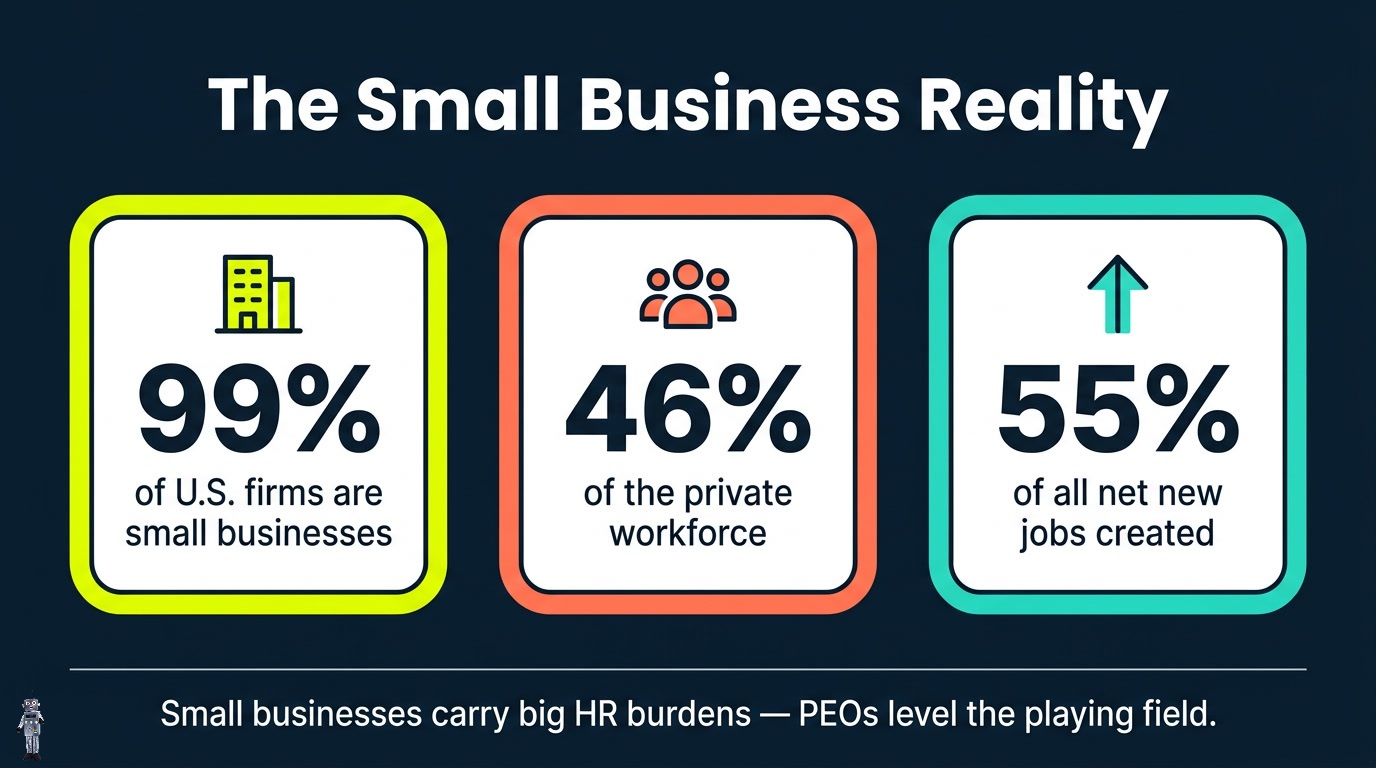
PEOs are particularly significant for small and mid-sized businesses, a segment that represents the overwhelming majority of U.S. employers. According to the U.S. Bureau of Labor Statistics, small businesses — defined as firms with fewer than 249 employees — accounted for 99 percent of the 5.6 million firms covered under Unemployment Insurance in the first quarter of 2023, while employing an average of 46 percent of the covered private workforce over the preceding decade.
These are precisely the organizations that face the most acute HR compliance burdens relative to their internal resources. Research consistently shows that businesses working with PEOs grow faster and experience lower employee turnover than comparable companies that manage HR in-house. Partnering with a PEO gives small and mid-sized employers access to enterprise-grade benefits, structured tax compliance infrastructure, and dedicated HR expertise — all without building a large internal department.
The National Association of Professional Employer Organizations (NAPEO) estimates that approximately 175,000 to 200,000 small and mid-sized businesses use PEO services in the United States, covering more than 4 million worksite employees. For leadership teams focused on growth, the co-employment model converts administrative complexity into operational clarity — freeing executives to direct their attention toward revenue-generating activities rather than payroll tax filings and benefits enrollment logistics.

Technology in Professional Employer Organizations
PEOs operate at the intersection of HR, payroll, and compliance — and their technology stack reflects that complexity. The foundation is typically a unified human resource information system (HRIS) or human capital management (HCM) platform that centralizes employee records, benefits enrollment, payroll processing, and compliance tracking across all client companies. Many PEOs layer a client-facing employer portal on top of this infrastructure, giving business owners real-time visibility into their workforce data.
Workflow Automation & Process Optimization
Automation has dramatically reduced manual effort in PEO operations. New hire onboarding sequences — including I-9 verification, direct deposit setup, benefits elections, and policy acknowledgments — are now triggered automatically upon offer acceptance. Payroll approval chains, workers' compensation audit submissions, and state tax registration workflows run through process automation platforms, cutting processing time from days to hours.
Document & Data Management
PEOs manage a significant volume of sensitive employment documentation — offer letters, W-4s, I-9s, benefits agreements, and state-specific compliance forms. Electronic signature platforms and cloud-based document management systems have replaced paper-based filing, enabling instant retrieval and audit-ready recordkeeping. Retention policies are built directly into records management systems to comply with federal and state requirements, and role-based access controls ensure that sensitive employee data is visible only to authorized personnel.
AI & Emerging Technologies
Artificial intelligence is reshaping how PEOs serve clients. Some are shifting to AI-powered chatbots to handle common HR inquiries — benefits questions, PTO balances, payroll discrepancies — reducing support ticket volume. Intelligent document processing tools extract and classify data from uploaded employment forms automatically. Predictive analytics engines flag clients at elevated compliance risk based on workforce patterns.
Integration & Interoperability
PEOs serve clients who use a wide range of time-tracking, accounting, and applicant tracking systems. Middleware and open application programming interfaces (APIs) allow these external systems to exchange data bidirectionally with the PEO's core platform, eliminating duplicate data entry and reducing error rates. This interoperability solves compliance gaps — for instance, a terminated employee remaining active in a benefits system because the HR platform and carrier feed are not synchronized.

Key Performance Indicators (KPIs)
PEOs operate on thin margins while managing high-stakes responsibilities — payroll accuracy, tax compliance, and benefits administration — across dozens or hundreds of client companies simultaneously. Without disciplined KPI tracking, operational failures compound quickly: a single payroll error affects multiple worksite employees, and a missed tax filing creates liability for both the PEO and its client. Well-defined metrics give PEO leadership the visibility to allocate resources, benchmark service delivery, and demonstrate measurable value to clients.
Core Operational KPIs
| KPI | Formula | Target |
|---|---|---|
| Payroll Accuracy Rate | (Error-free payroll runs ÷ total payroll runs) × 100 | 99.5%+ |
| Client Retention Rate | (Clients retained ÷ clients at start of period) × 100 | 90–92%+ |
| Time-to-Onboard New Clients | Days from signed contract to first live payroll run | Minimize; track trend |
| Compliance Incident Rate | Tax filing errors or regulatory violations per quarter | Zero-incident target |
Financial & Cost-Efficiency KPIs
| KPI | Formula | Target |
|---|---|---|
| Cost Per Worksite Employee (PEPY) | Total PEO operating costs ÷ total worksite employees | Primary unit economics metric |
| Benefits Loss Ratio | Claims paid ÷ premiums collected | Monitored for plan viability |
| Client Acquisition Cost (CAC) | Total sales & marketing spend ÷ new clients acquired | Benchmarked vs. client LTV |
Quality & Satisfaction KPIs
| KPI | Description | Target |
|---|---|---|
| Net Promoter Score (NPS) | Quarterly client survey measuring likelihood to recommend | 40+ (strong in B2B) |
| HR Ticket Resolution Time | Average time to close client or worksite employee support requests | Tracked & minimized |
| Audit Pass Rate | % of internal and external compliance audits passed without findings | As high as possible |
Measurement & Reporting Best Practices
PEO operations teams should maintain a tiered dashboard structure: weekly real-time operational metrics (payroll accuracy, open tickets); monthly financial and retention KPIs reviewed by leadership; and quarterly strategic metrics such as NPS and client growth reviewed in formal business reviews. Connecting KPI outcomes to individual team accountability — and sharing relevant metrics directly with clients — transforms data from a reporting exercise into a genuine driver of service improvement and client trust.

Frequently Asked Questions
What Does a PEO Do for a Business?
A Professional Employer Organization manages core HR functions — payroll, benefits, tax compliance, and risk management — on behalf of a client company through a co-employment arrangement. Rather than building a full internal HR department, businesses delegate these responsibilities to a PEO while retaining complete control over their day-to-day operations, hiring decisions, and company culture.
The co-employment model works by making worksite employees jointly employed by both the client company and the PEO. The PEO becomes the employer of record for tax and benefits purposes, assuming liability for payroll tax filings, benefits plan sponsorship, and employment law compliance. The client remains the operational employer — directing work, setting compensation, and managing performance. PEOs are particularly valuable for companies with 10 to 500 employees that lack the internal resources to manage HR compliance at scale.
How Is a PEO Different from HR Outsourcing?
A PEO differs from traditional HR outsourcing in one fundamental way: the co-employment relationship. In standard HR outsourcing, a vendor performs HR tasks on behalf of the employer, but the client company remains the sole legal employer. With a PEO, legal employer responsibilities — including payroll tax liability and benefits sponsorship — are formally shared between the PEO and the client under a contractual co-employment agreement.
This distinction has significant practical consequences. Because a PEO pools worksite employees from all its clients under one employer identification number for benefits purposes, it can negotiate large-group rates on health insurance and retirement plans that no individual small business could access independently. Administrative Services Organizations (ASOs) represent a middle ground — they perform HR administrative tasks without entering a co-employment relationship, meaning the client retains all employer liability.
What Are the Benefits of Using a PEO?
The primary benefit of using a PEO is access to HR infrastructure, compliance expertise, and enterprise-grade benefits that most small and mid-sized businesses cannot build independently. Research consistently shows that businesses working with PEOs grow faster and experience lower employee turnover than comparable companies that manage HR in-house.
Key benefits include: benefits access — by pooling thousands of worksite employees, a PEO can offer Fortune 500-caliber health, dental, vision, and 401(k) plans at rates individual small employers cannot negotiate; compliance protection — the PEO monitors employment law changes at the federal, state, and local levels and applies them proactively, reducing the risk of costly penalties; and leadership time savings — founders and executives can redirect time previously spent on payroll, onboarding paperwork, and benefits questions toward revenue-generating activities.
Is a PEO Worth It for Small Businesses?
For most small businesses with 10 or more employees, a PEO delivers measurable value that exceeds its cost. The fee structure is typically either a flat per-employee-per-month charge or a percentage of total payroll, generally ranging from 2% to 12% depending on the scope of services and workforce size.
The financial case rests on several factors: access to large-group health insurance rates often reduces per-employee premium costs significantly; a single payroll tax penalty or employment lawsuit can dwarf an entire year of PEO fees; and administrative time spent on HR tasks by owners or office managers is a real but often uncounted cost that PEO services eliminate. Small businesses in high-compliance environments — healthcare, construction, multi-state retail, and professional services — tend to see the strongest return on PEO investment.
How Do You Choose the Right PEO?
Choosing the right PEO begins with an evaluation of benefits quality, technology platform capability, service model, and industry experience. Confirm the PEO is licensed or registered in every state where your employees work. Request plan details and employer premium contributions — not just carrier names — and compare total benefits cost under the PEO against your current or projected small-group market cost. Request a demo of the PEO's HRIS and employee self-service portal and assess usability before committing.
Also evaluate the service model carefully: understand whether you will have a dedicated HR account manager or be handled by a general support queue. Review contract terms with close attention to termination provisions, transition assistance clauses, and benefits continuation terms. The right PEO partnership is built on aligned expectations, transparent pricing, and a technology platform that your team will actually use.
Key Takeaways
A Professional Employer Organization gives growing businesses access to enterprise-grade HR infrastructure — payroll processing, benefits sponsorship, compliance management, and workers' compensation — through a co-employment model that shares employer responsibilities between the PEO and the client. By pooling worksite employees across hundreds of client companies, PEOs unlock benefits quality and compliance depth that most small and mid-sized businesses simply cannot build on their own.
For businesses operating across multiple states or in compliance-intensive industries, the strategic and financial case for PEO partnership is well established. Evaluating benefits quality, technology platform capability, and service model alignment are the critical steps in identifying the right partner. As workforce complexity increases and employment law continues to evolve, the role of PEOs in supporting business growth will only expand.